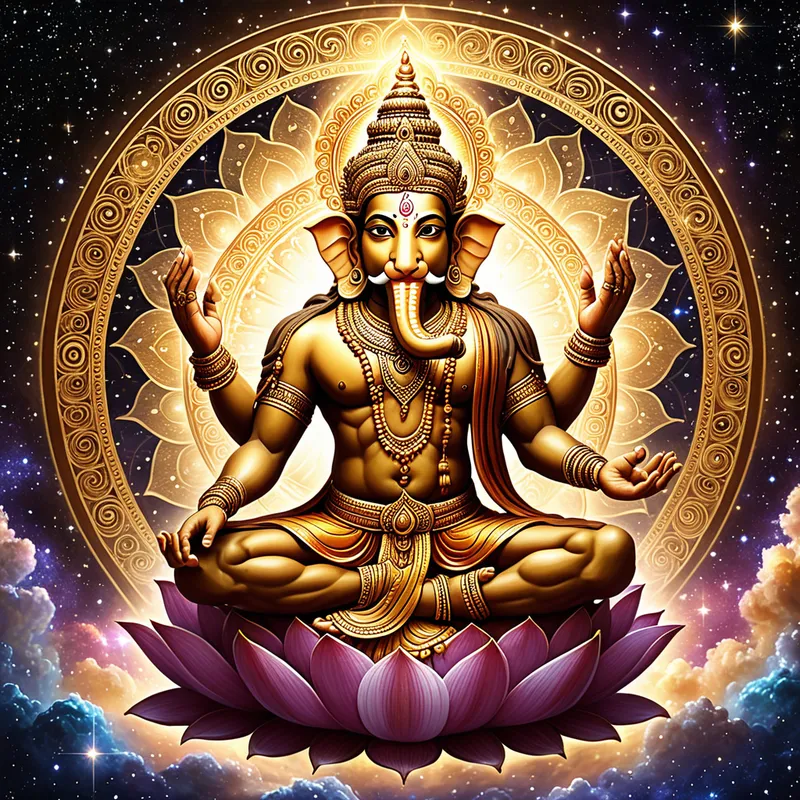
Nāda Brahma Myth Meaning & Symbolism
The cosmos is a vibration, a sacred sound. Nāda Brahma is the myth of creation as divine resonance, the primordial hum from which all form emerges.
The Tale of Nāda Brahma
Before the beginning, there was neither light nor dark, form nor void. There was only a profound, pregnant silence—a stillness so absolute it was not an absence, but a presence. A potential. In that boundless, timeless non-space, the One, the Brahman, existed as pure, undifferentiated consciousness. It was alone, and in its aloneness, a desire stirred. Not a petty want, but the primal, cosmic urge to know itself, to experience its own infinite nature.
And so, from the heart of that stillness, a vibration began. It was not a sound heard by ears, for there were none, but the first stirring of existence itself—a subtle, internal thrumming. This was Anāhata Nāda, the Unstruck Sound. It swelled from within the Absolute, a resonant hum that was both the thinker and the thought, the singer and the song. As this vibration intensified, it concentrated, coalescing into a single, luminous point of focused intent. This was the Hiranyagarbha, the Golden Womb, floating in the causal waters of possibility.
Then, from that luminous egg, a form manifested. It was Brahmā, the grand architect, seated upon a lotus that bloomed from the navel of the sustaining Vishnu. Brahmā opened his eyes upon the nascent chaos. He saw the latent elements, the sleeping principles of mind and matter, all waiting in a tangled, silent heap. To bring order, to initiate the great work of manifestation, he knew he must give them a pattern, a frequency to which they could attune.
Taking a breath that drew in the essence of eternity, Brahmā opened his mouth. What emerged was not a word, but the Mother of all words. It was the syllable AUM. The sound began deep and resonant—A—vibrating from the base of creation, solidifying the earth, giving weight and substance. It rose and rounded—U—filling the mid-regions with air and water, with passion and life. It culminated in a high, humming silence—M—that vibrated in the crown of the cosmos, the realm of light and thought. And then, the silence after, the Turīya, where the sound returned to its source, having done its work.
From this one sacred vibration, Nāda, all other sounds cascaded forth. The Vedas chanted themselves into being. The rhythms of time, the cycles of birth and death, the very laws of nature began to pulse in harmonic resonance with that first tone. The universe was not built; it was sung into existence, each galaxy a chord, each atom a note in the grand, unfolding symphony of Nāda Brahma.

Cultural Origins & Context
The doctrine of Nāda Brahma is not a single, linear myth but a profound metaphysical principle woven through the fabric of Hindu thought. Its roots dig deep into the Vedas and Upanishads, where speech (Vāc) is celebrated as the creative power of the gods. It finds systematic expression in the philosophical schools of Yoga and Gandharva Veda, and reaches its zenith in the esoteric practices of Tantra.
This knowledge was traditionally passed down through an unbroken oral lineage, from guru to disciple, in the secluded ashrams and forest schools. It was the province of rishis (seers) and adept musicians who understood music not as entertainment, but as sādhanā—a rigorous spiritual discipline. By mastering the external sounds of music (Āhata Nāda), the practitioner could learn to perceive and ultimately merge with the internal, unstruck sound, the Anāhata Nāda, thus realizing the self as not separate from the vibrational source of all. Societally, this myth reinforced a holistic worldview where art, science, and religion were inseparable, all flowing from the same sacred, resonant source.
Symbolic Architecture
At its core, Nāda Brahma is a map of emanation—a symbolic blueprint for how the One becomes the Many. The silence (Brahman) represents pure, potential consciousness. The first vibration (Anāhata Nāda) symbolizes the moment of self-awareness, the “I AM” of the cosmos. AUM is the divine template, the archetypal pattern containing within its tripartite structure the entire spectrum of manifested reality: the physical, the subtle, and the causal.
The universe is not a thing that makes a sound. It is a sound that has taken the shape of things.
Psychologically, this maps directly onto the process of thought and creation. The silent depth of the unconscious (Brahman) gives rise to a felt sense, an intuition or impulse (the vibration). This impulse is then given form through language, image, or action (the articulated AUM, leading to manifest creation). The myth teaches that our own creative acts—whether art, speech, or even thought—are microcosmic reflections of the macrocosmic creative act. Our inner world is also built from sound and resonance; our traumas are dissonant chords, our joys harmonious melodies. The goal of yoga and meditation, symbolically, is to retune the individual instrument of the body-mind to the fundamental frequency of the source, achieving harmony and liberation (Moksha).
The Dreamer’s Resonance
When the archetype of Nāda Brahma stirs in the modern unconscious, it often surfaces in dreams not of literal gods, but of foundational tones. One might dream of hearing a deep, resonant hum that underpins reality, a frequency that makes walls shimmer or the ground become transparent. Others dream of their own voice producing visible, shaping waves of light or color, or of being in a vast, silent hall where a single note causes a complex, beautiful structure to assemble itself from dust.
These dreams signal a profound somatic and psychological process: the reorganization of the psyche from its core. The dreamer is not just adjusting attitudes or healing memories on the surface; they are encountering the fundamental “vibration” of their own being. It is a process of attunement. The somatic experience might be a feeling of deep internal resonance, a buzzing in the crown of the head, or a sense of the body as a hollow, singing vessel. Psychologically, it marks a shift where one’s identity begins to loosen from its fixed, solid forms (the “struck sounds” of personality, career, roles) and starts to identify with the source of consciousness itself—the silent, vibrating awareness behind all experience.

Alchemical Translation
The alchemical journey modeled by Nāda Brahma is the ultimate process of psychic transmutation: turning the lead of fragmented, egoic identity into the gold of unified, cosmic consciousness. The prima materia, the base substance, is the chaotic, noisy mind—the cacophony of desires, fears, and internal dialogue (the multitude of Āhata Nāda).
The first stage of the opus is Silentio (Silence). This is the nigredo, the dark night, where one consciously withdraws from external noise and the internal chatter through meditation or deep introspection. It feels like a void, but it is the pregnant silence of Brahman.
Next is Vibratio (Vibration). In this albedo phase, one begins to perceive the subtle, unstruck hum of one’s own aliveness—the Anāhata Nāda within. This is the awakening of pure awareness, the “witness consciousness” that observes without being entangled.
The culmination is Symphonia (Symphony). The rubedo, or reddening. Here, the individual ego, having discovered its source as the silent vibrator, consciously becomes a co-creator. One’s life, actions, and creations are no longer seen as separate from the cosmic process but as unique, intentional expressions of the one great Sound.
Individuation is not about becoming a better note in the scale. It is the realization that you are the entire scale, the silence between the notes, and the ear that hears the music—simultaneously.
The modern seeker’s task is thus to listen—not with the ears, but with the entirety of their being. To move from being a passive hearer of life’s noise to an active listener for the foundational tone, and finally, to become a conscious singer, articulating their own unique AUM from a place of attuned silence, thereby taking their rightful place in the eternal symphony of Nāda Brahma.
Associated Symbols
Explore related symbols from the CaleaDream lexicon: