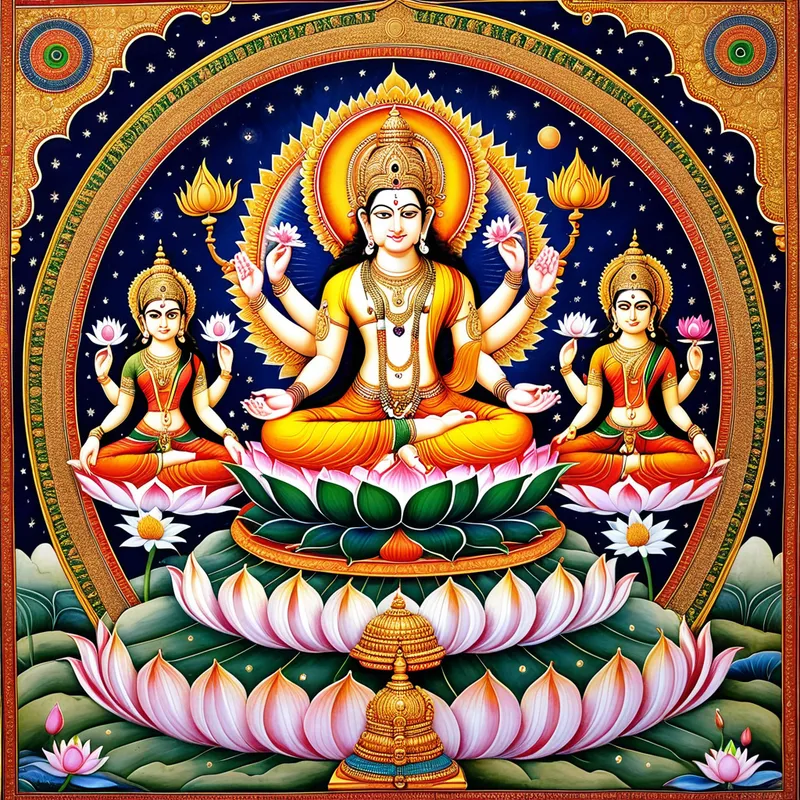
Natya Shastra Myth Meaning & Symbolism
The myth of Brahma creating the Natya Shastra, the fifth Veda, to bring the wisdom of the sacred scriptures to all through the art of performance.
The Tale of Natya Shastra
In the time when the worlds were still young and the echoes of the first chants still hung in the air, a profound silence fell upon the heavens. It was not a peaceful quiet, but a restless one. The gods, the sages, even the demons in the nether realms—all had grown weary. The wisdom of the four Vedas was vast, but it was locked away. Its language was the tongue of the elite, its rituals the domain of the priestly class. The common people, the shudras, were barred from its sacred sounds. A spiritual drought spread across the three worlds.
In his celestial abode, the creator Brahma felt this discord. He saw the boredom of the gods, the ignorance of humanity, the ceaseless conflict between devas and asuras. The sacred knowledge, meant to sustain the cosmos, was trapped. He closed his four faces, each contemplating a different purushartha, and descended into a state of profound meditation. He sought not to create a new thing, but to re-create—to distill the essence of the eternal into a form that could be seen, heard, and felt by every soul.
From the Om, he drew the fundamental resonance. Then, he began his great synthesis. From the Rig Veda, he took the power of the word, the pathya (recitation). From the Sama Veda, he extracted the divine melody, the sangeeta (music). From the Yajur Veda, he harnessed the language of gesture and physical expression, the abhinaya (acting). And from the Atharva Veda, he captured the raw, potent energy of emotion, the rasa (aesthetic flavor).
He blended these essences in the crucible of his mind. What emerged was not another scripture to be merely recited, but a living, breathing universe in miniature: Natya, the dramatic art. It was to be the Panchama Veda. To house this creation, he codified its every law—from the architecture of the playhouse to the movement of an eyebrow—into a monumental treatise: the Natya Shastra.
But a creation of such power needed a steward. Brahma summoned the wise sage Bharata and his one hundred sons. Into their care, he placed the sacred text. "Go," he commanded, "and perform this Samavakara. Let it be a mirror to the world, showing dharma and adharma, joy and sorrow, the sacred and the profane."
Bharata and his troupe prepared with utmost devotion. Their first performance, depicting the gods' triumph, was so potent, so real, that the demonic forces in the audience felt attacked and assaulted the actors. Chaos erupted. The gods, watching from above, were powerless to stop the violence on this sacred ground of art.
Bharata cried out to Brahma. The creator understood. The art was too powerful, too raw. It needed protection, a divine guardian for the stage itself. Thus, Brahma ordained that before any performance, the space must be consecrated. A jarjara (a banner-staff) was to be planted, and rituals were to be performed, invoking deities to inhabit and protect the theatrical space. The stage was no longer just a platform; it became a tirtha, a crossing between the human and the divine. From that day forth, drama was both a weapon and a salve, a spectacle and a sacrament, guarded by the very gods it portrayed.
Cultural Origins & Context
The myth of the Natya Shastra's origin is not merely a story about the birth of theater; it is a foundational charter for the role of art in society. Historically attributed to the sage Bharata, the text itself is a colossal encyclopedic work, likely compiled between 200 BCE and 200 CE, though its roots and oral traditions stretch back much further. It exists at the confluence of priestly ritual (the Vedic tradition) and popular, folk expression.
The myth was passed down through the shilpa and nat communities—actors, dancers, musicians, and stagecraftsmen. For them, this was not just a creation tale but a sacred genealogy, a divine mandate that elevated their craft from mere entertainment to a yajna (sacrifice), a spiritual offering. The storyteller was often the sutradhara (literally, "holder of the strings"), who would invoke this myth at the beginning of performances to sanctify the space and remind the audience of the art's holy provenance.
Its societal function was multifaceted. It democratized access to spiritual and philosophical truths, making the essence of the Vedas available to all castes and genders through the visceral medium of performance. It also served as a social regulator, a "mirror to the world" that taught dharma through narrative, modeling ethical behavior and its consequences in a way that dry scripture could not. The theater became a communal ritual where society could witness its own ideals, conflicts, and emotions played out, and in doing so, achieve a collective catharsis and reaffirmation of cosmic order.
Symbolic Architecture
At its heart, the myth is a profound allegory for the birth of consciousness from the chaos of undifferentiated experience. Brahma, the cosmic mind, represents the archetypal Creator who perceives a problem of fragmentation—knowledge is separated from feeling, the elite from the common, order from chaos.
The Fifth Veda is the psyche’s attempt to integrate the warring fragments of itself into a coherent, experiential whole.
The four Vedas symbolize the core faculties of human perception: Rig is Thought (logos), Sama is Sound and Emotion (pathos), Yajur is Action and Form (praxis), and Atharva is Instinct and Potency (bios). In their raw, separate states, they are powerful but inaccessible. The Natya Shastra is the symbolic "container" or "pattern" that allows for their synthesis. It is the mandala of the psyche, providing structure (the rules of theater) within which chaos (human emotion and experience) can be safely expressed and understood.
The initial failure—the attack by the demons—is crucial. It signifies that raw, uncontained emotional and psychic energy, even when aimed at portraying the good, is dangerous and can provoke the shadow. The jarjara and the consecration rituals represent the necessity of creating a temenos, a sacred and bounded space within the psyche (or society) where this powerful integrative work can occur safely. The stage becomes a model for the individuating Self—a protected arena where the conflicts between our inner "gods" and "demons" can be enacted, witnessed, and ultimately, harmonized.
The Dreamer's Resonance
When this myth stirs in the modern unconscious, it often manifests in dreams of potent, chaotic creativity or failed performances. You may dream of being handed a sacred, impossibly heavy book you must decipher, or of being on a stage where the script is written in a language you only half-understand. You may dream of a beautiful dance that suddenly summons hostile, shadowy figures from the audience.
These dreams point to a psychological process of synthesis under pressure. The dreamer is at a point where disparate parts of their life—intellectual understanding, deep emotion, physical habits, and primal instincts—are demanding integration. The "performance" is the new, more complex identity trying to be born. The chaos or attack symbolizes the resistance from older patterns (the inner "demons" of fear, shame, or old trauma) that are threatened by this new, holistic expression of the self.
The somatic feeling is often one of immense potential coupled with stage fright—a thrilling yet terrifying sense of being a conduit for something larger than oneself. The dream calls for the establishment of an inner jarjara: the creation of personal ritual, a dedicated practice, or a therapeutic container to safely hold this powerful integrative process.
Alchemical Translation
The journey of the Natya Shastra myth models the alchemical process of coagulatio—the bringing together of scattered elements into a valuable, enduring substance. For the modern individual, the "four Vedas" are the fragmented aspects of our being: our intellectual knowledge, our emotional body, our physical actions, and our instinctual drives. We often live in one at the expense of the others.
Individuation is not about becoming a perfect being, but about becoming a stage—a consecrated space where every part of the self, noble and shadowed, is allowed its entrances and exits, its soliloquies and its battles.
The first step is the "Brahma moment": a profound, often crisis-driven insight that this fragmentation is causing suffering (the "boredom of the gods," the "drought"). The call is to create a "Fifth Veda"—a personal art form or life practice that can hold all of you. This could be journaling, dance, painting, or even the art of conscious relationship.
The "Bharata phase" is the diligent, often frustrating work of learning the shastra—the rules and structures of this new practice. But the critical alchemical stage is the "first performance failure." This is when you first try to live this integration and your inner shadows (self-doubt, old wounds, societal conditioning) revolt. This is not a sign to quit, but a divine instruction to consecrate your space.
The alchemical translation is the establishment of your own rituals of protection and focus: setting boundaries, creating a daily practice, seeking a supportive community (your divine audience). You plant your jarjara. Your life, your body, your creative output becomes the consecrated stage. The final act is not a flawless performance free of demons, but the ongoing, sacred drama of a Self that can host its own complexity, transforming the raw ore of experience into the refined gold of rasa—the profound, savorable essence of a life fully felt and fully lived.
Associated Symbols
Explore related symbols from the CaleaDream lexicon: