
Narcissus from Greek mythology Myth Meaning & Symbolism
A youth of divine beauty falls in love with his own reflection, wasting away by a pool, becoming the flower that bears his name.
The Tale of Narcissus from Greek mythology
In the deep, green heart of Boeotia, where the mountains whisper secrets to the clouds, there lived a youth named Narcissus. He was not merely handsome; his beauty was a divine accident, a stroke of the gods’ brush so perfect it seemed a trick of the light. Son of the river god Cephissus and the nymph Liriope, his face stopped hearts and silenced tongues. But with this gift came a prophecy, given by the blind seer Tiresias to his mother: He will live to a ripe old age, provided he never knows himself.
The world loved Narcissus, but he walked through it like a man in a dream, untouched. Nymphs and youths alike pined for him, their sighs rustling the leaves, but he met all advances with a cool, marble indifference. His heart remained a locked chamber, and his gaze, when it fell upon others, was like moonlight—beautiful but cold, seeing only surfaces.
Among the lovelorn was the nymph Echo. She was cursed by the goddess Hera to never speak her own mind, only to repeat the fading ends of others' sentences. She trailed Narcissus through the forest, a ghost of sound and longing, her love a silent scream. One day, as he hunted stag, he became separated from his companions. “Is anyone here?” he called into the clearing.
“Here!” Echo repeated, her heart leaping. She stepped from behind the trees, arms open in desperate hope. Narcissus recoiled. “Do not touch me! I would die before I give you power over me!”
“I give you power over me,” she pleaded with his own words, but it was too late. He turned away, his disdain a physical blow. Echo wasted away from rejected love, her body dissolving into stone and air until only her voice remained, a faint repetition in lonely places.
But the scales of the gods balance all things. The spurned prayers of one broken heart reached the ears of Nemesis. Hearing Echo’s fate, she wove a punishment of poetic precision. She led Narcissus to a hidden pool in the woods, a mirror of flawless silver untouched by wind or beast. Thirsty from his hunt, he knelt to drink.
And there, in the liquid glass, he saw a face. It was the most beautiful being he had ever beheld—flawless features, star-like eyes, hair like spun darkness. A smile of invitation played on the lips. Enraptured, he reached to touch, and the image reached back. But at the kiss of his fingers, the water shivered, and the vision fragmented. Panic seized him. “Stay!” he cried. As the water stilled, the beauty returned.
He did not drink. He could not move. He spoke words of love to the silent water, words that were never his to give another. He tried to embrace the figure, but it vanished into ripples, only to return, tauntingly perfect. He knew, in a dawning horror, that the love he felt was as unreachable as a star reflected in a well. “I know you now,” he whispered to his own face. “I burn with love for my own self. The prophecy is fulfilled.”
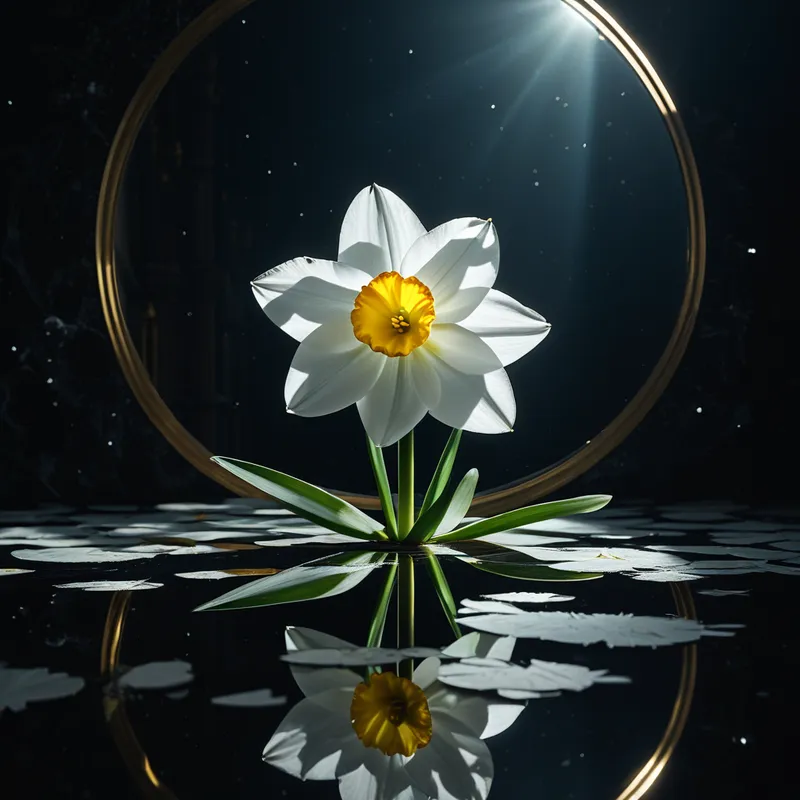
So he remained, fixed by his own gaze, feeding on nothing but his impossible passion. The vibrant youth faded. His form grew thin, his brilliance dimmed. As his life force ebbed into the earth beside the pool, the gods took pity—or completed the metaphor. Where his body once lay, a new flower sprang from the damp soil, its white petals bending toward the water, a golden cup at its heart forever bowing as if to its own reflection. They called it the narcissus.

Cultural Origins & Context
The myth of Narcissus comes to us primarily from the Roman poet Ovid, who included it in his epic Metamorphoses in the 1st century AD. While Ovid’s version is the most complete and literary, the core figure of Narcissus is older, appearing in earlier Greek sources like the travel writer Pausanias, who recorded a slightly different, more literal Boeotian tale. In this older tradition, Narcissus mourns the death of his twin sister, who looked exactly like him, and finds solace in his reflection, mistaking it for her. Ovid’s psychological genius merged these threads into the definitive parable of self-absorption.
The myth functioned as a cautionary tale within a culture deeply concerned with hubris (excessive pride) and the proper relationship between mortals and gods. It warned against the rejection of philia (communal love and friendship) and the dangers of ate (a blind folly sent by the gods). It was a story told not just to explain the origin of a flower, but to map the landscape of a particular human catastrophe—the collapse of the self into a closed loop, where the world becomes merely a mirror.
Symbolic Architecture
At its heart, the myth of Narcissus is not simply about vanity. It is a profound exploration of consciousness, identity, and the nature of perception.
The pool is the world as mirror, reflecting not reality, but the ego’s idealized and isolated self-conception.
Narcissus does not fall in love with himself, but with an image of himself. This is the critical distinction. The reflection is a two-dimensional illusion, lacking depth, substance, or otherness. It cannot love back, it cannot converse, it cannot truly see him. His love is for a phantom, a simulacrum of life. Psychologically, this represents the state of being trapped in the persona—the social mask one presents to the world—mistaking that curated image for the totality of the soul. The tragedy is his inability to differentiate his true, embodied self from this captivating specter.
Echo represents the fate of relationship in the shadow of such self-absorption. She is the voice of the Other, reduced to mere repetition, unable to initiate contact or express authentic need. Her dissolution signifies how the world outside the self becomes ghostly and insubstantial to the narcissistic consciousness. The nymph and the pool are two sides of the same coin: one is the ignored call of connection, the other is the seductive trap of self-admiration.
The Dreamer's Resonance
When this mythic pattern stirs in the modern dreamscape, it often signals a critical encounter with the Shadow or a profound dislocation of identity. To dream of being Narcissus—fixated on a mirror or reflection—suggests a somatic experience of psychic arrest. The dreamer may feel paralyzed, watching themselves from outside, connected to life only through a glass-like surface. It is the psyche’s depiction of depression, self-obsession, or a life lived for external validation.
Dreaming of being Echo is equally telling. It speaks to a feeling of having lost one’s voice, of being unable to express true desire, of only being able to react to the demands and narratives of others. Both dreams point to a rupture in the dialogue between the ego and the deeper self, or between the self and the world. The body in such dreams often feels heavy, numb, or dissolving—a direct somatic expression of the myth’s central wasting away.

Alchemical Translation
The alchemical process modeled here is one of mortificatio and solutio—death and dissolution—preceding a possible rebirth. Narcissus’s fixation is the nigredo, the blackening: the paralyzing, leaden state of total identification with the ego-image. His wasting away is the necessary breaking down of that rigid structure.
The flower that springs from his death is the symbol of the Self emerging from the shattered ego. It bows, but it is alive, rooted, and real.
For the modern individual, the path of individuation through this myth requires shattering the mirror. It demands the painful realization that the curated self—the one seen in social media, professional accolades, or even spiritual seeking—is a reflection, not the source. The transformative work is to turn away from the pool and begin the difficult task of feeling the actual, imperfect, embodied self. It is to listen for Echo’s true voice within, not as an echo of others, but as the nascent sound of one’s own soul. The narcissus flower, then, is not a symbol of the disease, but of its potential cure: a beauty that acknowledges its source in the dark earth, not in the illusory water, and grows toward the sun of a reality larger than itself.
Associated Symbols
Explore related symbols from the CaleaDream lexicon: