
Narcissus Myth Meaning & Symbolism
A beautiful youth falls in love with his own reflection, perishing by the pool, leaving behind a flower as a symbol of fatal self-absorption.
The Tale of Narcissus
In the deep, sun-dappled valleys of Boeotia, where the air hummed with the secrets of nymphs and the whispers of the gods, there lived a youth named Narcissus. His beauty was not of this mortal world; it was a curse and a blessing carved by the divine, so radiant that all who saw him—man, woman, or spirit—were struck with a longing that pierced the soul. Yet, within that exquisite form dwelt a heart of cold, polished stone. He spurned every offering of love, treating each admirer with a disdain that left wounds deeper than any blade.
Among the wounded was the nymph Echo. Hera, queen of the gods, had stolen her voice, leaving her only the ghost of speech—the ability to repeat another’s final words. Doomed to silence, Echo wandered the lonely cliffs, her love for Narcissus a silent fire burning in her chest. One day, as Narcissus hunted in the woods, she followed, her footsteps as light as falling leaves. When he called out, “Is anyone here?” she could only answer, “Here!” Stepping from the foliage, she moved to embrace him. But Narcissus recoiled as if from a serpent. “I would die before I give myself to you,” he spat. Her broken heart could only echo, “I give myself to you.” She fled, her body wasting away from grief until only her voice remained, a sound forever haunting the hollow places.
This cruelty was the final thread. The goddess Nemesis, she who balances the scales, heard the prayers of the scorned. She wove a fate as elegant as it was terrible. She led Narcissus to a hidden pool in the forest, a mirror of flawless silver set in a cradle of emerald grass and white flowers. Thirsty from his hunt, he knelt at the water’s edge. As he bent to drink, he saw a face.
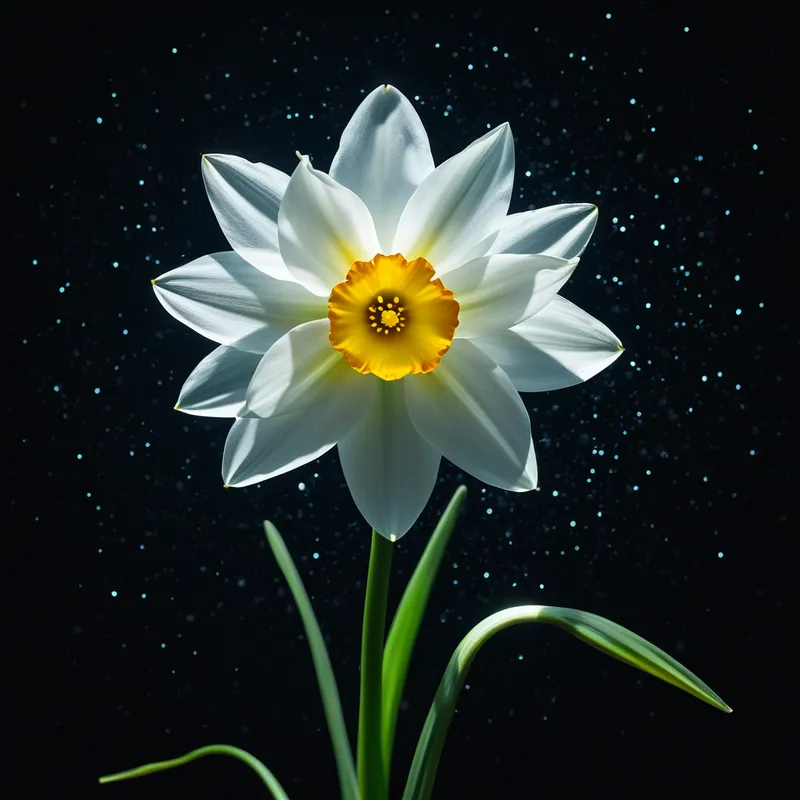
He froze. He had never seen such beauty. The eyes that gazed back were stars, the lips were sculpted rose, the hair a cascade of sunlight. A love, fierce and total, seized him. He smiled; the beautiful youth smiled back. He reached out to touch; the figure reached too, its fingers meeting nothing but cold, rippling water. “Why do you flee me?” he cried to the silent pool. He could not eat, could not sleep. He lay on the bank, fixed in a trance of adoration, pleading with a phantom that offered everything and nothing. He slowly understood the truth—the love was himself, a prison of his own making. The realization did not break the spell; it deepened it. “Alas! I am he!” he mourned, finally knowing the object of his passion. His strength ebbed, his radiant form fading like a mist under the sun. With a final sigh, he laid his head upon the grass and ceased to be. Where his body rested, the earth cradled a new flower, white petals around a golden heart—the narcissus, a monument to beautiful, fatal self-regard.

Cultural Origins & Context
The myth of Narcissus comes to us primarily from the Roman poet Ovid, who wove it into his epic tapestry of transformations, the Metamorphoses. However, its roots are undeniably Greek, with earlier, fragmentary references found in the works of the geographer Pausanias and the poet Theocritus. In the oral tradition of ancient Greece, such tales were not mere entertainment; they were foundational texts that explored the boundaries of the human condition, the capricious will of the gods, and the consequences of hubris.
Told in symposia and around hearths, the story served as a powerful social caution. In a culture that highly valued beauty, athleticism, and civic duty, Narcissus represented the dangerous extreme: the individual who becomes so consumed by his own gifts that he severs the vital bonds of community and reciprocity (charis). His rejection of Echo and all suitors was a rejection of the social contract itself. The myth thus functioned as a warning against spiritual and social isolation, teaching that the self, when made an absolute idol, becomes a tomb.
Symbolic Architecture
At its core, the myth is a profound allegory for the psyche’s encounter with its own image. The pool is not just water; it is the mirror of consciousness, the surface where the ego first recognizes itself as a separate, observable entity.
The reflection is the perfect lover because it promises total understanding without the threat of otherness. It is the ultimate illusion of self-sufficiency.
Narcissus does not fall in love with himself, but with an image—a flat, two-dimensional representation devoid of depth, history, or soul. This is the tragedy of identification with the persona, the glittering surface self we wish to project and believe in. Echo represents the fate of the authentic voice when it is not heard; she is the repressed soul, the instinctual life, reduced to a mere echo of the dominant ego’s monologue. Her fading is the atrophy of connection when the self will not engage with anything beyond its own spectacle.
The flower that springs from his death is the key to the symbol’s complexity. It is not merely a punishment, but a metamorphosis. The narcissus flower is beautiful, fragrant, and—significantly—poisonous. It embodies the full ambivalence of self-love: necessary for a sense of identity, yet toxic when it becomes the entirety of one’s world.
The Dreamer's Resonance
When this myth pattern stirs in the modern unconscious, it often manifests in dreams of mirrors, still water, or glass surfaces that either captivate or terrify. To dream of being unable to look away from one’s reflection suggests a psychic process where the dreamer is dangerously over-identified with an image—perhaps of success, beauty, intellect, or a curated online persona. The reflection may talk back, criticize, or make demands, indicating the ego’s dialogue with itself has become a closed, recursive loop, starving other parts of the psyche.
Somatically, this can feel like a peculiar paralysis, a luxurious stagnation. There is a feeling of being “stuck,” often accompanied by a deep, melancholic longing for something one cannot name—the very longing Narcissus felt for his phantom lover. This is the psyche’s signal that growth has halted because all energy is being reflected back into maintaining the image, rather than being risked in the messy, unpredictable world of relationship and action. The dream is an invitation to break the surface tension of the pool.

Alchemical Translation
The alchemical journey modeled here is the nigredo—the blackening, the descent into the solitary madness of self-encounter. Narcissus’s fixation is a necessary, if perilous, stage in individuation. One must first see the ego in its splendid isolation to understand its limitations.
The pool must be stared into until the image shatters, for only in the ripples can the depth beneath be sensed.
The transformation occurs in the moment of recognition—“I am he.” This is not just the realization of vanity, but the shocking identification of the lover with the beloved. It is the ego confronting the fact that it is both the subject and the object of its own obsession. This death of the purely self-referential ego is the prerequisite for rebirth. The flower symbolizes the potential outcome of this psychic death: a new form of being that incorporates the beauty of self-awareness but is rooted in the earth, connected to a wider life. It is the symbol that emerges when the libido, once trapped in a feedback loop, is finally released back into the world.
For the modern individual, the alchemical work is to move from self-reflection to self-knowledge. Reflection is passive, a staring. Knowledge is active, a diving. It requires breaking the mirroring surface to engage with the shadowy, unseen depths below—the echoes of our neglected instincts, the voices of our rejected parts. The myth warns that to love only the reflection is to perish. But to integrate what is seen in the reflection with all that is unseen is to be transformed.
Associated Symbols
Explore related symbols from the CaleaDream lexicon:
- Display
- Dresser
- Personal
- Appearance
- Famous
- Reflection
- Reaction
- Poster
- Shallow
- Aquarium
- Puddle
- Shiny
- Outer
- Handsome
- Persons
- Sleeve
- Identity
- Placid Pond
- Mirror Frame
- Framed Photograph
- Hologram
- Social Media
- Mirror Image
- Casting Shadows
- Moonlit Lake
- Reflected Thoughts
- Transient Beauty
- Shattered Glass
- Ephemeral Beauty
- Mirrored Reflections
- Abyss of Reflection
- Abstract Portrait
- Frosted Window
- Mirage
- Cubic Zirconia Frost
- Gallium Drop
- Heatwave Mirage
- Peony Reflection
- Phantom Flower
- Edelweiss Peak
- Riverbank Daffodils
- Mayfly Life
- Desert Mirage
- Reflective Pond
- Tidal Pool
- Mirror of Reflection
- Mindful Mirage
- Mirrored Waterfall
- Mermaid's Reflection
- Bewitched Mirror
- Fashion Runway
- Mirrored Dance Floor
- Home Aquarium
- Thoreau's Walden Pond
- Baroque Mirror
- Basin of Water
- Enigmatic Portrait
- Echoing Shapes
- Inverted Colors
- Impressionist Canvas
- Photorealistic Image
- Framed Mirror
- Dramatic Monologue
- Mirrored Trowel
- Reflective Wardrobe
- Sapphire Vanity
- Reflective Screen
- Glass Tumbler
- Silk Cravat
- Reflective Mirror Locket
- Smartphone Screen
- Glitching Camera
- Reflective Smart Mirror
- Illusory Animation
- Rectangular Reflection
- Name Tag
- Mirror Image of a Computer Screen
- Bubble Wand
- Translucent Crotales
- Surreal House of Mirrors
- Mirror House
- Illuminated Bathroom
- Mirror Room
- Glistening Pond
- Art Gallery Window
- Skyscraper Reflection
- Mirrored Reflection Pool
- Empowered Mirror
- Hazy Mirror
- Mirror of Truth
- Veil of Illusions
- Contemplative Waters
- Cogito Cogito (I think I think)
- Inner Monologue
- Mirrored Surface
- Goldfish Bowl
- Frosted Water's Edge
- Pond Reflections
- Wind-swept Lake
- Reflections in Still Water
- Soul Mirror
- Mirror Gaze
- Virtual Echo
- Glitching Avatar
- Social Feed
- Tech Addiction
- Nft Art
- Sound Reflection
- Absorption
- Gravitational Lens
- Replication
- Pedestal
- Monologue
- Foil
- Projection
- Scrying
- Indifference
- Shame
- Empathy
- Obsession
- Mirroring
- Mirrorless
- Cheesy
- Shimmer