Narada Myth Meaning & Symbolism
The celestial sage Narada, cursed to forget the divine, embodies the soul's journey through attachment, suffering, and the hard-won return to true knowledge.
The Tale of Narada
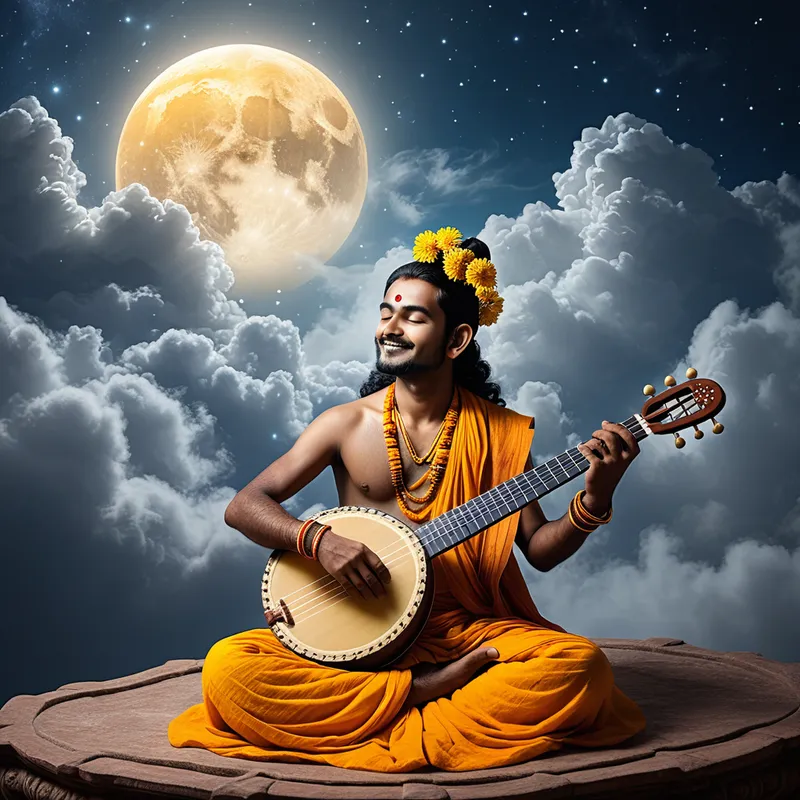
Listen. In the shimmering, timeless halls of Vaikuntha, where the air is perfume and the light is consciousness itself, there walked a being of pure sound. His name was Narada. He was a rishi, yet unlike the stern ascetics rooted to mountain peaks, Narada was movement. His feet danced upon the pathways between worlds; his voice, forever singing the names of Vishnu, was the thread stitching heaven to earth. In his hands, he carried the veena, and its music was the hum of creation.
To him, the Lord Vishnu was everything—the beginning, the end, the very breath in his song. Narada’s devotion was fierce, joyous, and complete. Or so he believed.
One day, as Narada sat at the lotus feet of the blue-skinned god, his heart swelled with a subtle, sweet poison: pride. He thought, “Surely, there is no devotee like me. My love is unparalleled.” Vishnu, who perceives the whispers of the ant and the storms in the heart, smiled a smile that held universes. “Beloved Narada,” he said, his voice like a deep, calm river, “your devotion is indeed sweet. But tell me, what do you know of love?”
Narada began to sing a hymn of dazzling complexity, describing the divine attributes, the cosmic play, the theoretical glory of devotion. Vishnu listened, then gently gestured. “See that village by the river? There lives a simple farmer. Go, observe him. Then return and tell me of love.”
Puzzled but obedient, Narada descended. He found the farmer: a man caked in the dust of the earth, his life a cycle of dawn-to-dusk toil, meals eaten with calloused hands, sleep born of exhaustion. The man would mutter “Narayana” once at dawn, once at dusk, between worries of rain and debt and his son’s fever. Narada watched for a day and returned, confident. “Lord,” he reported, “the man is barely conscious of you. His prayers are fleeting. His love is but a speck.”
Vishnu’s smile deepened. “Place this brimming cup of oil upon your head,” he instructed. “Now, circumambulate my court. But if a single drop spills, my guards will strike you down.” Narada, his heart now pounding not with devotion but with raw fear, obeyed. With agonizing precision, he walked the circle, his entire being focused on the trembling liquid above him. Not a drop fell.
“Now,” Vishnu asked, “as you walked, how many times did you remember me?” Narada’s face fell. In his total absorption in the task, he had not once thought of the divine name. “And the farmer,” Vishnu said softly, “carries a cup far heavier than yours—the welfare of his family, his survival, his duties. Yet, twice a day, he remembers me. Who, then, knows more of love’s weight?”
A profound lesson, but the seed of pride, though shaken, remained. Later, seeing Narada’s lingering sense of specialness, Vishnu chose a more potent medicine. “You wish to understand Maya,” the Lord said. “Then experience it.” With a touch, Narada’s celestial form dissolved.
He awoke as the son of a maid-servant in a bustling kingdom. He grew, forgot his divine origin, and lived. He knew hunger, thirst, and desire. He fell passionately in love with a beautiful princess, won her hand through great trials, and became a mighty king. He knew the fierce joy of his children’s births, the crushing grief of his parents’ deaths, the burdens of statecraft, the heat of battle, the sweetness of victory, and the acid taste of betrayal. For decades, he was utterly immersed, the veena of Vaikuntha a forgotten dream. His identity was this body, this name, these attachments.
Then, in a great war, his beloved sons were slain before his eyes. Sitting on the blood-soaked earth, clutching their lifeless forms, a wail of ultimate despair tore from his throat. In that shattering moment of absolute loss, when every worldly anchor was ripped away, the veil tore. The memory of Vishnu’s face flashed like lightning in the storm of his grief. “Narayana!” he cried, not as a ritual, but as the final, raw truth of a soul stripped bare.
The battlefield, the corpses, the crown—all shimmered and vanished like mist. He found himself once more in Vaikuntha, at Vishnu’s feet, tears of bewildered agony still streaming down his cheeks. The Lord’s gaze was infinite compassion. “Now, my child,” Vishnu whispered, “do you understand? For a moment, you forgot me for the love of a woman. For a lifetime, you forgot me for a kingdom. That is the power of Maya. And only when she shows you her ultimate face—that of utter separation and loss—does the soul remember its way home.”
Narada was silent. The pride was gone, burned away in the fire of lived experience. He picked up his veena. This time, his song was not about God. It was born from the memory of having forgotten Him. It was a hymn woven from the dust of the earth and the tears of mortality, and for the first time, it was truly divine.
Cultural Origins & Context
The myths of Narada are woven throughout the vast tapestry of Hindu literature, primarily in the Puranas like the Bhagavata Purana and the Vishnu Purana. He is a quintessential figure in the Vaishnava tradition, but his stories are told across sectarian lines. Unlike fixed historical narratives, these tales were fluid, passed down orally by storytellers, kathakars, and sadhus at crossroads and temple steps.
His societal function was multifaceted. As a divine messenger and informant, he drives plots, often delivering news that sets cosmic events in motion. But more profoundly, he is a teaching device. Narada is the eternal student, the devotee who is both immensely advanced and perpetually prone to very human lessons. His stories served to illustrate complex philosophical concepts—like the nature of Maya, the pitfalls of spiritual ego, and the essence of true bhakti—in an accessible, narrative form. He made the esoteric relatable, showing that the path to the divine is paved not with perfections, but with poignant, humbling errors.
Symbolic Architecture
Narada is the archetype of the Wandering Consciousness. His primary symbol, the veena, represents the harmonizing of dualities—the individual soul (the small gourd) with the cosmic whole (the large gourd), connected by the string of devotion. His constant travel signifies the restless mind and the soul’s journey through samsara.
The curse is not a punishment, but a sacred descent. To forget the divine is to fully incarnate.
His transformation into the king is the soul’s immersion in <abbr title="The ego, the sense of "I" as a separate individual">Ahamkara. The crown, the family, the kingdom—all are symbols of ego-identification. He does not merely observe Maya; he becomes its perfect embodiment. The pivotal moment—the death of his sons—symbolizes the inevitable failure of all worldly attachments to provide permanent identity or security. This devastating loss is the necessary catalyst for moksha, the shattering of the illusion.
Narada’s return to Vaikuntha is not a return to a previous state. It is an evolution. He is now the “sage who has been a king,” his wisdom tempered in the fires of lived experience. His devotion is no longer theoretical; it is the hard-earned remembrance of one who has known true forgetfulness.

The Dreamer's Resonance
When the pattern of the Narada myth stirs in the modern psyche, it often manifests in dreams of profound identity confusion or sudden, jarring transitions. You may dream of being a powerful CEO one moment and a lost child the next, with no memory of how you got there. You may dream of frantically searching for a crucial piece of knowledge—a password, a name, a face—that you know you possess but cannot access.
Somatically, this can feel like a “cosmic homesickness”—a deep, aching sense of being in the wrong life, coupled with a frustrating amnesia about what the “right” life might be. Psychologically, this is the process of the ego becoming painfully aware of its own constructed nature. The dreamer is living their “kingdom”—their career, relationships, social persona—but a part of the soul is beginning to recall it is a role. The grief in the dream, often sudden and catastrophic (like the loss of the sons), mirrors the necessary ego-death that must occur for the larger Self to be remembered. It is the psyche’s way of orchestrating its own “curse” to initiate a deeper remembering.

Alchemical Translation
The alchemical journey of the Narada myth is the opus of Solve et Coagula—dissolve and reconstitute—applied to the psyche. The first stage, the “curse” or descent into mortal life, is the Solve. The fixed, celestial identity of the “pure devotee” is dissolved into the chaotic, leaden matter of human experience with all its passions, attachments, and sufferings. This is not a fall from grace, but a crucial immersion in the prima materia of the soul: the raw, unrefined experience of being a separate self.
The ego must be crowned before it can be willingly deposed. One must fully become the king to understand the poverty of the kingdom.
The middle, mortal life represents the nigredo, the blackening. It is a period of confusion, struggle, and identification with the persona. The alchemist here is not Narada the sage, but Narada the king, utterly lost in the projection. The catastrophic loss is the mortificatio, the putrefaction. It is the fiery destruction of the ego’s most cherished structures—its legacy, its loves, its very sense of continuity. This is the darkest night of the soul, where all worldly meaning collapses.
From this ashes arises the albedo, the whitening. The cry of “Narayana!” is the first pure flash of the lumen naturae, the light of nature, which is the light of the true Self. It is the moment the personal grief is recognized as universal longing. The return to Vaikuntha is the coagula—the reconstitution. But the sage who returns is not the same as the one who left. He is the lapis philosophorum, the philosopher’s stone. His wisdom is now embodied, compassionate, and unshakable because it has been forged in the crucible of forgetting. For the modern individual, this myth models that our deepest spiritual awakening is often preceded by our most complete immersion in, and subsequent disillusionment with, the worldly roles we play. Our suffering is not an obstacle to the path; it is the very terrain of the path itself, the necessary curriculum for a wisdom that is felt in the bones, not just understood by the mind.
Associated Symbols
Explore related symbols from the CaleaDream lexicon: