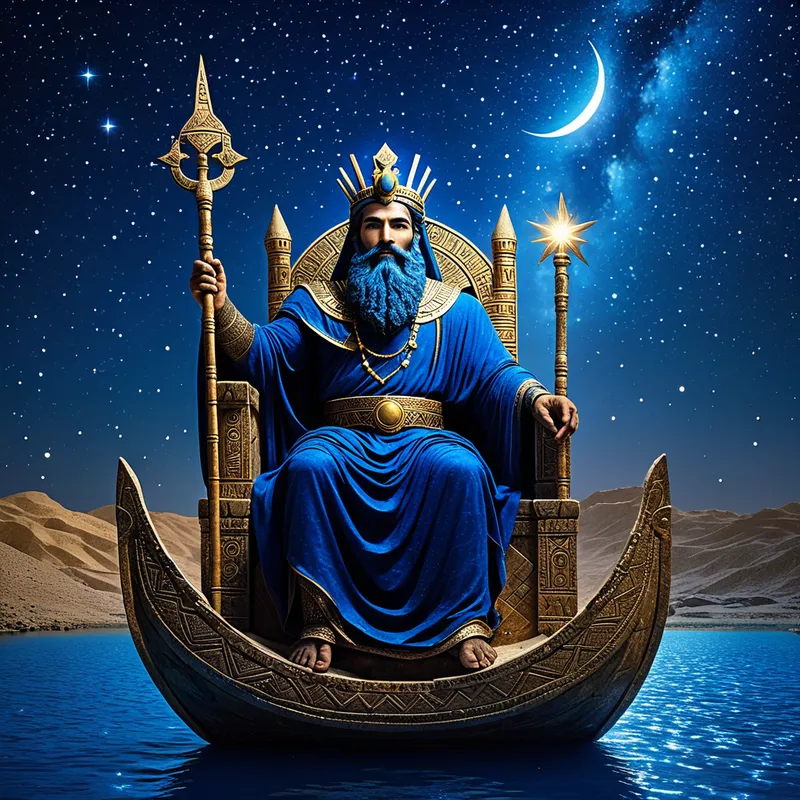
Nanna-Sin Myth Meaning & Symbolism
The luminous journey of the Moon God Nanna-Sin, whose celestial boat measures time, illuminates the night, and reveals the hidden patterns of fate.
The Tale of Nanna-Sin
Hear now the tale of the Measurer, the Illuminator of the Hidden. Before the first king took the scepter, before the first city’s walls were raised from the clay, there was the great dark. And in that dark, a light was born not of the harsh sun, but of a softer, more profound fire.
His name was Nanna-Sin, firstborn son of Enlil, the Storm King, and Ninlil. From his very essence flowed not thunder, but a cool, silver radiance. The gods decreed his domain: the velvet cloak of night, the vast and trackless sky. But Nanna-Sin was not content to merely hang in the void. He petitioned the divine assembly for a vessel.
From the Apsu’s deep wisdom and the crafted might of Ea, a boat was fashioned. Not of wood and pitch, but of captured starlight and the promise of dawn. This was his Barge of Heaven, a crescent sliver sharp enough to cut the fabric of time itself.
Each month, his journey begins. A thin, shy curve of light appears in the western sky, a newborn king setting out on his royal progress. He climbs his celestial river, growing fuller, brighter, his light revealing the sleeping world below—the silent fields, the hushed rivers, the dreaming cities huddled around their ziggurats. For fifteen nights he waxes, a swelling pearl of light, until he stands triumphant at the zenith, a perfect, luminous disc. The kabattû, the rounded one, ruler of the deep night.
But kingship knows its season. The descent begins. Night by night, the great light is consumed, swallowed by the very darkness it once ruled. The boat becomes a dying crescent, a frail bow facing the dawn. For three nights, he vanishes entirely. The world holds its breath in the ūm bubbuli, the “days of disappearance.” Where has the Measurer gone? The people whisper. They know the old stories: he descends to the Kur, the land of no return, to judge the shades and commune with the depths.
And then… a sliver of light. A curved promise on the western horizon. He has returned. The boat is rebuilt. The cycle is renewed. He has traversed the full spectrum of being—from hidden seed to glorious manifestation, to dissolution, and back again. He does not fight the darkness; he moves through it, his very form defining the rhythm of all things. He is the pulse of the cosmos, the gentle, inexorable heartbeat of time.
Cultural Origins & Context
This was not merely a story told for wonder. It was a foundational pillar of reality for the peoples of Sumer</ab title=“An ancient region in modern-day Iraq, the cradle of civilization”>Sumer and Akkad. The myth of Nanna-Sin was inscribed on cuneiform tablets, recited by temple priests (entu* and šangû), and lived by every farmer, shepherd, and king. His primary cult center was the magnificent Ekišnugal at Ur, the “House of the Great Light.”
His function was profoundly practical and deeply spiritual. As the celestial timekeeper, his phases divided the month, forming the basis of the lunisolar calendar that dictated the timing of religious festivals, agricultural cycles, and legal contracts. To observe Sin was to know when to plant, when to harvest, when to pay debts, and when to appease the gods. He was the divine scribe in the sky, inscribing the law of cycles onto the cosmos. His myth provided order in a seemingly chaotic universe, offering a predictable, divine pattern amidst the uncertainties of flood, drought, and war.
Symbolic Architecture
The myth of Nanna-Sin is a masterclass in symbolic thought, mapping the interior landscape of the soul onto the vast canvas of the night sky.
The moon does not create light; it receives and reflects. Thus, true wisdom is not of the ego’s harsh sun, but a reflected understanding of a greater, hidden source.
First, he is the Archetype of Cyclic Time. His perpetual waxing and waning embody the fundamental law of existence: all things rise, peak, decay, and are reborn. This is not a tragedy but a sacred process. The “days of disappearance” are not a failure, but a necessary descent into the unconscious, the fertile void from which new consciousness emerges.
Second, he is the Illuminator of the Unconscious. The sun reveals the objective world; the moon reveals the subjective, shadowed world. His light is the light of intuition, dreams, and hidden knowledge. He rules the night, the domain of secrets, emotions, and the unseen patterns that govern fate (me).
Third, his Barge of Heaven is the vessel of the soul. It is the container of identity (the crescent) that navigates the dark waters of the unknown (the night sky/the unconscious). The journey is solitary, majestic, and inevitable. We are all, psychologically, in that boat, moving through the phases of our own lives.
The Dreamer’s Resonance
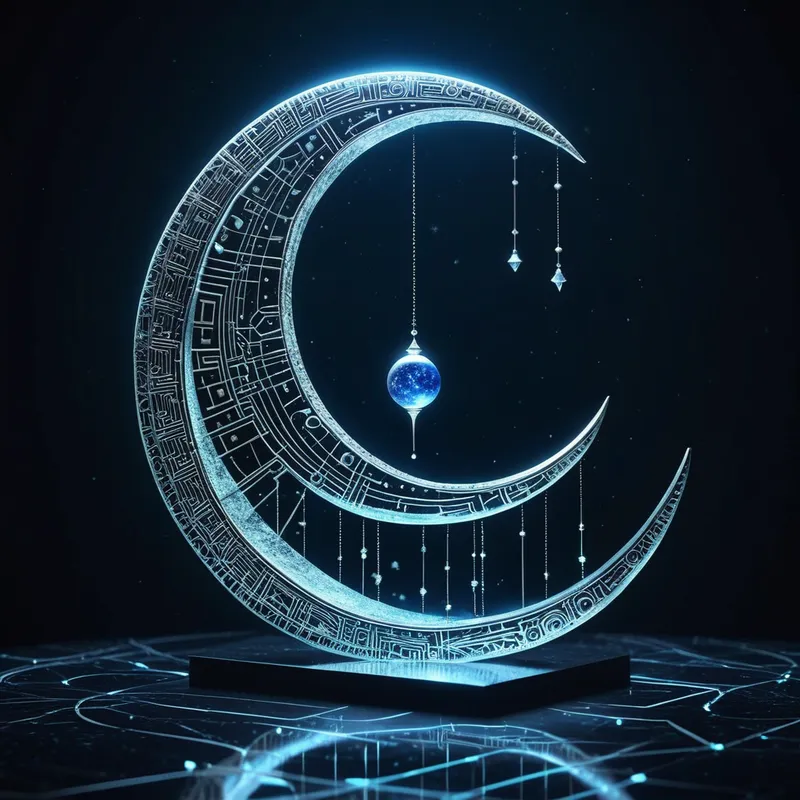
When the pattern of Nanna-Sin stirs in the modern dreamer, it signals a profound engagement with the psyche’s natural rhythms. This is not the stuff of heroic battles, but of deep, tidal processes.
To dream of a waning or disappearing moon often coincides with periods of depression, burnout, or creative emptiness. The psyche is in its ūm bubbuli, its days of disappearance. The conscious ego-light is dimming, and a necessary, if frightening, descent is underway. The dreamer may feel lost, without guidance, in a prolonged “dark night of the soul.” The somatic feeling is one of heaviness, depletion, and being pulled inward.
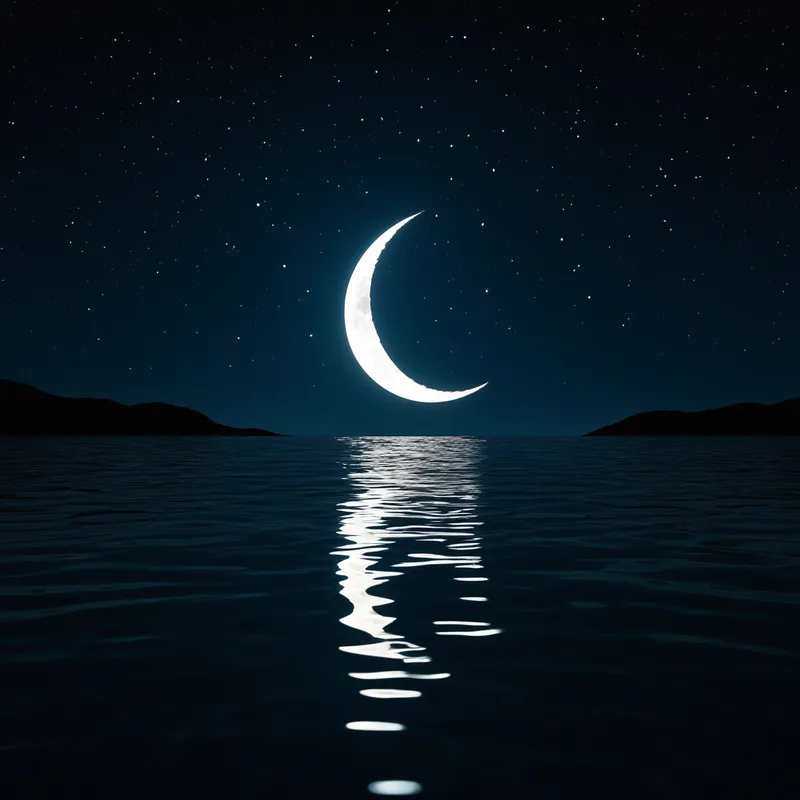
Conversely, dreaming of a new crescent moon, especially one that feels hopeful or promising, marks the nascent beginning of a new psychological cycle. Energy is returning, but it is fragile and new. A fresh perspective, a novel idea, or the slow healing of an old wound is germinating below the surface. The body may feel a subtle quickening, a lightness on the edge of awareness.
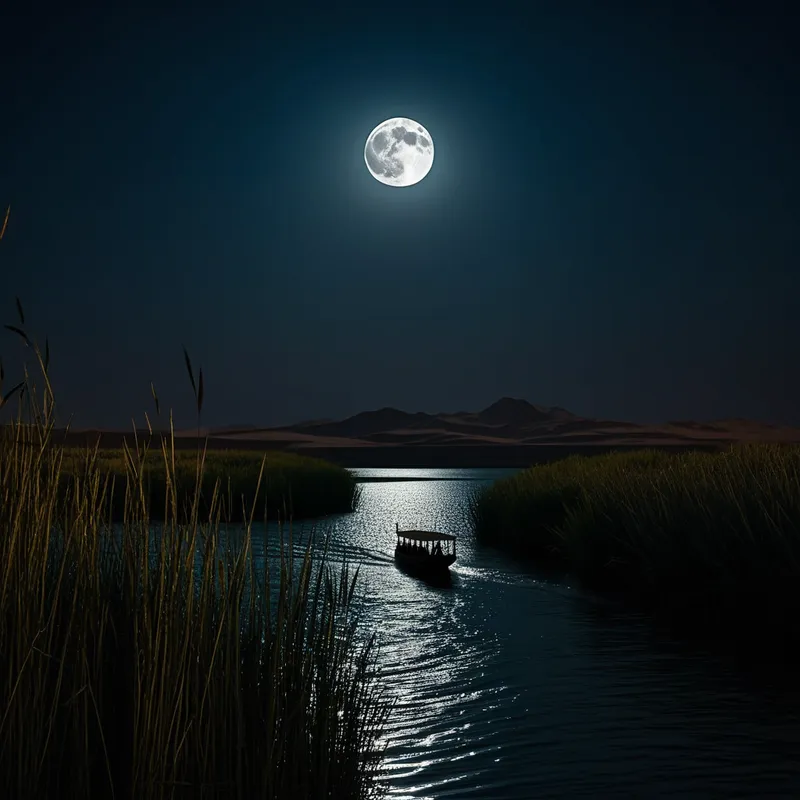
The dream of sailing a small boat on a night sea, guided only by moonlight, is the direct embodiment of the myth. It represents the ego’s conscious self navigating a period of great uncertainty or emotional depth, trusting in the reflected, intuitive light of the unconscious to find its way, rather than demanding the blinding, factual certainty of the sun.
Alchemical Translation
For the individual on the path of individuation, Nanna-Sin models the alchemy of psychic transmutation. His myth teaches us to surrender to the cycle, not fight it.
The modern ego, like the sun, wants constant shine, perpetual productivity, and unwavering visibility. This is a recipe for psychic fracture. The Nanna-Sin process invites us to honor our own inner phases. The period of full manifestation (the kabattû) is for action and external expression. But it must be followed by a waning—a time for reflection, release, and integration. The critical, often neglected step is the voluntary descent into the Kur—the purposeful engagement with our personal underworld of shadow, grief, and dormant potential.
Individuation is not a linear ascent to a permanent peak. It is a spiral dance of becoming, where each return to the dark deepens the quality of the subsequent light.
This is the alchemical solve et coagula: dissolve and coagulate. Nanna-Sin dissolves into the underworld (the solve) and is reconstituted, reborn as the new crescent (the coagula). Psychologically, this means having the courage to let old identities, outworn narratives, and compulsive patterns “die” or dissolve in the dark waters of the unconscious. From that fertile dissolution, a more authentic, nuanced self can coalesce.
The ultimate gift of this myth is the realization that we are not flawed for having periods of darkness, retreat, or invisibility. We are, in fact, participating in a divine, cosmic rhythm. By measuring our inner time by the moon’s gentle standard—not the sun’s frantic one—we reclaim the sacred right to our own completeness, a wholeness that includes both our brilliant light and our necessary, wise, and regenerative dark.
Associated Symbols
Explore related symbols from the CaleaDream lexicon: