
Nana Buruku in Candomble Myth Meaning & Symbolism
The myth of the primordial grandmother, Nana Buruku, who holds the primal waters of creation and the deep, silent wisdom of the cosmic womb.
The Tale of Nana Buruku in Candomble
Before the first word was spoken, there was the silence. Before the first light was kindled, there was the dark, moist deep. In that time before time, where the universe was a thought waiting to be dreamed, there sat Nana Buruku.
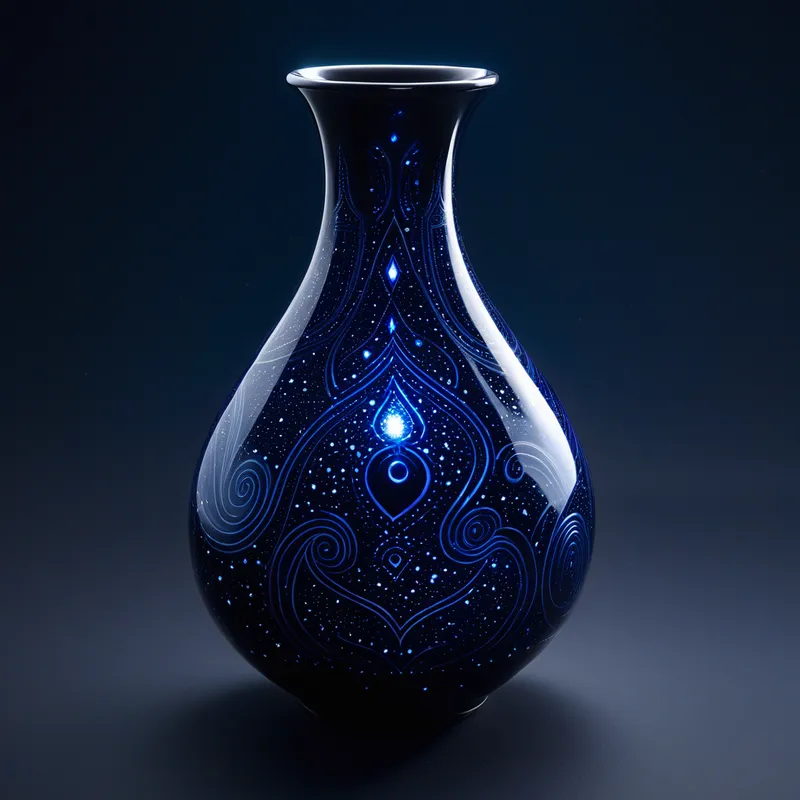
She did not stir, for stirring implies a before and an after, and for her, there was only the eternal now of potential. She sat upon the throne of primordial mud, where water and earth were not yet lovers but one indistinguishable substance. Her body was the very clay of existence, cool and patient. In her lap, she cradled a calabash, not carved by any hand, but formed from the intention of containment itself.
Within that vessel rested the Waters of Origin. They were not the waters of rivers or seas, but the essential moisture—the sap of the cosmic egg, the tears of possibility, the sweat of stars yet unborn. The surface of these waters was a perfect, dark mirror, reflecting nothing because there was nothing yet to see, only the infinite depth of her own being.
The first movement was not a sound, but a settling. A sigh of matter accepting its fate. From the stillness of Nana, a longing emerged—not a personal desire, but the universe’s need to know itself. This longing condensed into a presence beside her: Obaluaiye, the lord of earth and pestilence, and Xangô, the king of fire and thunder. They were her sons, born of her silence, embodiments of the forces that would shape the world to come.
They looked to her for guidance, for a word, for a command to begin the great work of creation. But Nana Buruku spoke no word. Her wisdom was not in speech, but in presence. She simply gazed into her calabash, and in that gaze was the instruction: Look. Listen. Be.
Xangô, vibrant with the impulse to act, to declare, to strike the first spark, grew restless in the face of such profound quiet. Obaluaiye, who understands the slow transformation of the soil and the body, felt a deeper resonance, but even he sought a sign.
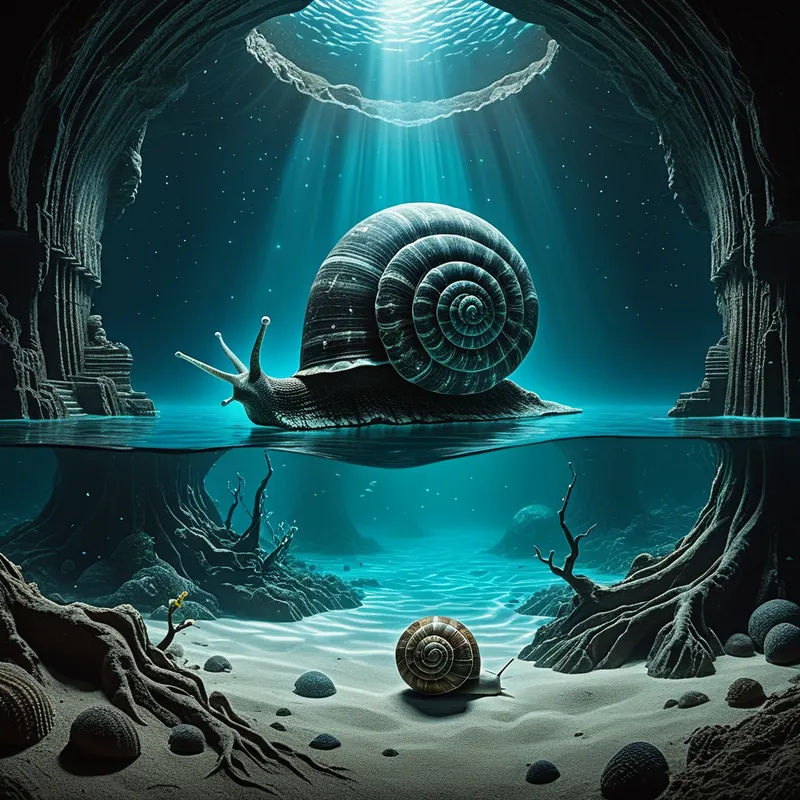
Then, from the rim of the calabash, a creature emerged. Not with haste, but with the inevitable grace of geological time. A snail. It left a glistening trail on the dark curve of the vessel, a silver path in the non-light. It moved toward Nana’s hand, and where its foot touched her skin, the clay there quickened, becoming fertile.
This was her answer. This was her myth. Not a battle, not a quest, but a slow, deliberate emergence from the source. The first law was not spoken; it was demonstrated: All life comes from the deep, dark, moist silence, and carries the memory of that origin within its very structure. She gave her sons not weapons or tools, but the example of the snail—the wisdom of the spiral, the patience of the deep earth, the power of the contained waters. With that silent lesson, the world began not with a bang, but with a slow, purposeful exhalation from the cosmic womb.

Cultural Origins & Context
The veneration of Nana Buruku traveled across the Atlantic in the hearts and memories of the enslaved Yoruba and Fon peoples. Uprooted from their land, their journey through the Middle Passage was itself a descent into a chaotic, watery abyss—a terrifying reflection of Nana’s own primal waters. In the brutal reality of slavery in Brazil, the ancient myths were not merely stories; they became maps of the psyche, reservoirs of identity, and systems of resistance.
Within the terreiros of Candomblé, Nana’s worship was preserved with particular reverence, often in secret. She is considered one of the most ancient orishas, sometimes placed even before Olodumare in the cosmic order. Her priests and priestesses understood her as the foundation, the absolute beginning. The myths were passed down not through written texts, but through sacred oral narratives, dances, songs, and the very arrangement of ritual objects. Her societal function was profound: she anchored a people in a dignity that predated their captivity, connecting them to a time before time, a power that was foundational, maternal, and utterly unconquerable because it was silent and deep.
Symbolic Architecture
Nana Buruku represents the ground of being itself—the unconscious foundation from which all conscious life emerges. She is not the active creator, but the necessary precondition for creation.
She is the silence that makes the first word meaningful, the darkness that gives definition to light, the void that makes form possible.
Her primary symbols are the primordial waters and the snail. The waters symbolize the undifferentiated psyche, the collective unconscious teeming with all potential life forms and thoughts. The calabash that contains them is the vessel of the individual soul or the cosmic womb—a boundary that allows for the gestation of identity. The snail embodies the process of individuation: slow, self-contained, leaving a trace of its journey (the silver trail), and carrying its protection (its shell) as it moves from the waters of the unconscious onto the solid earth of consciousness. Her association with mud and swamps points to the fecund, often murky, borderline state where life first stirs—the psychoid realm where matter and spirit are one.
The Dreamer's Resonance
To dream of Nana Buruku’s domain is to encounter the deepest strata of the Self. Such dreams are often characterized by a profound, sometimes unsettling, silence. The dreamer may find themselves at the edge of a vast, still, dark body of water—a lake, a well, an underground ocean. There is a sense of immense age and patience. One may see snails, or feel the coolness of wet clay.
Psychologically, this signals a somatic and psychic return to the origin. It is a process of re-grounding. The conscious ego, perhaps over-identified with action, noise, and surface-level identity (the realm of Xangô), is being called back to its source. The dream is an invitation to listen, not with the ears, but with the whole body. It often precedes or accompanies a period of necessary incubation, where active striving must cease so that a more authentic form of life can gestate in the dark. The “conflict” in such dreams is the ego’s resistance to this silent, regressive pull.
Alchemical Translation
The myth of Nana models the prima materia stage of psychic alchemy—the acknowledgment and honoring of the massa confusa, the dark, chaotic, foundational substance of the soul. Modern individuation is often obsessed with the later stages: the hero’s journey, the conquest, the brilliant realization (the rubedo or reddening). Nana teaches the necessity of the nigredo, the blackening—the willing descent into the silent, muddy origins of one’s being.
The alchemical work begins not in the fire of transformation, but in the patient contemplation of the waters from which the fire will eventually be born.
Her process is one of psychic transmutation through containment and patience. The modern individual, in emulating Nana’s principle, must learn to create the inner calabash—a sacred, bounded space of non-doing. Here, the swirling waters of emotion, memory, and potential are not analyzed or acted upon, but simply held in a gaze of deep acceptance. This is the cultivation of inner silence, the fertility of the mud, the slow, spiral wisdom of the snail. From this grounded, moist darkness, the true and resilient structures of the personality can finally root and grow. The triumph is not an explosion of light, but the first, slow, deliberate movement of life from the depths toward form—a movement that carries the wisdom of the source within it forever.
Associated Symbols
Explore related symbols from the CaleaDream lexicon:
- Water — The primordial, undifferentiated substance of the unconscious and the source of all life, contained within Nana's calabash.
- Snail — The embodiment of Nana's wisdom: slow, deliberate movement from the deep, carrying one's protective home while leaving a trace of the journey.
- Earth — The fertile mud and clay upon which Nana sits, representing the grounded, material potential born from the union of water and soil.
- Mother — Nana as the ultimate, primordial grandmother, the source from which all other divine and earthly forces are born.
- Silence — Her primary medium of instruction and her essential nature, representing the potent void from which all sound and meaning emerge.
- Circle — Symbolized by the calabash and the snail's shell, representing containment, the cosmic womb, and the cyclical nature of existence.
- Root — The deep, ancient, and often hidden foundations of being, connecting all later growth back to Nana's primal origin.
- Moon — Governing the tides, intuition, and the cyclical, reflective qualities associated with Nana's still waters and feminine mystery.
- Dream — The state of consciousness closest to Nana's realm, where images and potentials first stir in the dark waters of the psyche.
- African — The cultural and spiritual continent of origin for this myth, carried across the diaspora as a foundational pillar of identity and cosmology.