
Namakaokahai Sea Goddess Myth Meaning & Symbolism
A myth of volcanic fury and oceanic grief, where a goddess's rage carves the islands and a family's conflict births a new world.
The Tale of Namakaokahai Sea Goddess
Listen, and let the salt air fill your lungs. Let the memory of the deep ocean, the Po, whisper to you. In that time before time, when the world was a dream in the belly of the gods, there were sisters born of the same fiery womb. Their names were Pele and Namakaokahai.
Namakaokahai was the elder, a being of immense and ancient power. Her body was the fathomless ocean, her voice the roar of the surf, her breath the salt spray that kissed the empty sky. She was the domain, the great, encircling mother of waters. And Pele, the younger, was her opposite: a spirit of unquenchable fire, a spark of restless creation that danced in the darkness.
The trouble began not with malice, but with destiny. Pele’s fire was a hunger. It needed to burn, to build, to make land from dream. She took a great Pa‘oa and began to dig, seeking a home for her heart of flame. But wherever she thrust her staff into the ocean floor, raising up a new island in a cataclysm of steam and stone, Namakaokahai felt it as a wound. The fire was an affront to her realm, a burning insult in her cool, dark body.
So began the great chase, a saga written in eruptions and tidal waves across the Pacific. Pele would land on an island—first Kaua‘i, then O‘ahu, then Moloka‘i—and kindle her fires. She would shape craters and fill the night with a bloody glow. And Namakaokahai would come. Not as a gentle tide, but as a wall of righteous fury. Her waves, taller than the tallest mountain, would rise from the deep and crash upon her sister’s works, hissing and roaring as they quenched the flames and shattered the newborn land.
The air was filled with the scream of steam, the groan of dying rock. Pele fled, again and again, her spirit bruised but unbroken, her fire dimmed but not extinguished. She was the spark, and Namakaokahai was the quenching deep. This was the law of their being, a divine and terrible balance.
The final confrontation came on the island of Maui. Pele, desperate and cornered, dug her last, deepest pit at the summit of Haleakalā. Namakaokahai summoned all the power of the ocean. She drew the waters back, past the reefs, past the horizon, until the seafloor lay bare and gasping. Then, with a sound that cracked the sky, she sent it all rushing back—a mountain of water destined to scour the island clean of fire forever.
The wave met the mountain. The sister’s eyes met across the storm of their making. And in that moment, something broke, and something was born. Pele did not flee. Her fire met the water not with defiance, but with a final, transformative surrender. The legend says Namakaokahai believed her sister slain, her body torn apart by the sea. But Pele’s essence had retreated, traveling unseen to the youngest land, Hawai‘i, where her fire found its eternal home in the pit of Kīlauea.
Namakaokahai, her vengeance spent, her sister seemingly gone, became the sea that now guards the islands. Her waves still lap at Pele’s shores, a perpetual reminder of their sacred, violent bond. The chase was over, but the relationship—forged in conflict—had defined the very shape of the world.
Cultural Origins & Context
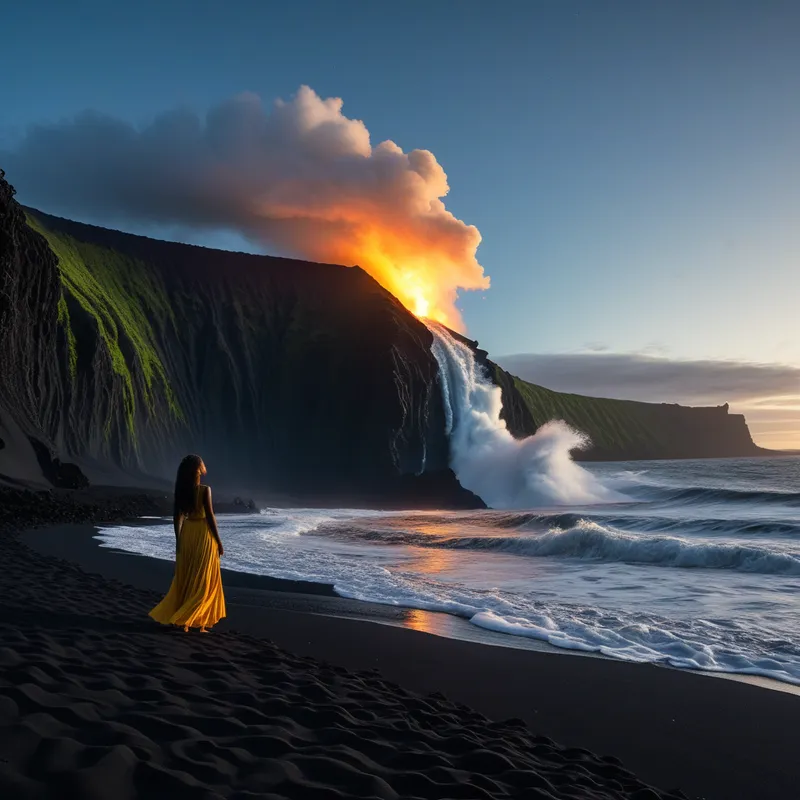
This myth is not merely a story of gods, but the Kumulipo of the land itself. Passed down through kāhuna and storytellers, it served as a cosmological map and a social charter. The dramatic, familial conflict explained the visible, volatile geology of the island chain—why the older islands to the northwest (like Kaua‘i) are more eroded and dormant, while the southeastern island of Hawai‘i remains fiercely active. It was a narrative born from acute observation: the people lived with the evidence of this divine struggle in the black sand beaches (Pele’s cooled lava meeting Namakaokahai’s sea) and the ever-present steam plumes where lava meets ocean.
The myth functioned as a profound lesson in natural forces and familial kapu. It taught respect for the immense, complementary powers of creation and destruction, embodied as sisters. It warned of the consequences of trespass and the inevitability of elemental conflict. To hear this chant was to understand one’s place in a universe alive with passionate, personified forces, where the landscape itself was the scar tissue of divine emotion.
Symbolic Architecture
At its heart, this is a myth of differentiation. Namakaokahai represents the primordial, encompassing state—the unconscious, the maternal waters from which all life emerges. Pele is the eruptive force of individual consciousness, the ego-fire that must differentiate itself from the mother-sea to exist.
The birth of the Self is always an act of perceived betrayal against the old, encompassing order.
Namakaokahai’s rage is not evil; it is the necessary resistance of the old form against the new. Her waves are the psychic backlash when one attempts to establish a new identity (“dig a new home”) within the territory of an old, unconscious pattern. The chase across the archipelago is the soul’s journey, where each attempted settlement of the psyche is challenged and dismantled by unresolved depths, until a final, stable center of consciousness is forged.
The ocean and the volcano are a perfect alchemical pair: Solutio and Calcinatio. One cannot exist without the tension of the other. Their conflict is the process of creation.
The Dreamer's Resonance
To dream in the pattern of Namakaokahai is to feel the uprising of a long-contained emotional tsunami. It may manifest as dreams of being pursued by a vast wave, of standing on a shore as an unstoppable tide approaches, or of trying to keep a fragile fire alive in a drowning world.
Somatically, this speaks to a process of immense emotional release. The dreamer may be confronting a deep, perhaps ancestral, well of grief or rage that has been held at bay—the “sea” of the unconscious finally responding to some new, fiery assertion of self (a career change, a relationship boundary, a creative act). The body might feel heavy, pressurized, or conversely, shaky and ungrounded. The dream is the psyche’s way of enacting the inevitable confrontation between a burgeoning new identity and the powerful, established emotional currents that resist its formation.
Alchemical Translation
The individuation process modeled here is brutal and glorious. It is not a peaceful meditation but a territorial war within the soul. The modern seeker is both sisters: we are the Pele, trying to build a solid, passionate identity, and we are the Namakaokahai, the deep emotional body that floods our efforts with old pain, fear, and loyalty to the familial or cultural “sea” we came from.
The triumph is not in the victory of one over the other, but in the establishment of a new, dynamic equilibrium where both forces are honored as sacred.
The alchemical work is to stop fleeing the wave. It is to stand, as Pele finally did, and allow the full force of our repressed emotional ocean to crash upon us. This is the mortificatio. The apparent “death” of the old ego-structure is necessary. Only through that symbolic drowning can the essence of our true fire retreat to its rightful, fertile ground—the “Big Island” of the authentic Self. There, the fire burns not in reckless defiance, but in stable, creative relation to the sea that guards its shores. We become an island, distinct yet forever in relationship with the deep. Our creativity (Pele) and our emotional depth (Namakaokahai) are no longer at war, but in a perpetual, world-shaping dance.
Associated Symbols
Explore related symbols from the CaleaDream lexicon:
- Goddess — The myth centers on the dynamic between two divine feminine forces, representing the dual aspects of creation and dissolution within the psyche and nature.
- Water — Namakaokahai’s primary element, symbolizing the unconscious, the emotional body, primordial chaos, and the dissolving power of the deep.
- Fire — Pele’s element, representing conscious will, creative passion, transformative energy, and the driving force of individuation.
- Ocean — The specific domain of Namakaokahai, representing the vast, encompassing, and often vengeful realm of the collective or personal unconscious.
- Mountain — The land formed from the conflict, symbolizing the achieved, solid structure of the Self born from the struggle between fire and water.
- Rage — The catalyzing emotion of the myth, representing the necessary, destructive force that clears the way for new growth and establishes boundaries.
- Sacrifice — The apparent death of Pele’s forms represents the ego’s necessary sacrifices to move closer to its true, essential home.
- Journey — The epic chase across the archipelago mirrors the soul’s arduous journey through successive trials to find its authentic place and purpose.
- Shadow — Each sister acts as the other’s shadow; Namakaokahai is the watery, engulfing shadow of fiery Pele, and vice versa.
- Rebirth — The entire myth is a cycle of creation, destruction, and re-creation, with Pele’s final home on Kīlauea symbolizing the rebirth of consciousness in its rightful place.