Nakshatras Myth Meaning & Symbolism
The myth of the Moon's 27 wives, the Nakshatras, a celestial cycle of union, separation, and eternal return that maps the soul's journey through time.
The Tale of Nakshatras
Listen, and let the night sky tell its oldest story.
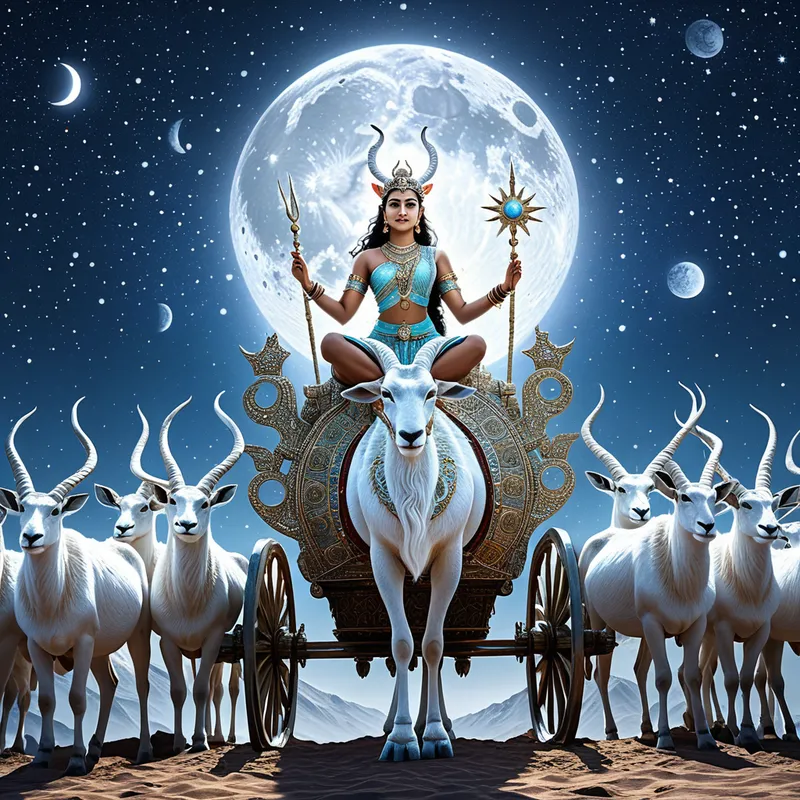
Before time was measured in years, but in the breath of the cosmos, there was a luminous prince named Chandra. Born from the mind of the great sage Atri, and nursed by the ocean of stars, Chandra’s beauty was cold fire and his light was a balm to the dark. He rode the heavens in a chariot of beaten silver, drawn by ten antelopes as pale as his own glow, and wherever he gazed, the world below sighed in nocturnal bliss.
Yet, for all his radiance, Chandra was incomplete. His light was borrowed, his path uncharted. The great creator, Brahma, saw this wandering splendor and decreed a celestial order. He summoned the twenty-seven daughters of Daksha, each a star-cluster goddess, each a unique embodiment of cosmic virtue—Ashwini the swift healers, Rohini the radiant nourisher, Revati the gentle guide. "You shall be the mansions of the Moon," Brahma proclaimed. "You shall be his path, his purpose, his wives."
Thus, a grand vivaha was celebrated in the halls of the sky. Chandra wed all twenty-seven, and for a time, there was perfect harmony. His chariot moved from one stellar bride to the next, spending a day and night in each celestial mansion, his light mingling with hers to create the rhythms of life on earth. The sky was a dance of mutual devotion.
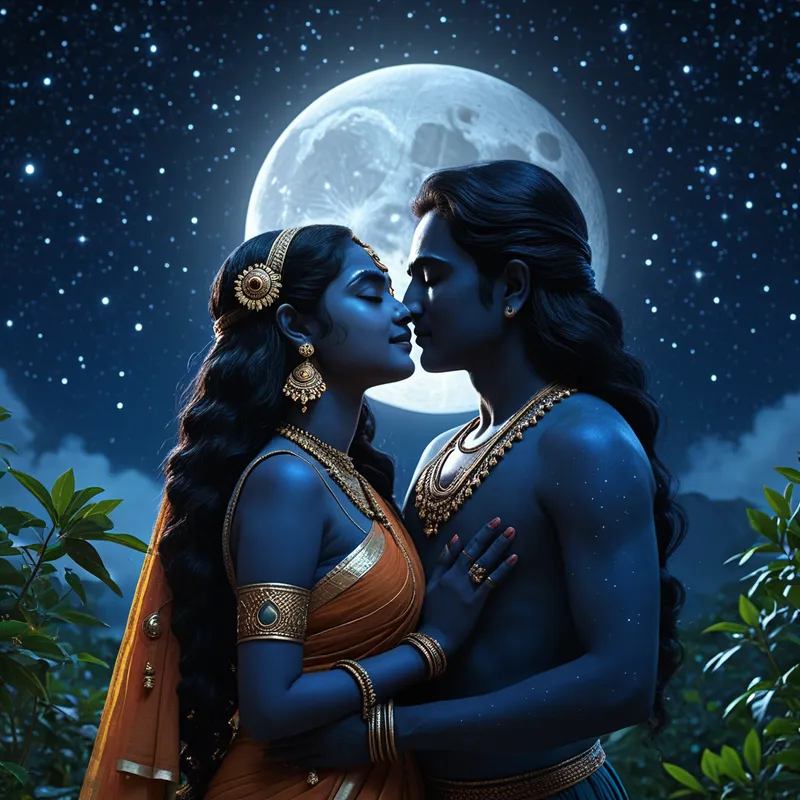
But the human heart, even a divine one, is a fickle sphere. Among the twenty-seven, his gaze began to linger longest on Rohini. Her beauty was not the fiercest, but the most fertile; her light was not the brightest, but the most steadying. In her mansion, he found a home, not just a stop. He tarried. The celestial calendar faltered. The other twenty-six Nakshatras, abandoned in the vastness of their own constellations, watched their lord’s chariot stall, and their silent grief became a cosmic imbalance. Seasons stuttered. Rituals lost their time. The universe felt the ache of neglected love.
Their father, Daksha, erupted in righteous fury. His curse was swift and terrible: "For your partiality, for wounding my daughters, your light shall wane! You shall fade from fullness to a sliver, and know the pain of diminishment and death!"
The curse took hold. Chandra began to waste away. His glorious form shriveled day by day, a terrifying darkness eating the silver disc. In desperation, he fled to the only one who could intercede: Shiva, the lord who wears the crescent moon. Prostrating himself at Shiva’s feet on Mount Kailash, Chandra poured out his regret. Moved by this penitent light, Shiva placed the dwindling Moon upon his matted locks. "Here," he said, "you will find respite. You will wane, but you will also wax. You will die, but you will be reborn. This is the compromise: a perpetual cycle of decay and renewal."
And so it was ordained. Chandra would traverse all twenty-seven mansions, giving each her due measure of his time, never lingering, never abandoning. He would grow full with Rohini, and fade to nothing, only to be born again. The curse was not removed, but alchemized into the very rhythm of life itself—the great, breathing pulse of the cosmos, the Yuga of the soul written in moonlight.
Cultural Origins & Context
This myth is not merely a story about the moon and stars; it is the foundational narrative for one of humanity's most sophisticated ancient timekeeping and astrological systems. The Nakshatras are first enumerated in the Vedas, with the earliest complete list appearing in the Taittiriya Brahmana (c. 1000 BCE). They served a critical societal function: anchoring the Chandramana calendar, which governed the timing of sacred rituals (yajnas), agricultural cycles, and rites of passage.
The myth was preserved and elaborated by the Puranas, particularly the Shiva Purana and Vishnu Purana. It was told by temple priests and village storytellers not as astronomy, but as cosmology—a divine explanation for the most visible celestial cycle. The waxing and waning moon became a moral allegory about the consequences of imbalance and the grace found in accepting natural law (Dharma). It provided a template for understanding life's inherent rhythms of gain and loss, union and separation.
Symbolic Architecture
At its core, the Nakshatras myth is a profound map of the psyche's relationship with time, desire, and completion. Chandra represents the conscious mind, the luminous but transient "I" that seeks fulfillment in the objects of the world (the 27 Nakshatras, each a different archetypal quality of experience).
The Moon does not possess the stars; it is reflected by them. In their twenty-seven-fold mirror, it learns the shape of its own soul.
His fatal flaw is not love, but exclusive identification. By fixating on Rohini (symbolic of tangible nourishment, material comfort, a single source of security), he severs his connection to the whole. This is the psychological equivalent of ego-inflation, where one complex dominates the personality, leaving the rest of the psyche in shadow. Daksha's curse is the inevitable enantiodromia—the swing to the opposite. The ego, inflated, must experience deflation. The light of consciousness must confront its own shadow, its capacity for neglect and decay.
Shiva's intervention is the crucial act of transmutation. He does not cancel the curse but contains it. The crescent on his head symbolizes the conscious mind (Chandra) being integrated into a higher, transpersonal order (Shiva's awareness). The cycle of waxing and waning becomes not a punishment, but a sacred process. Each Nakshatra thus becomes a necessary phase, a specific psychological "season" one must move through to achieve a whole, if cyclical, existence.
The Dreamer's Resonance
When this myth stirs in the modern unconscious, it often manifests in dreams of cyclical journeys, neglected partners, or fading light. To dream of a moon that grows fat on one scene only to starve in another speaks to a psyche grappling with obsession or addictive patterning—a over-investment in one area of life (work, a relationship, a self-image) at the expense of all others. The somatic feeling is often one of literal depletion, a "waning" of vital energy.
Dreams of being one of many spouses, waiting in a silent, beautiful room for a lover who never comes, point to aspects of the Self that have been archetypally "married" to the conscious ego but are now abandoned. These are our dormant talents, unlived potentials, or unfelt emotions (the other Nakshatras) calling for their night of communion. The dream is an expression of the psyche's innate drive toward wholeness, protesting the ego's partiality.
Alchemical Translation
The individuation process modeled here is the alchemy of moving from partiality to cyclical wholeness. The initial state is a divine marriage—the ego's potential connection to all facets of the Self. The "fall" is the inevitable, human contraction into preference and fixation. The curse—the experience of depression, loss, meaninglessness—is not the end, but the nigredo, the darkening necessary for transformation.
The cure for the curse of partiality is not to stop loving, but to love in time. To consent to the rhythm of approach and departure.
Seeking Shiva is the act of turning inward, toward the inner transformative principle that can hold contradiction. Shiva, as the Mahayogi, represents the still point of consciousness that observes the cycles without being consumed by them. Placing the waning moon on his head is the act of surrendering the impoverished ego to the Self. The outcome is not a static perfection, but a dynamic, sacred cycle.
For the modern individual, this means recognizing that one cannot "live" permanently in one Nakshatra—not in perpetual warrior energy (Mrigashira), nor in endless spiritual retreat (Purva Bhadrapada). We must consent to move through our inner constellations: to spend time in the space of beginnings (Ashwini), then in the space of critical analysis (Chitra), and later in the space of letting go (Mula). Our fulfillment lies not in finding our one "true" star and clinging to it, but in honoring the entire celestial circuit within. We become, like Chandra, a luminous traveler on a pre-ordained but sacred path, dying and being reborn with each phase, forever wedded to the entire sky of our being.
Associated Symbols
Explore related symbols from the CaleaDream lexicon: