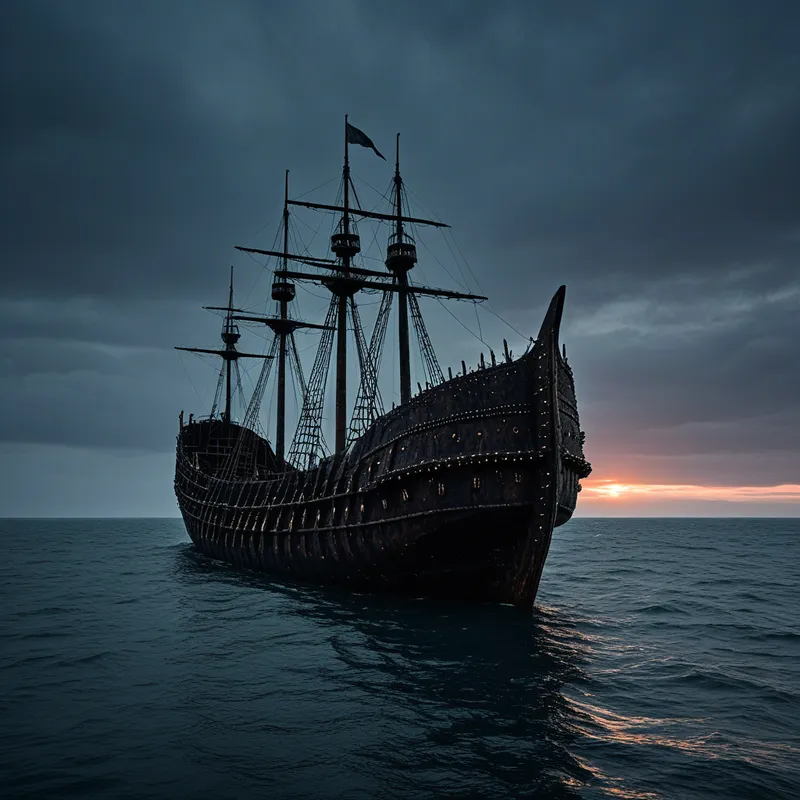
Naglfari Myth Meaning & Symbolism
The silent, unlaunched ship built from dead men's nails, destined to carry the legions of Hel to the final battle at Ragnarök.
The Tale of Naglfari
Listen, and hear the sound of a world holding its breath. This is not a tale of thunder or fire, not yet. This is the tale of the silence before the scream, of the thing built in the dark when no one is watching.
In the deep folds of time, where the roots of the Yggdrasil drink from waters of memory and murk, there is a shipyard that knows no sun. Its foreman is not a god of the Æsir, nor a clever Vanir. It is a giant, a being of the old, cold earth, whose name is whispered only when the wind dies. His task was given in the first prophecy, etched into the bark of the World Tree by the Norns themselves.
His materials are not oak or pine, not woolen sail or tarred rope. His materials are the clippings of oblivion. From every warrior who falls and is buried with honor, from every soul that passes into the care of Hel, a single nail is taken. Not by grave-robbers, but by the slow, patient work of time and decay. The flesh falls away, the bone remains, and from each hand and foot, the final, hardened piece of the self is quietly, inexorably, drawn down through the soil, through the roots, to that lightless dock.
There, the giant works. He does not hammer with rage, nor sing with purpose. His movements are the movements of geology, of a mountain settling. One by one, he sets the nails. They are blackened iron and yellowed keratin, a mosaic of the forgotten dead. The hull takes shape—a monstrous, bristling shell. The mast rises, a spine of countless splinters of self. This is Naglfari.
It is built for one voyage only. Its crew will be the silent, numberless legions of Hel, those who died of sickness and age, whose deaths held no song for the halls of Valhalla. When the wolf Fenrir breaks his bonds and the serpent Jörmungandr rises from the deep, the giant will be done. The final nail will be set. And on a tide of despair, with a sail woven from funeral shrouds, Naglfari will slip its moorings in the utter dark. It will not sail across water, but across the solidified dread of the ages, bearing its cargo of the unmourned and the inglorious dead to the final plain, to the battle where all things—even the gods—must meet their end.
This is its tale. It is not a story of action, but of accumulation. It is the sound of a single drop, falling in a cavern, for millennia, until it fills an ocean.
Cultural Origins & Context
The name Naglfari appears fleetingly in the Old Norse poem Völuspá (The Prophecy of the Seeress), part of the Poetic Edda. It is not a saga with heroes; it is a single, chilling line in a cosmic forecast. The seeress, recounting the signs of Ragnarök, states it plainly: "A ship journeys from the east, Naglfari will come / Muspell's sons are at the helm." Its power lies in its stark, logistical horror.
This myth functioned as the ultimate memento mori for a culture intimately acquainted with death, but one that often glorified the warrior's end. While the einherjar feasted in Valhalla, the vast majority of humanity—those who died in bed, of plague, or at sea—were destined for Hel. Naglfari was their vessel. It served as a narrative balance, a reminder that the glorious destruction of the gods would be witnessed and participated in by the anonymous masses. It was a democratization of apocalypse. Told by skalds and seers, it rooted the cosmic in the bodily—your own fingernails, the mundane waste of your physical self, would become part of the engine of the world's end. This created a profound, unsettling connection between individual mortality and universal destiny.
Symbolic Architecture
Naglfari is the ultimate symbol of the repressed collective shadow. It is not built from weapons, but from the discarded, insignificant parts of the self. The nail is that which we cut away and forget, the dead husk of our growth, the utterly utilitarian and uncelebrated.
The ship of fate is not built by conscious hands, but from the accumulated refuse of life, the forgotten decisions and the unmourned losses that slowly assemble into an inescapable destiny.
Psychologically, Naglfari represents the "complex" that forms in the unconscious. It is not a single traumatic event, but the slow, silent accumulation of unresolved emotions, neglected duties, and unacknowledged weaknesses. Each dismissal of a small sadness, each repressed anger, each neglected inner call is a "nail" added to this structure. It grows autonomously, in the dark, until it becomes a vessel capable of carrying a whole army of repressed contents—the "legions of Hel"—into conscious life. This invasion is what we experience as a life crisis, a breakdown, or a sudden, overwhelming confrontation with everything we've tried to ignore.
The Dreamer's Resonance
When this myth stirs in the modern psyche, it rarely appears as a literal ship. The dreamer may instead encounter:
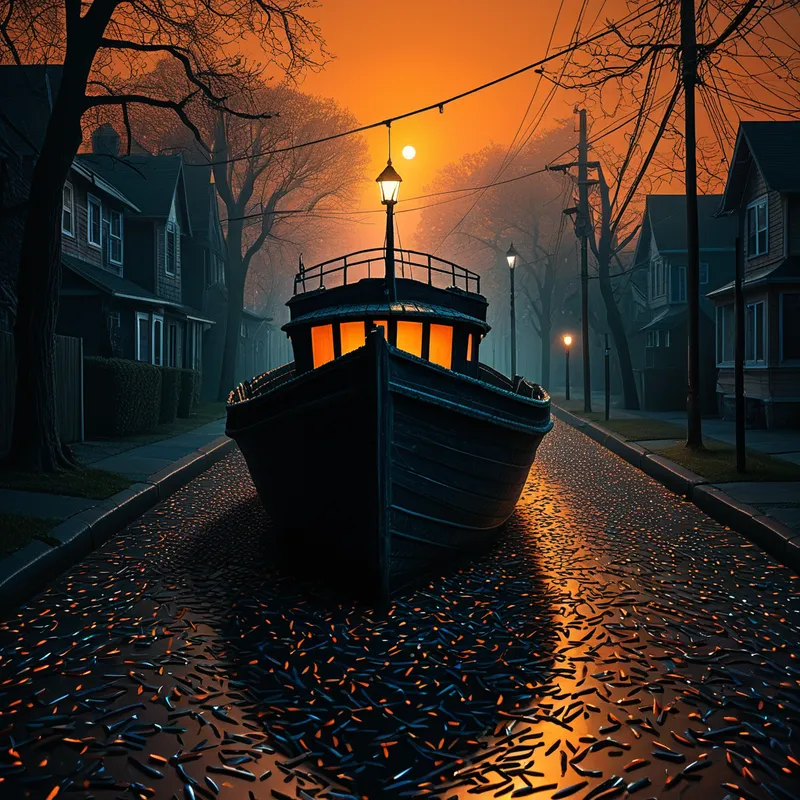
- An overwhelming pile of mundane, discarded objects (pencils, buttons, receipts) that somehow feels terrifyingly significant.
- A slow, silent, and inevitable process happening in the basement or attic of a dream house—a machine assembling itself from scrap.
- A profound anxiety about "waste" or "leftovers," a sense that what has been thrown away is now returning.
- The somatic feeling of something sharp, splintered, and cold accumulating in the gut or chest.
This is the psyche signaling that the "ship" is nearing completion. The unconscious has finished its silent labor of compiling all that has been denied. The dreamer is on the cusp of a necessary, if terrifying, confrontation. The rising dread is not of an external monster, but of the sum total of one's own avoided inner truths, now demanding passage into the light of awareness. It is the feeling of a reckoning being prepared in the books of the soul.
Alchemical Translation
The alchemical process mirrored here is Nigredo—the blackening, the putrefaction, the confrontation with the massa confusa of the shadow. Naglfari is the vessel of the Nigredo. Its construction is the unavoidable first stage of individuation: the gathering and acknowledging of all that is base, dead, and forgotten within us.
The alchemist does not fight the blackening; they provide the vessel to contain it, knowing it is the raw material of the Stone.
For the modern individual, the "alchemical translation" is not to prevent the ship from being built—that is impossible, as life will always produce "nails." The work is to become conscious of the shipyard. It is to periodically descend into that inner darkness and witness the construction. To ask: What am I discarding? What dead matter of my experience am I ignoring?
The triumph is not in stopping Ragnarök, for in the psyche, the great conflict that leads to renewal is necessary. The triumph is in knowing the ship is coming, and in choosing to meet its cargo at the dock of consciousness, rather than being overwhelmed when it beaches itself upon the shores of your waking life. By acknowledging the nails—the petty resentments, the small griefs, the unfulfilled potentials—you begin to transmute them. They lose their autonomous, fateful power. The ship may still sail, but you are no longer its helpless victim; you become, in part, its aware and reluctant captain, steering the inevitable conflict toward the rebirth that follows the mythic fire. The end of the world becomes the beginning of the self.
Associated Symbols
Explore related symbols from the CaleaDream lexicon: