Naga Myth Meaning & Symbolism
Serpentine deities of primordial waters, guardians of esoteric wisdom, and symbols of the coiled, transformative power within the human psyche.
The Tale of Naga
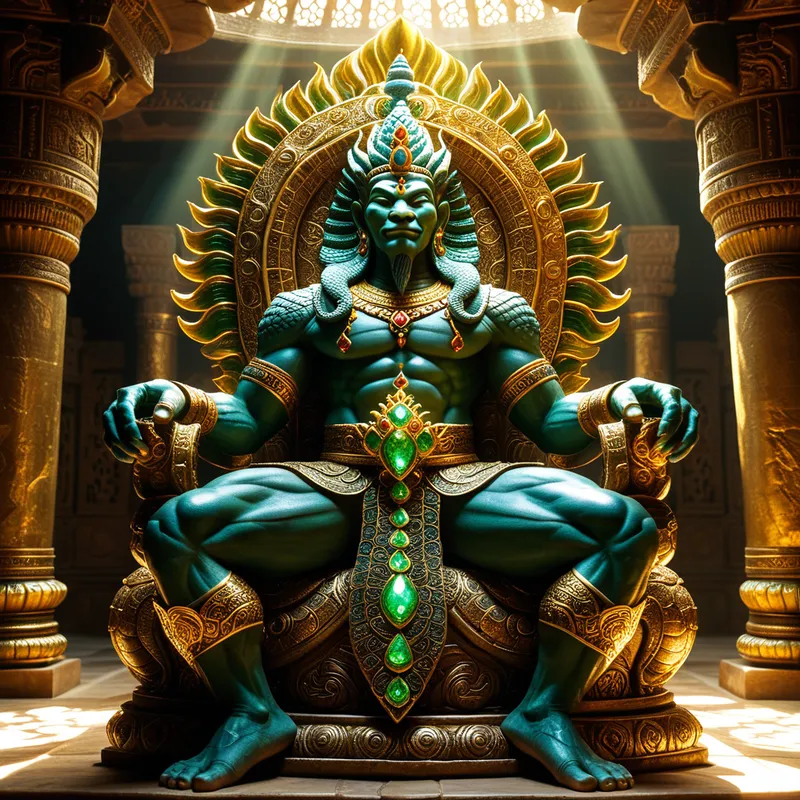
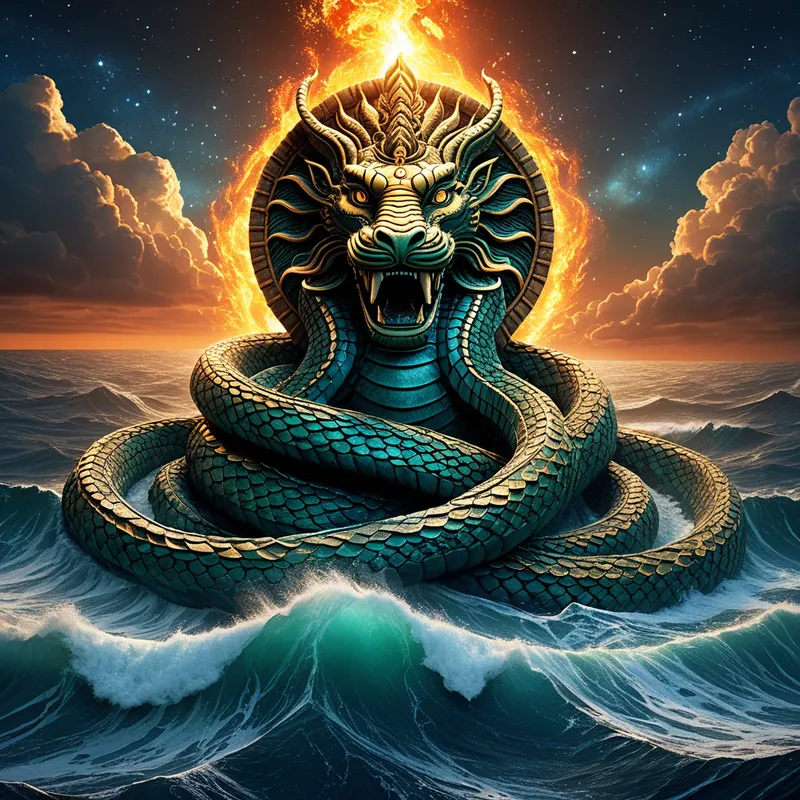
Listen. In the time before time, when the world was a single, boundless ocean, the great serpent slept in the abyss. Its name was Ananta Shesha, and its coils were the foundation of all that is, was, and will be. Upon its thousand hoods, the preserver, Vishnu, reclined in yogic sleep, dreaming the cosmos into being. From the dark, fertile waters, life stirred.
But the serpents were not only of the deep. They were of the earth, the rivers, and the hidden places. They built glittering cities—Bhogavati—beneath the mountains, lit by the cold fire of jewels they guarded. They were the Nagas: beings of sublime duality, with the torso of a human and the powerful, flowing body of a serpent. They could take any form, whispering secrets to the wise and striking terror into the foolish.
One tale sings of a great labor, a churning of the cosmic ocean. The Devas and the Asuras, locked in eternal struggle, sought the nectar of immortality. They uprooted the mountain Mandara and needed a churning rope. They called upon Vasuki, king of the Nagas. He offered himself, allowing his immense body to be coiled around the mountain. Gods pulled at his head, demons at his tail. As they churned, Vasuki suffered, breathing forth venom that threatened to poison all creation. From the chaos rose treasures and terrors, until the god Shiva, in boundless compassion, drank the poison, holding it in his throat, turning his neck blue. The serpent’s sacrifice and the god’s containment saved the worlds.
Another whispers of a different king, Muchalinda. When the newly awakened Buddha sat in deep meditation, a great storm arose. Seeing the sage in peril, Muchalinda emerged from his roots, coiled his body seven times around the Buddha, and spread his great hood like a canopy, sheltering him from the lashing rain and wind until the skies cleared. In silence, the serpent protected the ultimate truth.
Cultural Origins & Context
The Naga mythos is a foundational stratum in the spiritual geology of South and Southeast Asia, flowing seamlessly through Hindu, Buddhist, and indigenous folk traditions. Their origins are pre-Vedic, rooted in the animistic worship of serpent spirits associated with water, fertility, and the chthonic powers of the earth. As Vedic and later Hindu cosmology developed, these powerful nature spirits were integrated into the grand pantheon, becoming devas in their own right—often ambiguous, capable of great benevolence or fierce wrath.
In Buddhism, particularly the Mahayana traditions that spread across Asia, Nagas became crucial protectors of the Dharma. They are revered as guardians of hidden texts, said to have safeguarded the profound Prajnaparamita Sutras until humanity was ready to receive them. This societal function is dual: they are both local tutelary deities of rivers and groves, invoked for rain and protection, and cosmic symbols in art, scripture, and temple architecture, representing the raw, untamed forces that must be acknowledged and harmonized with.
Symbolic Architecture
The Naga is the ultimate symbol of paradoxical unity. It embodies the reconciliation of opposites that defines the deepest layers of the psyche.
The serpent lies at the threshold of worlds: it is of the unseen deep and the visible earth, a creature of instinctual wisdom and potential spiritual poison.
Its dwelling in subterranean palaces speaks to its connection with the shadow and the unconscious—the repository of primal instincts, forgotten knowledge, and creative potential. The jewels it guards are the latent treasures of the self, the innate wisdom and vitality that can only be accessed by bravely engaging with these deeper layers. Its venom is the transformative, potentially destructive power of unintegrated psychic energy—raw passion, repressed rage, or unacknowledged desire. The myth of Shiva drinking the poison is a supreme allegory for conscious integration; not rejecting the shadow's toxin, but containing and transmuting it into a source of power (the blue throat).
Furthermore, the Naga’s ability to shed its skin is a universal emblem of rebirth and renewal. Its coiled form is a direct analogue to the Kundalini—the serpent power that, when awakened, rises through the spiritual centers of the body, leading to enlightenment. Thus, the Naga is the instinctual energy that must be awakened and guided, not slain or denied.
The Dreamer's Resonance
When the Naga glides into modern dreams, it signals a profound engagement with the foundational layers of the psyche. This is not a superficial symbol but an encounter with the somatic and instinctual core.
Dreaming of a serene, majestic Naga, perhaps offering a jewel or providing shelter, often coincides with a period where deep, instinctual wisdom is becoming available. The dreamer may be discovering inner resources, accessing creative wells, or finding an innate capacity for healing and protection they didn't know they possessed. It is the psyche’s way of announcing that the treasures of the underground kingdom are within reach.
Conversely, dreams of being chased or threatened by a Naga point to a fraught relationship with one’s own primal energy. The “venom” may be surfacing—perhaps in the form of overwhelming emotions, a health crisis forcing a reckoning with the body, or a situation where repressed instincts are erupting in disruptive ways. The coiled serpent in the dream may represent a potent energy, like creative force or sexual vitality, that is bound up, asleep, or feared, causing stagnation or a sense of being “in a knot.”

Alchemical Translation
The Naga myth provides a precise map for the alchemical process of individuation—the journey toward psychic wholeness. It models not a heroic slaying of the dragon, but a sacred dialogue with it.
The first step is Descent: acknowledging the existence of the subterranean kingdom within. This is the courage to look into one’s own depths, to explore the shadow, the instincts, the murky waters of the unconscious where the Naga resides. It is the work of therapy, deep reflection, or engaging with art—any practice that brings the hidden to light.
The second is Confrontation and Containment (the Shiva Process). The emerging “venom”—the anger, the grief, the wild desire—must not be expelled or acted out blindly. Like Shiva, the conscious ego must learn to “drink” it, to hold this potent energy in awareness without being destroyed by it. This is the immensely difficult work of sitting with discomfort, metabolizing emotion, and refusing to project one’s shadow onto others.
The goal is not to become pure spirit, but to become a fully embodied soul—a being in whom the serpentine earth and the divine sky are in constant, creative conversation.
The final stage is Awakening and Alliance (the Buddha Process). Once the energy is integrated, it becomes a protective, supportive force. The coiled power (Kundalini) rises, not as a threat, but as the very source of enlightenment. The Naga becomes the guardian of one’s deepest truth, sheltering the nascent, authentic self (the Buddha in meditation) from the storms of life. The individual no longer fights their nature but is upheld by it, having made an ally of the primal serpent within. The myth teaches that wisdom is not found by escaping the earthly coil, but by understanding its sacred, spiraling dance.
Associated Symbols
Explore related symbols from the CaleaDream lexicon: