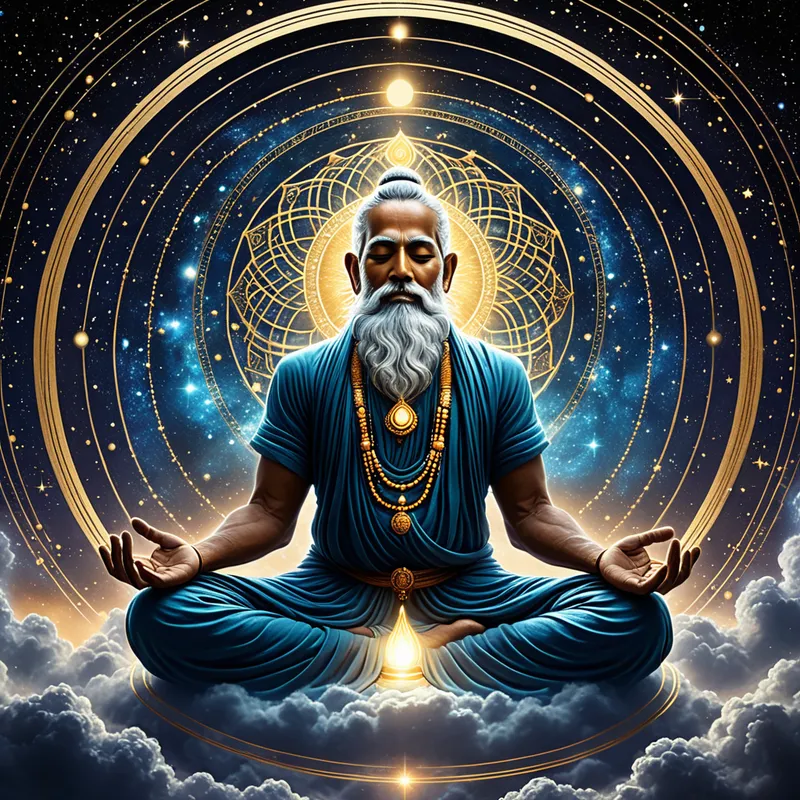
Nada Brahma Myth Meaning & Symbolism
The primordial vibration from which all reality emerges, a cosmic hum that is both the source of the universe and the essence of the self.
The Tale of Nada Brahma
In the beginning, there was not darkness, nor light. There was not form, nor void. There was only That. A boundless, undifferentiated potential, a sleeping infinity known as Brahman. It was not silent, for silence implies the absence of sound. It was a perfect, pregnant stillness, a consciousness aware only of itself.
And within that supreme consciousness, a desire stirred. Not a human desire, but the first impulse of being: “May I become many.” This was the Shabda, the unspoken Word before all words. From the heart of that intention, a subtle tremor arose. A single point of focused potential began to hum. This was the Aum, born not as a chant, but as the first self-expression of existence.
The hum grew. It was Nada Brahma—the Sound that is God. It began to spiral, to differentiate. From its core emerged the Gandharva, celestial beings whose very essence was melody. They did not play music; they were the music, the first fractals of the cosmic vibration. The hum split into tones: the deep, grounding resonance of the earth; the fluid, flowing notes of water; the crackling, transformative pitch of fire; the whispering, carrying sighs of air; and the vast, spacious silence of ether.
These tones wove together. They did not just make sound; they became substance. The deep resonance thickened into mountains and plains. The fluid notes pooled into oceans and rivers. The crackling pitch ignited suns and the inner fire of life. The whispering sighs became the wind and the breath in all lungs. The hum was the loom, and the five elements were its tapestry.
The gods themselves, the Devas, arose from specific harmonics of this eternal sound. Agni was its transformative crackle. Vayu was its rushing exhalation. And the great Varuna was the law inherent within its perfect frequency. The universe was not created by a sound; it was, and forever is, the sound itself, perpetually sung into being. The story does not end, for the tale of Nada Brahma is not a past event. It is the eternal present. The hum continues. It is the spin of electrons, the orbit of planets, the rhythm of a heartbeat, and the space between thoughts. To listen is to remember your origin.

Cultural Origins & Context
The concept of Nada Brahma is not a single, codified myth from one text, but a profound philosophical thread woven through the tapestry of Vedic and post-Vedic thought. Its roots are in the Vedas themselves, particularly in speculations about the power of the spoken word (Vak) and ritual chant. The priests, the Hotri and Udgatri, were not merely performers; they were technicians of reality, believing correct pronunciation and meter could sustain cosmic order (Rta).
This idea crystallized in the Upanishads, such as the Maitri Upanishad, which explicitly discusses meditation on sound as a path to Moksha. It was further systematized in the classical Indian traditions of music (Hindustani and Carnatic) and the yoga of sound (Nada Yoga). The myth was passed down not just as a story, but as an experiential truth through disciplined practice—the musician seeking the perfect Raga, the yogi listening for the inner Anahata Nada. Its societal function was to map the macrocosm to the microcosm, providing a sonic model of a universe that was inherently interconnected, intelligent, and resonant.
Symbolic Architecture
At its core, Nada Brahma dismantles the duality between creator and creation. The sound is not a tool used by a separate god; it is the divine substance.
The universe is not a manufactured object, but a sung into being—a continuous performance where the singer, the song, and the act of singing are one.
The primordial hum, the Aum, symbolizes undifferentiated consciousness—the Self before it identifies with any particular form. Its differentiation into the many notes and elements represents the process of manifestation, the One becoming the Many. This is not a fall from grace, but a creative expression. The Gandharvas symbolize the archetypal patterns and laws (the Tattvas) that structure this expression from within.
Psychologically, this maps perfectly onto the emergence of the individual psyche from the unconscious. The silent, boundless Brahman is the collective unconscious. The first hum is the stirring of an individual point of awareness—the ego beginning to coalesce. The subsequent symphony of elements and forms represents the development of the complex personality: the solidity of our habits (earth), the flow of our emotions (water), the drive of our passions (fire), the movement of our intellect (air), and the space of our awareness (ether).
The Dreamer's Resonance
When this myth activates in the modern psyche, it often surfaces not as a literal narrative, but as a somatic or auditory dream experience. One might dream of hearing a profound, beautiful hum that seems to source from the center of their own chest or from the very walls of the dreamscape, bringing a sense of peace and cosmic connection. Another may dream of their body dissolving into light or vibration, or of seeing geometric patterns (Yantras) that pulse with sound.
These dreams signal a process of psychic re-tuning. They often occur during periods of deep introspection, spiritual seeking, or after a significant life change has shattered old, rigid structures of identity. The somatic experience of vibration points to the dreamer touching the foundational level of their own being, beneath the stories of the ego. It is the psyche’s way of remembering its essential, resonant nature, healing the perceived separation between the self and the environment. The dream is an invitation to listen inward, to find the central tone around which one’s life can harmoniously organize.

Alchemical Translation
The alchemical journey modeled by Nada Brahma is the path of Individuation through conscious resonance. The prima materia, the leaden state of the unexamined life, is the experience of being a discordant note—feeling separate, isolated, and out of sync with one’s purpose and the world.
The work is not to build a new self, but to quiet the internal noise until you can hear the fundamental frequency that has always been there.
The first operation is Negrito: the darkening. This is the conscious withdrawal from external distractions, the meditation practice of Pratyahara. We stop chasing outer validation and become still. In this silence, we initially hear only the chaos of our own thoughts—the psychic static.
The Albedo, or whitening, begins when, amidst the noise, we detect a consistent tone—the inner sound, the Anahata Nada. This is the discovery of the authentic Self, the Atman. The work then becomes one of alignment (Citrinitas): gradually tuning our thoughts, emotions, and actions to resonate with this core frequency. We let go of habits (earth) that dampen our vibration, allow emotions (water) to flow without creating dissonance, direct our energy (fire) wisely, and clarify our mind (air).
The final Rubedo, the reddening or golden dawn, is not an end state but a mode of being. It is living as a conscious instrument of Nada Brahma. Your life becomes your unique note in the cosmic symphony. You understand your individuality not as separation, but as a necessary and beautiful variation in the universal theme. Your creative acts, your relationships, your very presence becomes an expression of the original hum, contributing to the harmony of the whole. You realize you were never singing alone.
Associated Symbols
Explore related symbols from the CaleaDream lexicon:
- Tune
- Audio
- Volume
- Sounded
- Melody
- Echoing Soundwave
- Celestial Tuning Fork
- Echoing Symphony
- Sonic Artwork
- Echoing Tuner
- Soundbar
- Tuning Fork of Truth
- Sound Waves
- Melodic Harmony
- Resonance
- Frequency
- Overtone
- Sound Wave
- Sound Sculpture
- Sonic Texture
- Frequency Shift
- Decibel
- Acoustic Texture
- Sound Current
- Sound Atmosphere
- Sound Propagation
- Acoustic Field
- Acoustic Levitation
- Thermospheric Resonance
- Acoustic Diffusion
- Sonic Resonance
- Wavelength
- Waveform