
Nabu God of Writing
Nabu, the Babylonian deity of writing and wisdom, served as the divine scribe who recorded destinies and communicated divine will through sacred texts.
The Tale of Nabu God of Writing
In the celestial courts of Marduk, the air hummed with the weight of unspoken decrees. It was here that Nabu, the luminous son, took his seat not with a weapon, but with a stylus of lapis lazuli and a tablet of purest clay. His was the silent thunder, the shaping of reality through the incisive mark. While the great gods decreed fate in the council of the Dingir, it was Nabu who gave those decrees form, who etched the immutable šimtu—the destiny of every man, woman, king, and empire—into the fabric of the cosmos.
His tale is woven not in grand battles, but in the quiet spaces between thought and word, between divine will and mortal understanding. He was the messenger, the interpreter, the one who crossed the threshold from the ineffable to the inscribed. When the gods’ will was a formless storm, Nabu was the lightning rod, channeling its power into legible cuneiform wedges. He served as the tongue of his father Marduk, the scribe of the Tablet of Destinies, holding the very authority of the universe in the careful custody of his records.
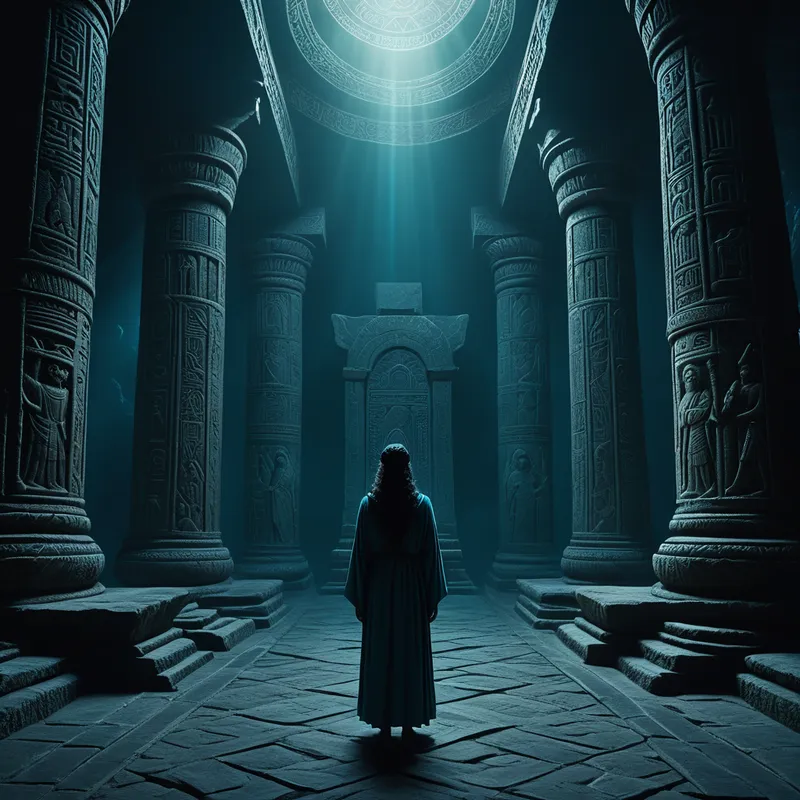
Each year, in the sacred ritual of the Akitu festival, Nabu’s role was paramount. His cult statue would journey from his own city of Borsippa, along processional ways lined with hopeful awe, to reunite with Marduk in Babylon. This was no mere visit; it was the annual re-inscription of the world’s order. In the dim sanctum of the Esagila temple, amidst incense and chant, it was as if Nabu would open the celestial ledger, review the destinies set the year prior, and with his father’s authority, confirm or amend the fates of lands and people. His stylus was the instrument of cosmic renewal, his writing the very act of sustaining creation.
Cultural Origins & Context
Nabu’s ascent to prominence is a testament to the rising cultural power of the written word in ancient Mesopotamia. Initially a minor deity, perhaps of fertility or scribal arts, his status grew exponentially alongside the political and theological ascendancy of his father, Marduk, during the Babylonian era. As Babylon became the center of empire, so too did its patron god require a bureaucracy. Nabu became that divine bureaucracy—the vizier, the chief administrator, the keeper of all accounts, both celestial and terrestrial.
His primary cult center was the Ezida temple in Borsippa, a city so closely associated with him it was often called “his beloved city.” Here, he was not just Marduk’s son but a sovereign lord in his own right, “the one who holds the writing board of the Tablet of Destinies.” This reflects a profound societal shift: the scribe, once a mere recorder, was now recognized as a wielder of immense power. To control the record was to control reality. Kings would invoke Nabu’s blessing on their inscriptions, seeking to have their deeds and decrees etched into the permanent, divine record he oversaw. He was the patron of the ṭupšarru—the scribal class—who were the engineers of civilization, managing law, economy, literature, and religion through the medium of the clay tablet.
Symbolic Architecture
Nabu represents the archetypal moment of consciousness capturing the unconscious. He is the principle that translates the chaotic, divine intuition (Marduk’s victory over primordial Tiamat) into a structured, communicable code. His symbols are tools of articulation: the stylus, the clay tablet, the waxed writing board. These are not passive objects but active agents of creation and constraint.
The written word, in Nabu’s domain, is fate solidified. It moves destiny from the realm of potential and whispered council into the realm of law. This carries a profound tension: the liberation of making thought permanent is also a binding, a limitation of infinite possibility into a single, authoritative line.
His association with wisdom (nemequ) is not the wisdom of the solitary sage, but the wisdom of the administrator—the one who knows where every record is kept, how every decree connects, and what the precedent dictates. He symbolizes the intellect applied to the cosmic order, the mind that maps the will of the gods. Furthermore, as a god of vegetation in his earlier aspects, there is a deep link between his stylus and a planting stick, between writing and sowing seeds—both are acts of implanting a potential form into a receptive medium (clay, earth) to yield a predetermined result.

The Dreamer's Resonance
To encounter Nabu in the inner landscape is to confront the part of the psyche that seeks to name, define, and record. He is the internal scribe who, upon waking, tries to pin down the fleeting images of a dream into a narrative. He is the voice that insists on journaling, on analyzing, on creating a coherent story from the raw data of experience. This function is vital for consciousness and ego-stability; it builds the tablet of our personal identity from the fragments of memory and impulse.
Yet, Nabu’s shadow is the tyranny of the record. When this archetype dominates, the psyche can become a rigid bureaucracy. Spontaneity is feared as a threat to the established “text.” Feelings are invalid until they are analyzed and labeled. The fluid, poetic, and ambiguous aspects of the soul are suppressed in favor of a literal, factual interpretation. The individual may live according to a “script” of destiny—parental expectations, societal norms, self-imposed life plans—etched so deeply it feels like divine decree, forgetting they themselves hold the stylus. Nabu challenges us: Are we reading from a tablet written by another, or do we have the courage to take up the stylus and author our own becoming, even if it means erasing old lines?

Alchemical Translation
The alchemy of Nabu is the transformation of the invisible into the visible, the spoken breath into enduring mark. Psychologically, this is the process of making the unconscious conscious—not through explosive revelation, but through patient, careful notation. It is the therapy session where a pattern is finally seen and named. It is the creative act where a nebulous inspiration is given form in a sketch, a melody, a draft.
This god does not deal in the gold of instant enlightenment, but in the base clay of diligent practice. His sacred work is the slow, often tedious, transcription of the soul’s whispers into a legible text. The power lies not in the content of the whisper alone, but in the act of faithful recording, which in itself alters the recorder.
To integrate Nabu is to commit to the discipline of self-reflection. It is to understand that we are both the council of gods (our complex, often conflicting inner drives) and the scribe who must listen, interpret, and record their decisions into a workable life. The ultimate wisdom he offers is that while destinies may be written, the tablet is not stone. It is clay—malleable, capable of being softened, reworked, and inscribed anew with the application of conscious effort and the waters of new insight.
Associated Symbols
Explore related symbols from the CaleaDream lexicon:
- Fate — The immutable decree given form; the concept Nabu transcribes from divine will into tangible, binding law on the Tablet of Destinies.
- Tablet — The fundamental medium of inscription, representing the receptive surface of reality or the mind upon which knowledge and destiny are permanently marked.
- Stylus — The active instrument of creation and definition, piercing the formless to impose order, meaning, and lasting record.
- Temple (Ezida) — The sacred space dedicated to the preservation and practice of sacred knowledge, housing the divine scribe and his records.
- Key — The instrument of access to hidden or sealed knowledge; Nabu holds the key to the destinies recorded in the celestial ledger.
- Order — The structured cosmos maintained through careful record-keeping and the annual re-inscription of divine decrees during the Akitu festival.
- Destiny — The pre-ordained path of an individual or nation, given concrete existence through the act of being written by the divine scribe.
- Knowledge — Not merely information, but the structured, recorded, and authoritative wisdom that governs both heaven and earth, curated by Nabu.
- Circle — The cyclical nature of time and fate, reviewed and renewed each year in Nabu’s ritual, ensuring the eternal return of cosmic order.
- Tapestry of Fate — The interwoven destinies of all beings, a grand textile whose threads are placed and cut according to the divine records Nabu maintains.
- Veiled Knowledge — The profound truths that exist before articulation, which Nabu’s work gradually unveils through the patient process of writing and interpretation.
- Writing Desk — The mundane yet sacred workspace where chaos is translated into cosmos, where the individual engages in their own act of destiny-shaping through reflection and record.