Musubi Creative Spirit Myth Meaning & Symbolism
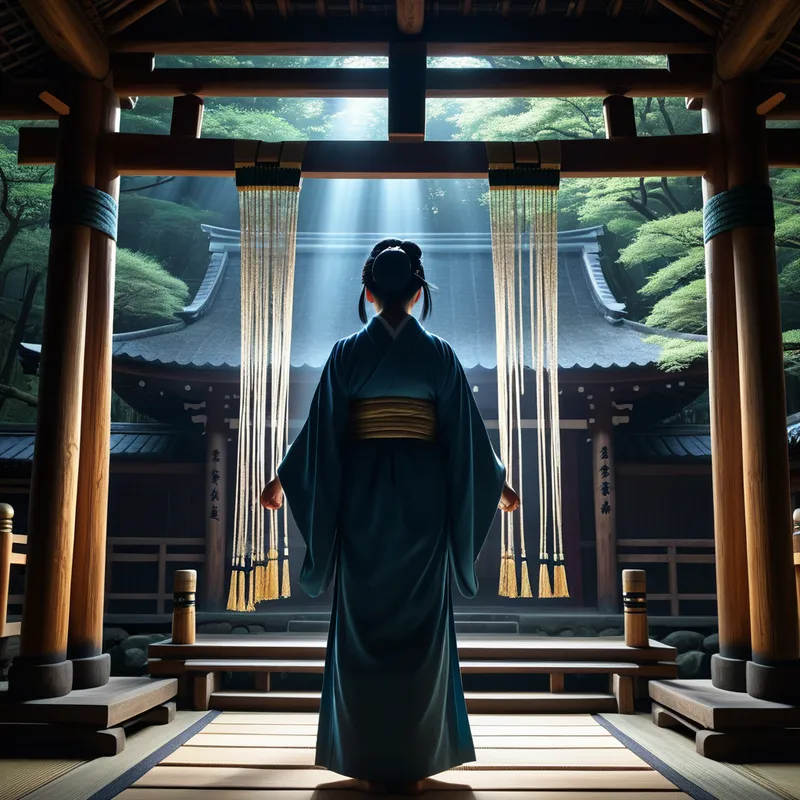
The ancient Shinto tale of the Musubi deities, whose sacred union births all existence through the creative, binding power of spiritual energy.
The Tale of Musubi Creative Spirit
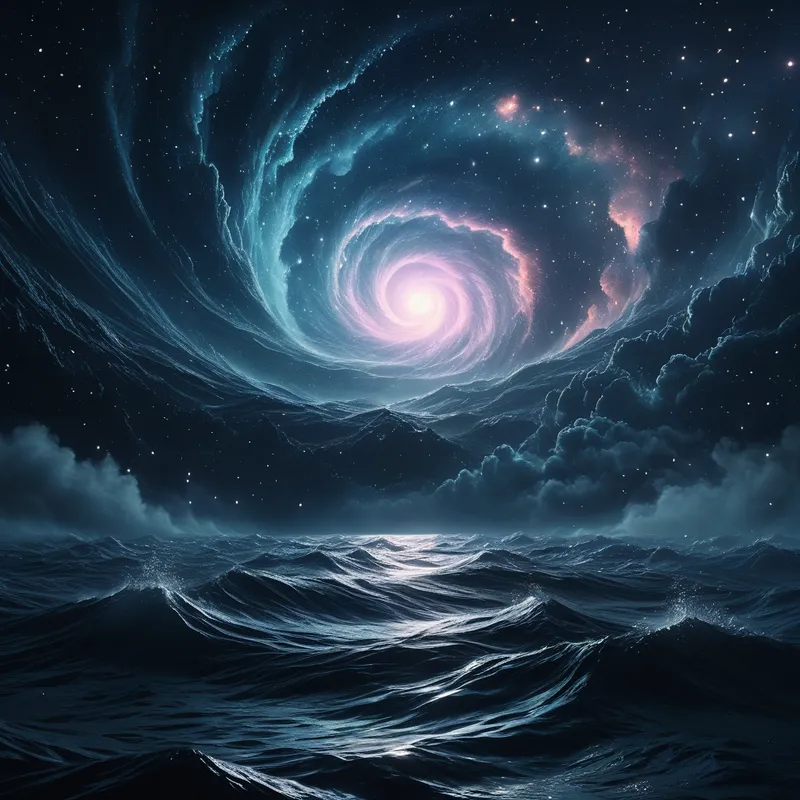
In the beginning, there was not silence, but a churning, nameless potential. The Takamagahara was yet unformed, and the earth below was a floating, oily chaos, like driftwood upon a primordial sea. From this fertile void, the first thing to come into being was not a shape, but a presence—a solitary, august spirit who named itself the Ame-no-Minakanushi-no-Kami, the Heavenly Central Master. It was a deity of pure, latent authority, a still point in the swirling nebula of possibility.
Yet, stillness alone cannot birth a world. From this central essence, two further divine presences emerged, not as separate beings, but as the first dynamic principles of the cosmos. They were the Takami-musubi-no-Kami, the High August Producing Musubi, and the Kami-musubi-no-Kami, the Divine Producing Musubi. Their essence was not flesh, but the very force of becoming. Musubu—to tie, to bind, to give birth.
Where the primordial chaos was formless, they were the urge to form. Where there was only potential, they were the sacred act of connection that makes potential real. They did not command the world into being with words, but wove it into being through relationship. Their creative energy was a silent, profound attraction, a spiritual gravity that drew the scattered elements of the universe toward one another.
From their sacred, generative interplay, the paired forces of the world began to crystallize. The next deities to emerge were not individuals, but couples: Umashi-ashikabi-hikoji-no-Kami and Ame-no-tokotachi-no-Kami, establishing the pillar of eternity. Then came more pairs, each representing a fundamental aspect of existence—the muddy earth, the sprouting reed, desire, and finally, the magnificent pair, Izanagi-no-Mikoto and Izanami-no-Mikoto, who were charged by the elder deities to "complete and solidify this drifting land."
Thus, armed with the Ame-no-nuboko given to them by the Musubi spirits, Izanagi and Izanami stood upon the Ame-no-ukihashi, the bridge between heaven and the chaos below. They stirred the brine with the spear, and as they lifted it, the drops that fell from its tip coagulated into the first island, Onogoro-shima. Upon this newborn land, they performed the great ritual of circumambulation, their meeting and union a direct enactment of the Musubi principle. From their union were born the Oyashima, the mountains, rivers, grasses, trees, and finally, the deities of wind, sea, mountain, and field. The world was not made from nothing, but from the sacred, creative binding of spirit to spirit, force to force, born from the original, generative breath of Musubi.
Cultural Origins & Context
This cosmogony is recorded in Japan's oldest chronicles, the Kojiki (712 CE) and the Nihon Shoki (720 CE). These texts were commissioned by the imperial court to establish a divine lineage for the sovereign, tracing it back to the sun goddess Amaterasu-Ōmikami, herself a descendant of Izanagi and Izanami, and thus, of the primordial Musubi.
The myth was not merely a story but a foundational ontology, preserved and recited by ritual specialists and court historians. Its societal function was profound: it explained the sacred nature of the Japanese archipelago (Ashihara no Nakatsu Kuni), the divine right of the emperor, and, most importantly, it established a worldview where the entire cosmos is alive (kami) and interconnected through generative, spiritual energy. The concept of musubi permeates Shinto practice, seen in the sacred ropes (shimenawa) that bind off holy spaces, in the rituals that seek to bind favorable outcomes, and in the understanding that relationships—between people, between people and nature, between humans and kami—are the fundamental creative fabric of reality.
Symbolic Architecture
At its core, the myth of Musubi presents creation not as a singular, external act, but as an ongoing, relational process. The primary deities are not anthropomorphic creators but personified principles of energy.
Creation is not an event that happened once, but a continuous verb in which we participate—the eternal act of tying spirit to matter, intention to form, and self to other.
The Takami-musubi-no-Kami represents the active, projective, and stimulating force—the spark of an idea, the initial impulse. The Kami-musubi-no-Kami represents the receptive, fertile, and formative force—the ground that receives the seed, the womb that nurtures the impulse into manifestation. Their interplay is the archetypal pattern of all creativity. The subsequent emergence of paired deities illustrates how reality itself is structured by complementary opposites (male/female, heaven/earth, permanence/change) held in creative tension by musubi.
Psychologically, Musubi represents the ego's capacity to connect disparate psychic contents. It is the function that binds a feeling to a memory, an intuition to an action, a complex to consciousness. It is the "aha!" moment of synthesis, where chaos finds a temporary, meaningful order.
The Dreamer's Resonance
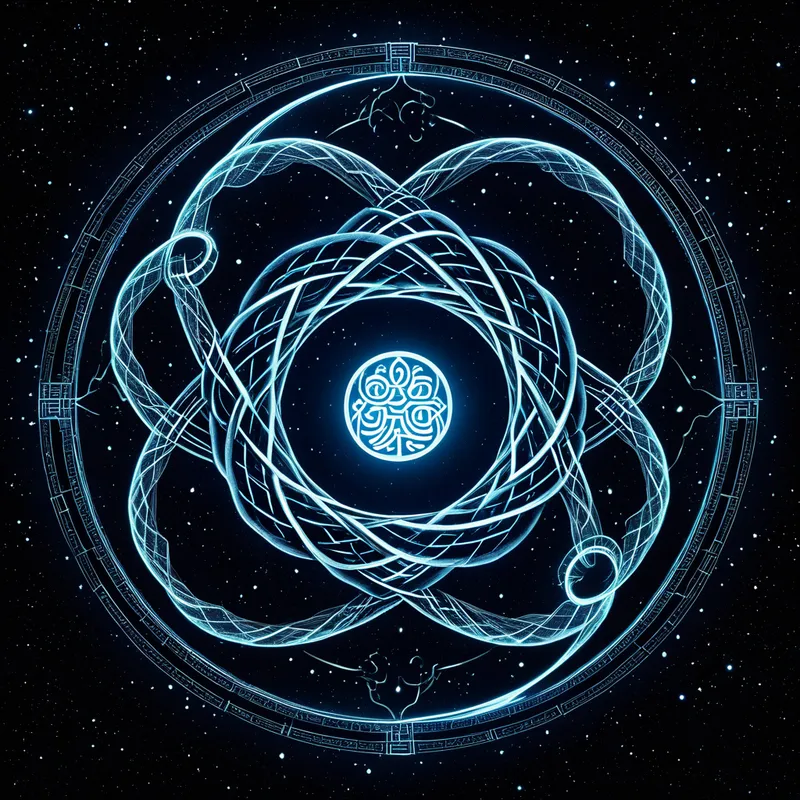
When the pattern of Musubi stirs in the modern unconscious, it often manifests in dreams of profound connection and creative emergence. One might dream of finding a simple object—a stone, a piece of string, a seed—that, when held, reveals itself to be a nexus point in a vast, luminous network. The dreamer may feel this object pulsing, and with that pulse, they sense connections to forgotten people, to landscapes, to future possibilities.
Somatically, this can accompany a feeling of warmth in the chest or solar plexus, a sense of energetic "quickening." Psychologically, it signals a phase where latent potentials within the psyche are seeking alignment and integration. The dreamer may be on the cusp of a new creative project, a deeper relationship, or a significant inner synthesis where previously conflicting parts of the self are ready to be "tied" together into a new, more cohesive whole. The dream is an affirmation from the deep psyche that the power to create, connect, and give birth to new forms of life and meaning is actively present.
Alchemical Translation
The individuation process, the journey toward psychic wholeness, is the ultimate human enactment of Musubi. It is the long, often arduous work of tying together the conscious ego with the contents of the personal and collective unconscious.
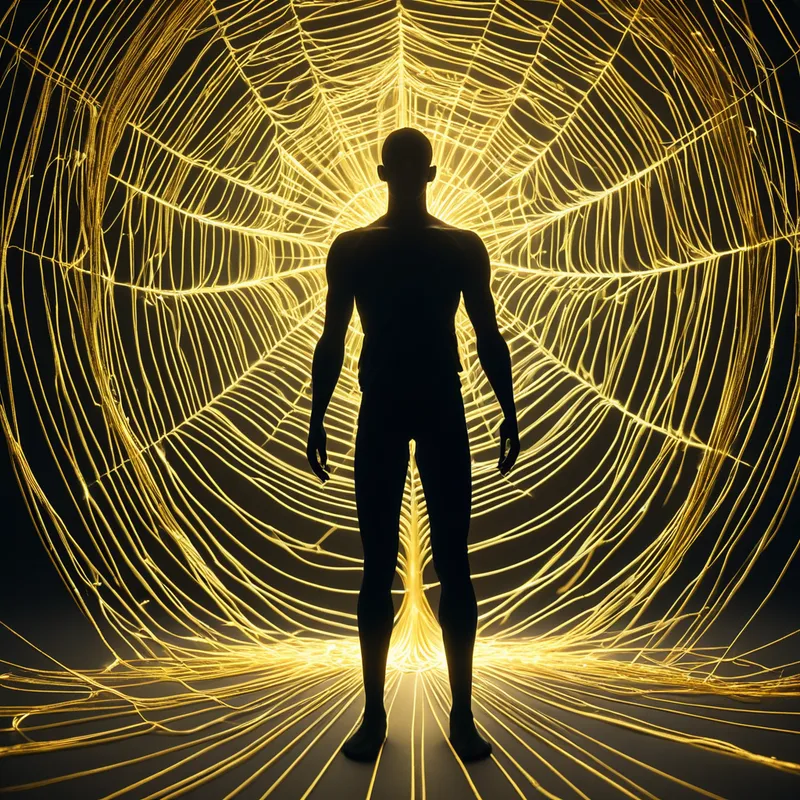
Individuation is the personal myth of Musubi: the Self weaving the scattered fragments of our experience into the singular, unique tapestry of a life.
The initial, solitary "Ame-no-Minakanushi" phase represents the undeveloped ego, a central but latent authority unaware of its creative potential. The emergence of the Musubi pair symbolizes the awakening of the dynamic tension between the conscious attitude (the active principle) and the unconscious (the receptive principle). Their "offspring"—the paired deities—are the myriad psychic complexes, archetypal patterns, and opposing traits (our inner masculine and feminine, our ordered and chaotic impulses) that we must recognize and relate to.
The gift of the Ame-no-nuboko to Izanagi and Izanami is akin to the ego receiving a tool from the deeper Self—perhaps a newfound insight, a therapeutic technique, or a symbolic image from a dream—to "stir the brine" of the unconscious. The resulting "island" is the first firm ground of a new conscious attitude, a nascent realization upon which one can stand to perform the sacred ritual of integration. Each act of understanding a complex, of reconciling an inner conflict, of giving creative form to a vague intuition, is a act of musubi. We are not creating ourselves from nothing, but from the sacred, creative binding of all that we are and have been.
Associated Symbols
Explore related symbols from the CaleaDream lexicon:
- Spirit — The fundamental essence of Musubi itself, representing the invisible, generative energy that binds and creates all things, the breath of life and connection.
- Water — The primordial chaos from which the Musubi spirits draw forth form, symbolizing the unconscious, the fertile, undifferentiated potential of the psyche.
- Bridge — The Ame-no-ukihashi, representing the critical threshold between non-being and being, the unconscious and consciousness, where creative acts are initiated.
- God & Goddess — The paired Musubi deities and all subsequent divine pairs, embodying the archetypal masculine and feminine principles whose sacred union is the engine of creation.
- Seed — The latent potential within the primordial chaos, activated and given form by the binding power of Musubi, symbolizing nascent ideas, talents, or aspects of the Self.
- Root — The foundational, originating power of the Musubi spirits, from which the entire manifest world and psychic reality grows and branches.
- Creation — The core action and purpose of Musubi, the continuous process of bringing the unmanifest into being through sacred connection and intention.
- Ritual — The structured enactment of Musubi, as performed by Izanagi and Izanami, through which formless potential is guided into tangible reality, both in myth and in personal practice.
- Circle — The sacred circumambulation performed by the creator deities, representing the cyclical, ongoing nature of creation, binding, and renewal inherent in the Musubi principle.
- Knot — The literal manifestation of musubu (to tie/bind), representing a point of concentrated creative energy, a sacred connection, or a complex synthesis of disparate elements.