Muspelheim's Sparks Myth Meaning & Symbolism
The primordial fire realm's sparks, cast by Surtr, ignite the world's creation and foretell its end, embodying the psyche's creative and destructive potential.
The Tale of Muspelheim's Sparks
Listen, and hear the tale of the First Fire and the seed of all that is.
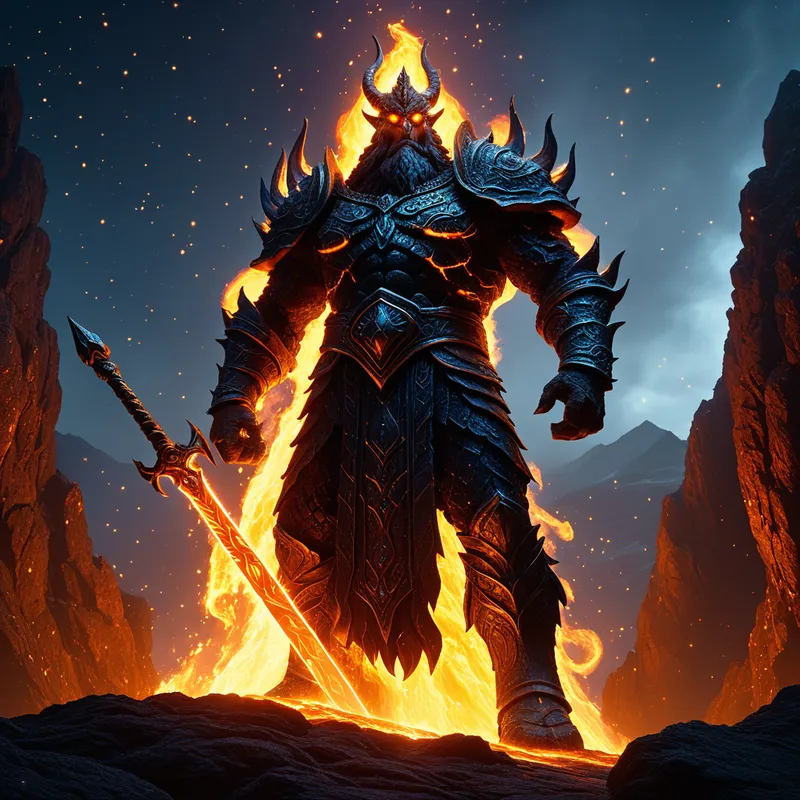
Before the worlds were shaped, there existed only the great void, Ginnungagap. To the north of this nothingness lay Niflheim, a realm of grinding ice, freezing fog, and rivers so cold they hissed with a silence that devoured sound. To the south blazed Muspelheim, a kingdom of eternal, roaring flame. Its ground was not earth but cracked and glowing stone; its air shimmered with heat that could melt thought. And there, at the border of this realm, stood its guardian, a being older than time itself: Surtr. He was a figure forged from the heart of the sun, cloaked in living flame, and in his hand he held a sword that burned brighter than a thousand forges.
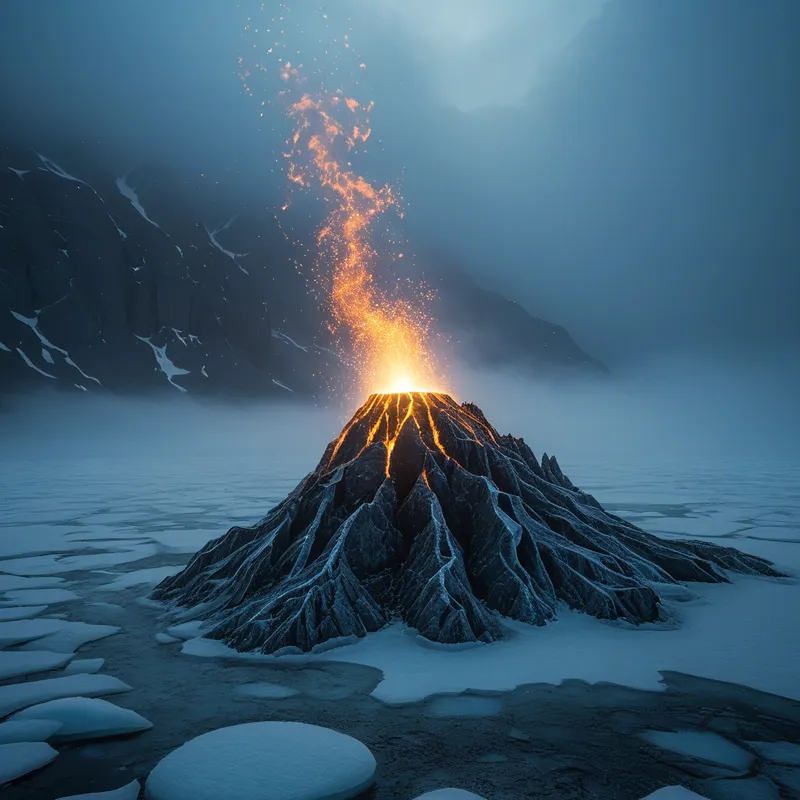
The silence of the void was not empty. It was a tension, a yearning. The bitter rivers of ice from the north crept forward. The radiant heat from the south pressed outward. And in that pressing, at the very lip of Muspelheim, where fire met the absolute cold of the gap, a miracle of violence occurred. Not with a crash, but with a hiss. Sparks, great and small, were flung from Surtr’s realm. They were not mere embers, but seeds of potential, fragments of pure, unbound cosmic fire. They flew like golden stars across the blackness of Ginnungagap.
They traveled through the endless night until they met the creeping tendrils of ice from Niflheim. And where a spark met the ice, the ice did not merely melt—it lived. The hissing steam coalesced, warmed by the fire’s gift, and from that dripping, rime-covered slush, the first being stirred. This was Ymir, the frost giant. And from the sweat of his sleeping form, more giants awoke. The sparks had done their work; they had ignited the process of being from non-being.
Yet the tale of the sparks does not end with a gentle dawn. They are a promise and a threat. For Surtr still stands, his sword ever-burning. The myths whisper that at the world’s end, at Ragnarök, he will march forth from Muspelheim at the head of his fiery host. He will cross the Bifröst, and it will shatter under his tread. His final act will be to raise that same sword, the source of the first sparks, and set all the worlds aflame, burning the old cycle to ash so that a new green world can rise from the soot. The first gift and the final judgment are born from the same flame.
Cultural Origins & Context
This myth forms the foundational cosmology of the Norse worldview, primarily preserved in two 13th-century Icelandic texts: the Prose Edda by Snorri Sturluson and the older, poetic verses of the Völuspá (The Seeress's Prophecy). It is crucial to remember these were written down centuries after the Nordic peoples had converted to Christianity; Snorri was a Christian scholar attempting to systematize a fading pagan tradition for poets.
The story was not a simple bedtime tale. It was a sacred narrative explaining the origin and inevitable fate of the cosmos. It would have been recited by skalds (poets) and perhaps invoked in ritual contexts, reinforcing a cultural psyche that understood existence as cyclical, dynamic, and fundamentally precarious. The world was not created from nothing by a benevolent deity, but from a violent, impersonal collision of opposing elemental forces—fire and ice. This reflects a lived reality in a harsh Northern climate, where survival depended on mastering fire to ward off the lethal cold. The myth legitimized a worldview where creation and destruction were two sides of the same coin, and where even the gods were subject to this immutable, fiery logic.
Symbolic Architecture
The Sparks of Muspelheim are not literal fire; they are the primordial symbol of activated potential. They represent the initial catalytic impulse that disrupts stasis and forces being into existence.
The spark is the moment of consciousness igniting in the void of the unconscious, the painful yet necessary idea that ends complacency, the surge of passion that melts frozen emotion.
Muspelheim itself symbolizes the raw, undifferentiated energy of the psyche—the libido, the drive, the passionate and often destructive force of the instincts. Niflheim is its absolute opposite: stagnation, inertia, frozen trauma, and unconscious latency. The void, Ginnungagap, is the potential space where the psyche's drama unfolds. Surtr is the archetypal guardian of this fierce, creative power. He is not evil; he is absolute. He is the psychological function that both initiates life (by casting the sparks) and demands the death of outworn structures (at Ragnarök). The myth tells us that life itself begins with a traumatic, heating event—a spark that forces frozen potential to move, to drip, to become something, even if that something is initially monstrous (like the giant Ymir).
The Dreamer's Resonance
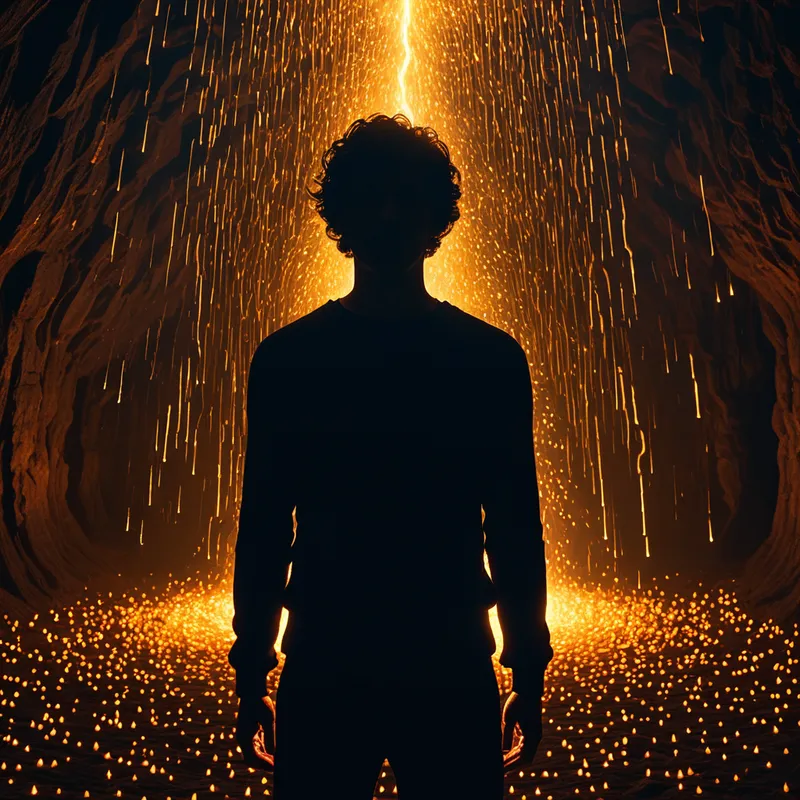
When this myth pattern stirs in the modern dreamer, it often manifests as dreams of sudden, illuminating, or destructive fire. A single spark landing on a carpet of dry leaves in a vast, dark forest. The controlled flame of a welder's torch fusing two separated pieces of metal within the dreamer's own body. A house fire where one room is consumed, revealing a stronger foundation beneath.
Somatically, this can correlate with a sudden "heating up"—a fever, inflammation, or a rush of adrenaline upon waking. Psychologically, the dreamer is experiencing the catalytic moment in a process of inner change. The "ice" of Niflheim represents a frozen state: depression, creative block, emotional numbness, or a rigid life pattern. The spark is the intrusive, often uncomfortable insight, the burst of anger that breaks a pattern of passivity, the sudden creative vision, or the acute awareness of a deep need. The process is rarely gentle. The melting of psychic ice can feel like a flood of overwhelming emotion or chaotic energy. The dream is signaling the end of stasis and the painful, necessary beginning of formation.
Alchemical Translation
In the alchemical journey of individuation—the process of becoming psychologically whole—the myth of Muspelheim's Sparks maps directly onto the initial stage, nigredo or the blackening. This is the crucial first step where the prima materia (the raw, unconscious self) must be "heated" and broken down.
The psyche's Ragnarök is not a punishment, but a prerequisite for rebirth. The ego, identified with the current world-order, must be burned by the truth of the Self.
The modern individual lives in various states of "frozen" adaptation: personas, complexes, and defenses that have congealed into a seemingly solid identity (Niflheim). The "spark" is the arising of the Self, the total psyche, which often first appears as a disruptive symptom: a burning anxiety, a consuming passion, a depression that feels fiery in its numbness, or a profound sense of meaninglessness that scorches old certainties. This is Surtr's gift. The individual's task is not to extinguish this spark out of fear, but to contain its heat in the vessel of conscious attention—to allow it to melt the frozen aspects of the personality without letting the entire psychic structure be consumed in uncontrolled conflagration (psychosis, destructive acting out).
The ultimate goal is not to avoid the final fire, but to understand that one's personal "Ragnarök"—the end of an old life phase, identity, or belief system—is modeled on this cosmic principle. By consciously engaging with the fiery, transformative energy within (the sparks of insight, courage, and painful truth), we align ourselves with the creative-destructive cycle of the cosmos itself. We move from being passive victims of fate to active participants in our own perpetual becoming, forging ourselves in the very fires that first gave us life.
Associated Symbols
Explore related symbols from the CaleaDream lexicon: