Music of the Spheres Myth Meaning & Symbolism
An ancient belief that the celestial bodies move in divine, mathematical harmony, creating a silent symphony that is the foundation of all reality.
The Tale of Music of the Spheres
Listen. Not with your ears, but with the bone at the base of your skull. Before time was counted, when the sky was a dark and fathomless ocean, the great architect surveyed the void. From the formless potential, the first note was struck—a deep, foundational hum that was not a sound, but the very idea of vibration. This was the birth of The One.
From that singular tone, differentiation began. The architect, whom some call the Demiurge, and others simply the Mind, began to spin. He took the raw substance of being and stretched it upon the loom of necessity, measuring it with the unbreakable rules of geometry. Each measured length sang a different pitch. The fastest, brightest spin became the sphere of the fixed stars, a brilliant, high choir holding the outermost rim of creation. Inside that crystal shell, he set other spheres to turning, each at its own ordained and perfect speed.
One for Kronos, slow and profound, its bass note the groan of deep time. Another for Zeus, a resonant, kingly tone. Then one for Ares, a fierce and driving rhythm. The sphere of the Sun, Helios, blazed at the center, its note a pure, golden middle C, the heart of the harmony. Inside spun the spheres for Aphrodite, whose note was sweet and compelling, for Hermes, quick and chattering, and for the Moon, Selene, whose silvery, high note was the closest to the Earth.
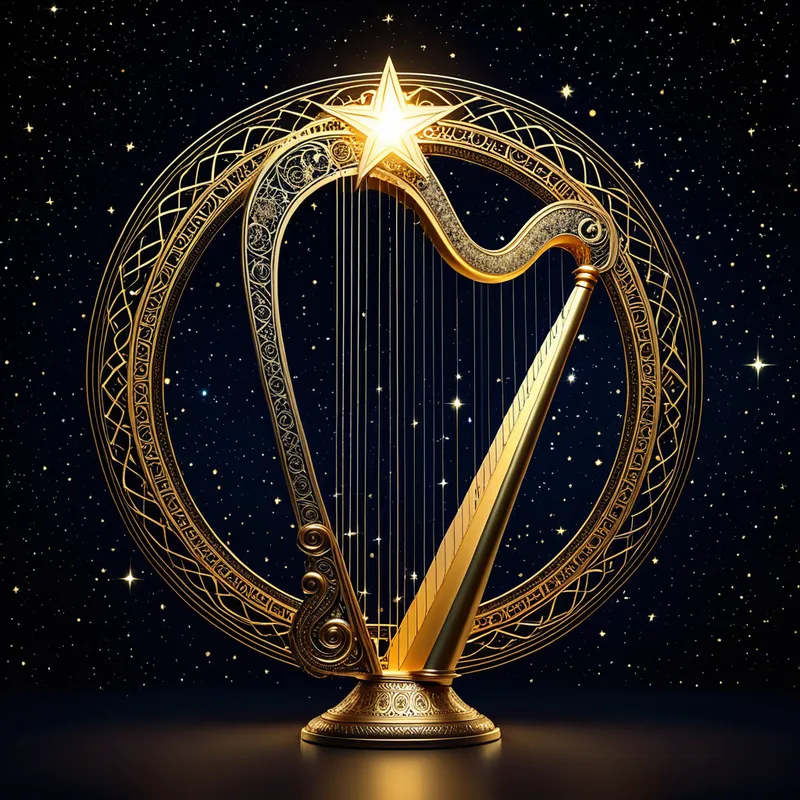
And so the cosmos was not silent machinery, but a living, breathing instrument—a great lyre of unimaginable scale. The spheres, turning in their perfect, interlocking ratios, generated a symphony of such sublime complexity and beauty that it was the very music of truth itself. It was the logos made audible, the mathematical mind of the universe expressing itself in song.
But here lies the sorrow, and the mystery. We, the children of clay, born on the static, silent Earth at the center, are deaf to it. Our ears are stoppered with the mud of matter, our souls dulled by the clamor of the senses. The most beautiful sound in all of creation pours over us every moment of our existence, and we hear only silence. Only in rare moments—in the ecstasy of pure thought, in the clarity of a perfect mathematical proof, or in the deepest, most forgotten chamber of the dreaming soul—does a faint echo of that celestial chord reverberate. A haunting memory of a home we have never seen, a harmony we have never heard, yet without which we would be utterly lost.

Cultural Origins & Context
The myth of the Music of the Spheres is not the property of a single tribe, but a profound intuition that emerged independently across civilizations, finding its most formal philosophical expression in the ancient Greek world. Its earliest seeds are in Pythagoras and his secretive school in the 6th century BCE. For the Pythagoreans, number was the essence of all things. Discovering that musical intervals could be expressed in simple numerical ratios (like 2:1 for the octave), they extrapolated this harmony to the cosmos. The planets, moving at different distances and speeds, must also produce notes based on their ratios, creating a "cosmic octave."
This idea was poetically solidified by Cicero and philosophically enshrined by Plato in his Republic (the Myth of Er) and Timaeus. It was further developed by later thinkers like Johannes Kepler in the 17th century, who, in a beautiful fusion of mysticism and nascent science, attempted to calculate the actual musical notes of the planets based on their orbital velocities. The myth was passed down not as a folktale, but as a philosophical and metaphysical doctrine among scholars, astronomers, and mystics. Its societal function was to provide a model of a rational, beautiful, and ordered universe—a cosmos governed by divine mathematics, offering a profound antidote to chaos and a template for harmony in human society and the individual soul.
Symbolic Architecture
At its core, the myth symbolizes the fundamental belief that reality is not chaos, but a hidden, intelligent order. The "music" is the audible symbol of the Logos—the underlying rational principle that structures everything from the orbit of galaxies to the growth of a leaf. The deafness of humanity represents our fallen state, our alienation from this fundamental truth due to our immersion in the material, the temporal, and the egoic.
The greatest symphony is played for an audience that has forgotten how to hear. Our spiritual task is not to create the music, but to remember the faculty with which to perceive it.
The celestial spheres represent the layered structure of reality and the psyche itself. The outermost sphere of fixed stars is the archetypal realm, the world of perfect, eternal forms. The inner planetary spheres are the mediating principles, the archetypes as they manifest in time and space, each with its own psychological "tone" (e.g., the assertive drive of Mars, the unifying love of Venus). The silent Earth at the center is the embodied ego, the seat of consciousness that feels separate and isolated from the glorious harmony it inhabits.
The Dreamer's Resonance
When this myth stirs in the modern unconscious, it rarely appears as literal planets singing. Instead, one might dream of being in a vast, architecturally perfect space—a grand cathedral, a cosmic library, or a silent concert hall—where a tremendous vibration is felt in the chest and bones, but no sound is heard. There is a profound sense of awe, longing, and sometimes frustration. One may dream of intricate, glowing geometric patterns that pulse with a silent rhythm, or of finding a forgotten instrument that, when touched, makes the very air shimmer.
These dreams signal a somatic and psychological process of re-attunement. The dreamer's psyche is grappling with dissonance—a life out of sync, a feeling of fragmentation, a nagging sense that something essential is missing. The silent music is the call of the Self, the central archetype of wholeness. The dream is an invitation to move from the noisy periphery of one's concerns (the "Earth") toward the silent, harmonizing center. It is a process of listening inward, of seeking the mathematical truth of one's own nature beneath the chaotic narrative of daily life.

Alchemical Translation
The alchemical work modeled by this myth is the transmutation of perception. The base metal is our ordinary, fragmented consciousness, deafened by the mundus imaginalis of personal complexes, societal noise, and sensory overload. The goal is not to escape the world, but to hear the world as it truly is: an ordered, meaningful, and beautiful expression of a unifying principle.
The first stage (nigredo) is the acknowledgment of our deafness—the melancholic realization that we are missing the essential melody of our own existence. The second (albedo) is the purification of the "inner ear" through contemplation, study, art, or analysis—clearing away the psychic debris to perceive the underlying patterns. The third (rubedo) is the glorious moment of integration, where one suddenly "hears" the harmony. This is not a literal auditory hallucination, but a cognitive-emotional shift where one's life, with all its struggles, is perceived as a necessary and beautiful note in a larger composition.
Individuation is the process by which the ego, the silent Earth, learns to resonate with the specific pitch of its own sphere, finding its unique place in the cosmic chord.
The triumphant philosopher on the cliff, who seems to hear the music, has achieved the Philosopher's Stone. He has not changed the music; he has changed himself. He has aligned his soul's vibration with the cosmic scale, transforming leaden isolation into golden participation. For the modern individual, this is the journey from chaos to cosmos—from being a discordant note of anxiety to becoming a conscious, harmonious participant in the great and silent song of all that is.
Associated Symbols
Explore related symbols from the CaleaDream lexicon: