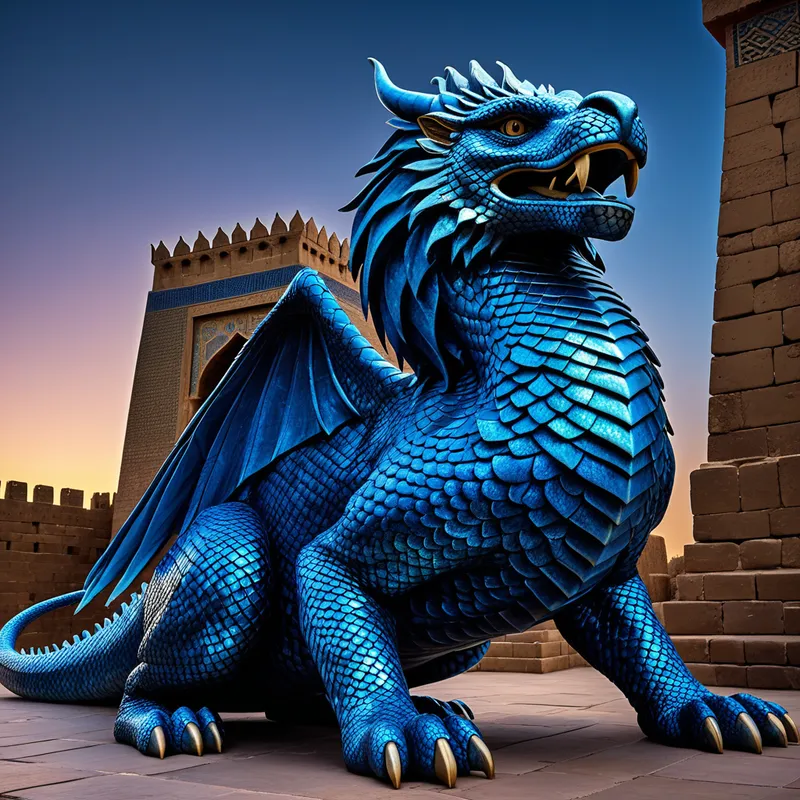
Mushussu Myth Meaning & Symbolism
A divine, composite dragon-serpent, servant of gods, embodying the primal chaos that must be mastered to forge cosmic and inner order.
The Tale of Mushussu
Hear now, and let the dust of forgotten cities stir. Before the walls of Babylon were raised, when the world was younger and wetter with the blood of older gods, there was a being of the first mud and the first fire. Its name was whispered in fear: Mushussu.
It was born not of a womb, but of the churning, formless deep, the Tiamat. Its body was a congress of kingdoms: the scaled, coiling might of the serpent, wise with the earth’s oldest memories; the powerful, clawed forelegs of the desert lion, king of the tangible world; the keen, taloned hind legs of the imperial eagle, lord of the sky and vision. Its head was crowned with horns, and its tongue flickered with a sound like dry reeds in a hot wind. It was chaos given a magnificent, terrible form. It served the old powers, a guardian of thresholds no mortal was meant to cross.
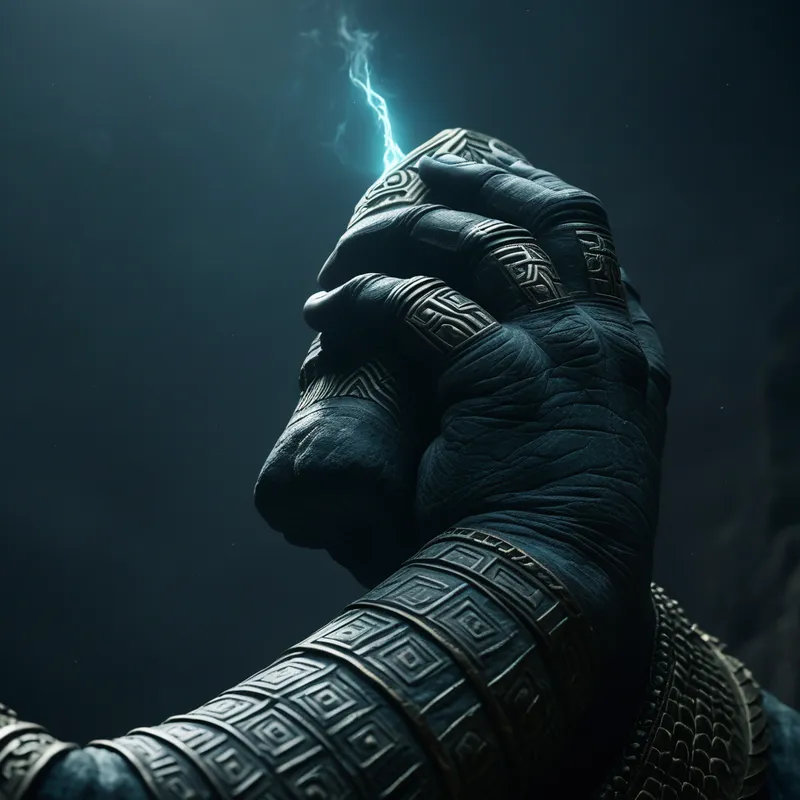
Then came the storm. The young god Marduk, armed with the winds and lightning, rode forth to battle the primal mother, Tiamat. The cosmos itself was the prize. In that titanic struggle, the Mushussu was there, a roaring, slashing testament to the old, wild order. It fought with the fury of the un-tamed world. But Marduk was cunning and mighty; he cast his net of divine law, he unleashed the seven winds, and he prevailed.
Yet, the story does not end in slaughter. Marduk, now sovereign, looked upon the defeated dragon. He saw not merely a monster to be slain, but a power to be reckoned with. In a gesture of supreme kingship, he did not destroy the Mushussu. Instead, he mastered it. He bent its wild essence to his will, not breaking its spirit, but redirecting its formidable nature. From a symbol of rebellious chaos, the Mushussu was transformed into the ultimate symbol of legitimate, ordered power. It became Marduk’s sacred animal, and later, the devoted companion of his divine son, Nabu.
And so, the creature of the abyss came to grace the Processional Way of Babylon. Its image, glazed in lapis lazuli and gold, stared from the bricks of the Ishtar Gate. Where once it roared for chaos, it now stood silent and majestic, a guardian of the city’s divine law. It had passed through the crucible of conflict and emerged, not annihilated, but appointed. Its very presence at the gate proclaimed a profound truth: true sovereignty is not the absence of chaos, but the integration of its raw power into the fabric of order.
Cultural Origins & Context
The Mushussu is not a creature of a single, tidy narrative, but a potent symbol woven through millennia of Mesopotamian thought, from the Sumerian to the Babylonian empires. Its earliest depictions likely connect to the Sumerian god Ninazu, but its most famous association is with Marduk, the national god of Babylon. This shift mirrors Babylon’s own political rise, appropriating and re-contextualizing older symbols into its new cosmic order.
The myth was not merely a story told in temples; it was architecture, politics, and identity cast in clay and glaze. The Enuma Elish, recited during the New Year festival (Akitu), reinforced Marduk’s—and by extension, the king’s—right to rule through his victory over chaos. The Mushussu’s image on the Ishtar Gate was a permanent, public declaration of this divine order. To walk beneath it was to submit to and be protected by a power that had conquered the primordial wild. It was a symbol of the civilization’s triumph over the untamed forces of nature and disorder, a divine mandate made visible.
Symbolic Architecture
The Mushussu is a living hieroglyph, a composite being whose very anatomy is a map of symbolic territories. It represents the undifferentiated, primal power of the unconscious—the psychoid realm—before it is split into manageable categories.
The dragon is the unmediated totality of instinct, a congress of all the animal kingdoms within the human soul before the ego builds its walls.
Its serpentine body speaks of chthonic wisdom, the deep, coiled knowledge of the earth and the unconscious. The lion’s forelegs embody raw, terrestrial power, courage, and passionate affect. The eagle’s hind legs grant the capacity for lofty perspective, spirit, and transcendent vision. Together, they form a triune being: of the below, the here, and the above. It is the prima materia of the psyche—powerful, awe-inspiring, and potentially destructive if left in its original, unallied state.
Its transformation from agent of chaos to servant of divine order is the central symbolic act. It does not cease to be powerful; its power is claimed and channeled. This represents the psychological process of integrating the shadow—not eliminating our raw, instinctual, or “monstrous” parts, but bringing them into conscious relationship with the ruling principle of the psyche (the ego, in alignment with the Self). The Mushussu at the gate is the integrated shadow, the once-wild instinct that now guards the threshold of consciousness.
The Dreamer's Resonance
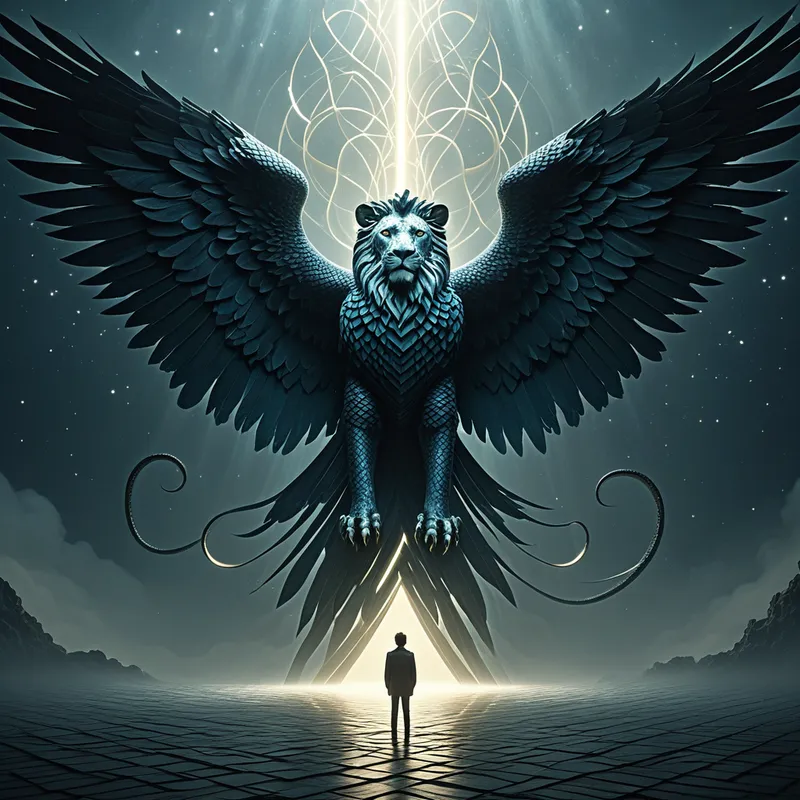
When the Mushussu slithers into the modern dreamscape, it rarely appears as a museum relic. It manifests as a overwhelming, composite creature in a landscape of personal upheaval. You may dream of a being that is part your deepest fear, part your repressed anger (the lion), part your intuitive, slippery knowing (the serpent), and part your most soaring ambition or spiritual longing (the eagle). It may block your path or seem to guard a magnificent, forbidden gate.
This dream signals a somatic and psychic confrontation with one’s own undifferentiated power. The body may feel it as a tightening in the gut (serpent), a pounding heart (lion), or a feeling of weightlessness or anxiety (eagle). Psychologically, you are facing a complex that is too large, too primal, for your current conscious attitude to handle. It is the chaos of a major life transition, a surge of creative energy that feels monstrous, or the aggregated force of unlived life demanding recognition. The dream asks: What raw, chaotic power within you is rising, and how will you relate to it? Will you flee, fight, or, like Marduk, find a way to master and ally with it?
Alchemical Translation
The myth of the Mushussu is a precise blueprint for the alchemical coniunctio and the Jungian process of individuation. The initial state is chaos (the unintegrated psyche, the rule of complexes). The conflict with Marduk represents the necessary nigredo, the dark night of the soul where the conscious self confronts the terrifying, magnificent totality of the Self.
The victory is not in the slaying of the beast, but in the transformation of the relationship between the sovereign and the instinctual.
Marduk’s act of mastering, not killing, the dragon is the albedo. It is the moment of insight where we see our “monsters” not as enemies to be destroyed, but as disowned parts of our own potency waiting to be redeemed. The final state, the Mushussu gleaming on the Ishtar Gate, is the rubedo—the embodiment of achieved, embodied wholeness.
For the modern individual, this translates to a profound inner shift. It is the process of moving from being possessed by our chaotic emotions and drives (the dragon runs wild) to taking possession of them. We learn to “ride the dragon.” The fierce passion of the lion becomes directed courage. The deep, often unsettling wisdom of the serpent becomes grounded intuition. The lofty detachment of the eagle becomes clear-sighted perspective. The Mushussu, once a symbol of terror, becomes the guardian of our deepest authenticity, a living emblem that our greatest power lies in the integration of all that we are.
Associated Symbols
Explore related symbols from the CaleaDream lexicon: