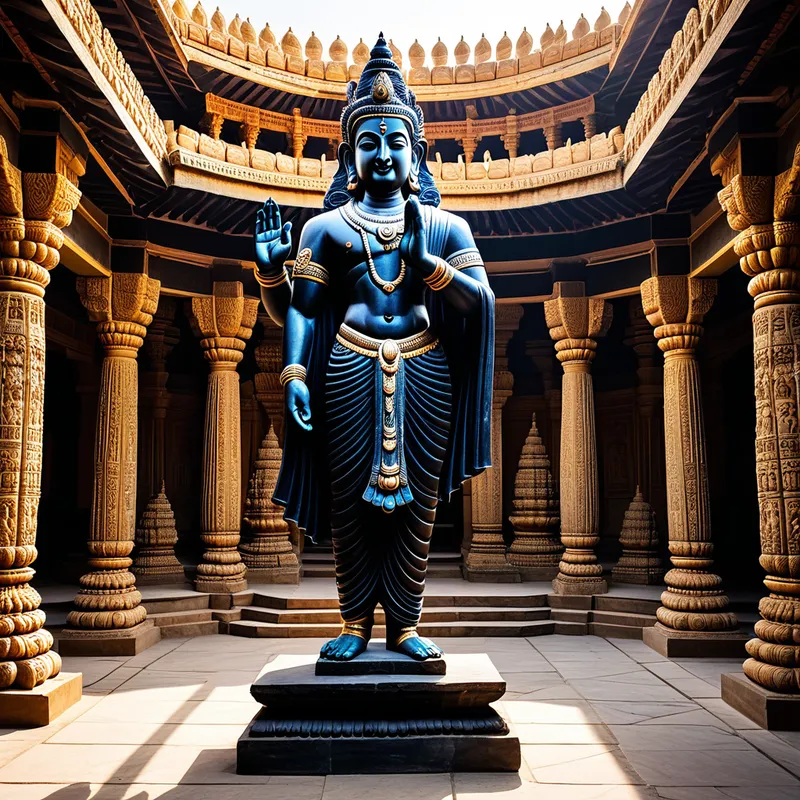
Murti Myth Meaning & Symbolism
The story of how the formless divine, through compassion for human longing, consented to be held in form, creating a bridge for the soul's communion.
The Tale of Murti
In the beginning, before names and forms, was the One—vast, silent, and complete. It was the hum of potential, the breath between thoughts, the boundless ocean of being. From this ocean, the worlds arose: the dance of stars, the sigh of mountains, the quickening of life in the dark soil. And with life came a peculiar longing, a sweet ache in the heart of the human creature.
They looked upon the grandeur of a storm and felt awe. They witnessed the tender unfurling of a leaf and felt wonder. In the stillness of the night, they felt a presence, immense and intimate, yet utterly beyond grasp. They yearned to speak to it, to offer it the first fruits of their harvest, the fragrance of their flowers, the music of their hearts. But how does one address the wind? How does one clasp the horizon?
Their prayers were whispers lost in the sky. Their love had no place to land. A great sorrow settled upon the earth, the sorrow of a child calling for a parent in an empty house. This sorrow, this pure and desperate love, did not go unheard. It rose like incense through the layers of reality, a fragrance so poignant it stirred the very heart of the formless.
And so, the divine, moved by an compassion deeper than any ocean, chose to bend. Not to diminish, but to bridge. A voice, not of thunder but of tender gravity, spoke within the hearts of the sages and the artists: "Make a form for me."
Trembling, they asked, "But how can we, with hands of clay, shape that which has no shape? How can we, with minds of fleeting thought, conceive the inconceivable?"
The voice replied, "Use the elements of my own body. Take earth, the dust of stars. Take water, the flow of time. Take fire, the spark of consciousness. Take air, the carrier of song. Take space, the womb of all. Assemble them with love, and I will enter."
And so, under the guidance of the sacred Shilpa Shastras, the first hands went to work. A sculptor found a stone that had waited a million years for this moment. A painter mixed pigments with devotion. A chanter found syllables that were not words, but vessels. They worked not as creators, but as midwives.
Then came the moment of Prana Pratishtha. The air grew thick and still. The crafted form—a curve of a smile, a gesture of a hand, the gaze of an eye—sat in expectant silence. The chief priest, his own self emptied, became a conduit. With mantra and ritual, with water, breath, and the final opening of the eyes with a golden needle, he issued not a command, but an invitation from all of creation.
And the divine consented.
It was not a crashing descent, but a gentle filling, like dawn flooding a valley. The stone did not move, yet it was no longer just stone. The painted eyes did not blink, yet they saw into the soul. The form was there, solid, beautiful, available. The boundless had chosen a shore upon which the human heart could wash its love. The first devotee approached, tears of recognition streaming down their face, and placed a flower at its feet. The flower was received. The bridge was crossed. The Murti was born.
Cultural Origins & Context
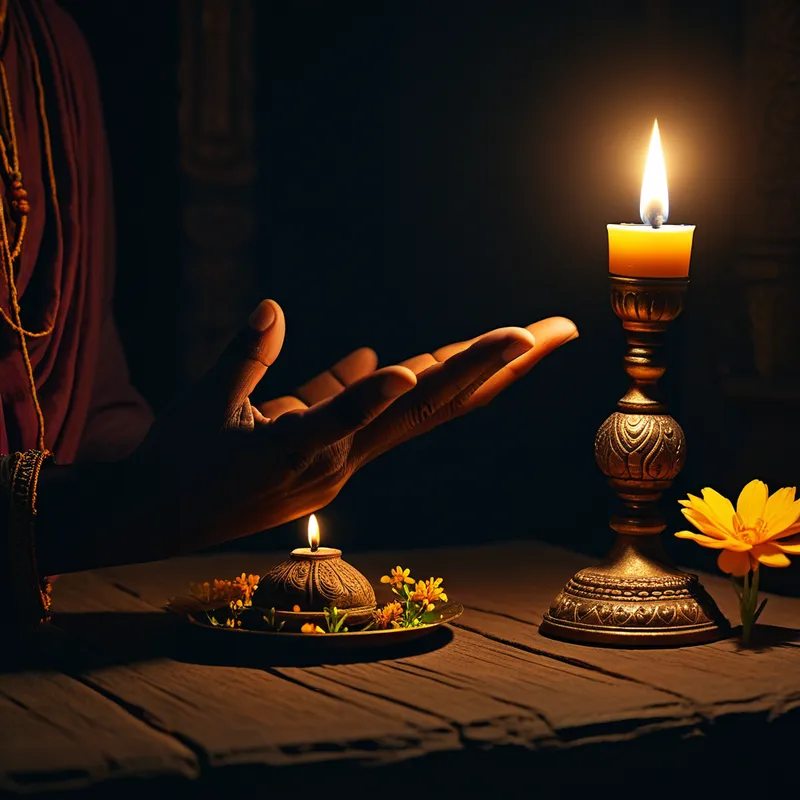
The concept and practice surrounding the Murti are not the product of a single mythic event but are woven into the very fabric of Sanatana Dharma. Its origins lie in the ancient Vedic shift from purely aniconic worship of natural forces (Agni as fire, Surya as the sun) to the need for a more intimate, personal focus for devotion, a process that blossomed fully in the Puranic and Bhakti periods.
The mythic rationale for the Murti is found scattered across texts like the Puranas and the Bhagavad Gita, where the divine explicitly offers itself in forms accessible to human minds. This was not a theological decree handed down, but a living, breathing tradition passed from guru to shishya, from master sculptor to apprentice, and most importantly, from the heart of one devotee to another in the silent language of darshan—the sacred act of seeing and being seen by the divine. Societally, the temple and its central Murti became the axis mundi of the community, a place where cosmology, art, social order, and individual longing converged. It democratized the divine encounter, making it available to the prince and the peasant alike, provided they came with a sincere heart.
Symbolic Architecture
At its core, the myth of the Murti is a profound dialogue between the Absolute (Nirguna Brahman) and the Relative (Saguna Brahman). It symbolizes the ultimate act of divine compassion: making the unknowable known, not by reducing its essence, but by clothing it in the grammar of human perception.
The Murti is not God captured, but the human mind provided a harbor in which the ocean of God can be contemplated.
Psychologically, it represents the essential human need to project inner, unconscious contents—the Self, in Jungian terms—onto an external form to begin a relationship with it. The raw, overwhelming power of the archetype is too much for the conscious ego to bear directly. The Murti acts as a transformer, stepping down the infinite voltage of the numinous into a voltage the human psyche can withstand and engage with. The crafted form—its symmetry, its mudras (symbolic hand gestures), its serene expression—provides a container. This container holds not a literal god, but a focal point for the devotee's own latent wholeness, their own divine essence, which is otherwise too abstract to grasp.
The ritual of Prana Pratishtha is the key symbolic act. It marks the transition from artifact to archetype, from symbol to living symbol. It signifies the moment when a collective and individual psychic investment becomes so potent that the symbol becomes psychically real, capable of affecting the inner world of the believer. It is the ritualized enactment of giving a face to the faceless forces of the soul.
The Dreamer's Resonance
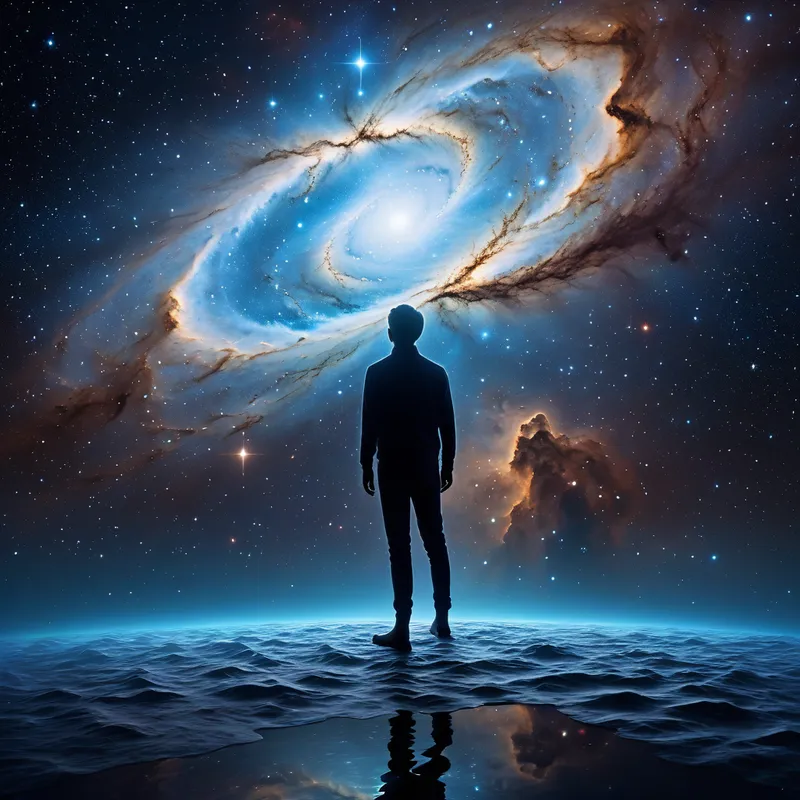
When this mythic pattern stirs in the modern dreamer, it often signals a profound somatic and psychological process: the longing for concretion in a world of abstraction. The dreamer may encounter a powerful but vague presence—a feeling of immense love, a creative impulse, a guiding force, or even a terrifying shadow. This presence feels real and impactful, but formless, like an anxiety without a source or an inspiration without a medium.
Dreams of finding a strangely potent object (a stone, a piece of wood, a forgotten statue) and feeling an urge to "awaken" it, clean it, or bring it home are modern echoes of the Murti myth. The dreamer is grappling with a powerful content of the unconscious that is seeking to become conscious, to take a form that can be related to. It is the psyche's attempt to build its own altar.
Somatically, this can feel like a restless energy seeking shape—a tension in the hands that want to make, a pressure in the chest that wants to express, a fog in the mind that seeks an image. The psychological process is one of personification. The dreamer is moving from being passively affected by unnamed forces (depression as a "cloud," anxiety as a "knot") towards being able to relate to them as inner figures with whom one can dialogue, negotiate, and ultimately integrate.
Alchemical Translation
The alchemical journey modeled by the Murti myth is the very process of individuation: the transformation of the prima materia of raw, unconscious psychic energy into the lapis philosophorum of the realized Self. It outlines a precise psychic operation.
First, there is the Longing (The Sorrow of the Devotee): This is the initial, often painful, recognition of a disconnect—a feeling that one's life lacks meaning, depth, or connection to something greater than the ego. It is the nigredo, the dark night of the soul, where the formless divine feels absent.
Second, the Invitation (The Divine Consent): This is the crucial turning point, where the ego, in humility, stops demanding the unconscious conform to its will and instead invites it to reveal itself. It is the shift from "I need to figure myself out" to "What in me is seeking to come into form?" This is an act of surrender that paradoxically grants agency.
Third, the Crafting (The Work of the Shilpin): This is the conscious work of giving form. In therapy, this is speaking the unspeakable feeling. In art, it is painting the vague vision. In life, it is making a concrete choice that aligns with a vague value. It is using the "elements" of one's life—memory, emotion, skill, relationship—to build a container. This is the albedo, the whitening, where things begin to take shape.
Finally, the Infusion (Prana Pratishtha): This is the moment of integration, when the crafted form—the new habit, the understood complex, the created artwork, the conscious relationship pattern—ceases to be just an exercise and becomes ensouled. It takes on a life of its own and begins to feed back into the psyche. The bridge is complete. Energy flows. What was projected outward (onto a therapist, an ideal, a god) is recognized as an inner reality. This is the rubedo, the reddening, the culmination where the sacred is realized not in a temple, but in the temple of one's own embodied existence.
The ultimate Murti, fashioned by the alchemy of consciousness, is the individual life itself—a unique, imperfect, and beautiful form through which the impersonal divine consciously experiences its own creation.
Associated Symbols
Explore related symbols from the CaleaDream lexicon: