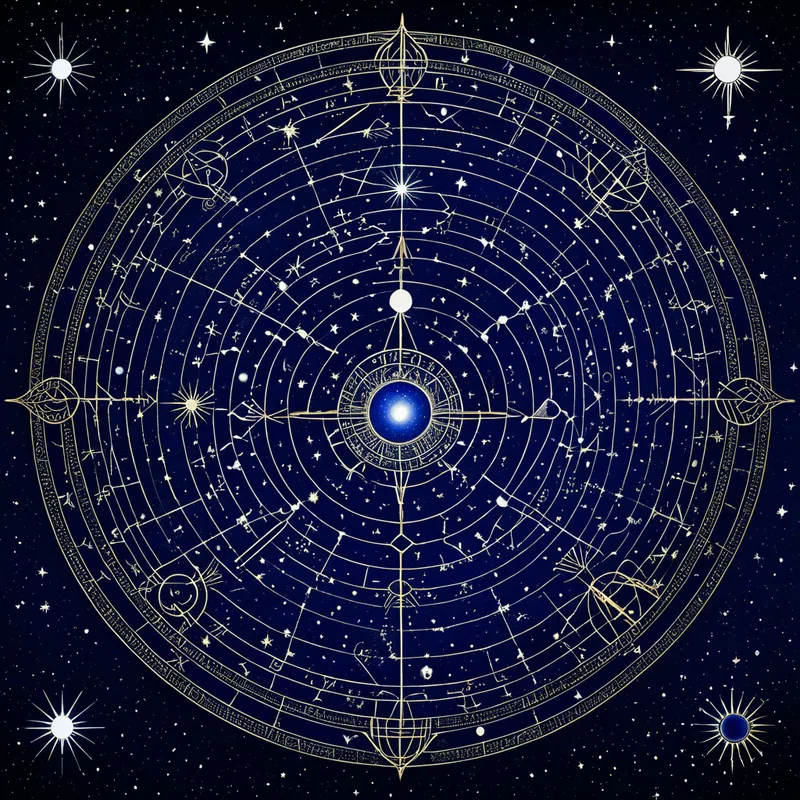
MUL.APIN Myth Meaning & Symbolism
A Babylonian celestial compendium and mythic narrative mapping the heavens, establishing divine order from primordial chaos, and guiding the soul's navigation of fate.
The Tale of MUL.APIN
Listen, and let your spirit ascend to the vault of heaven. Before the first king, before the first brick of Esagila was laid, there was the dark, sweet water of Apsu and the salt-churning sea of Tiamat. From their mingling, the gods were born, and with them, chaos—a writhing, unbounded expanse where no law held sway, not even the law of time.
Then came the Plow. Not of earth, but of heaven. The great gods—Anu of the high zenith, Enlil of the commanding middle, and Ea of the deep abyss—took their stations. They did not conquer with thunder, but with measure. With the unblinking eye of the scholar-priest, they fixed their gaze upon the ceaseless dance of the Sebettu. They saw not random sparks, but a herd of luminous wild bulls, charging in great, looping paths across the black field of night.
The conflict was not of clashing swords, but of chaos against number, infinity against boundary. The rising action was the patient, eternal work of observation. From the high ziggurats, the ṭupšar Enūma Anu Enlil watched. They felt the chill of the north wind marking the start of MUL.APIN, the "Heavenly Plow." They tracked the mournful rise of the GIR.TAB as the days grew short. They noted the precise gate where the sun entered and exited the mountain of the east and the mountain of the west. They listened to the silence between stars and heard a rhythm.
The resolution was a map written in clay and fire. They named the three great roads across the sky: the Path of Anu for the planets, the Path of Enlil for the northern stars, the Path of Ea for the southern stars. They set the <abbr title="A group of stars used to mark time and direction, often called the "Three Stars Each"">Zappu as sentinels of the seasons. They yoked the celestial bulls to the plow of the year, carving the endless circle into measured furrows of months, days, and watchful nights. Order was not imposed, but revealed. The myth is not an explosion, but a settling. The final word is not "victory," but "know." Know the star, know the hour, know your place beneath the woven threads of fate.
Cultural Origins & Context
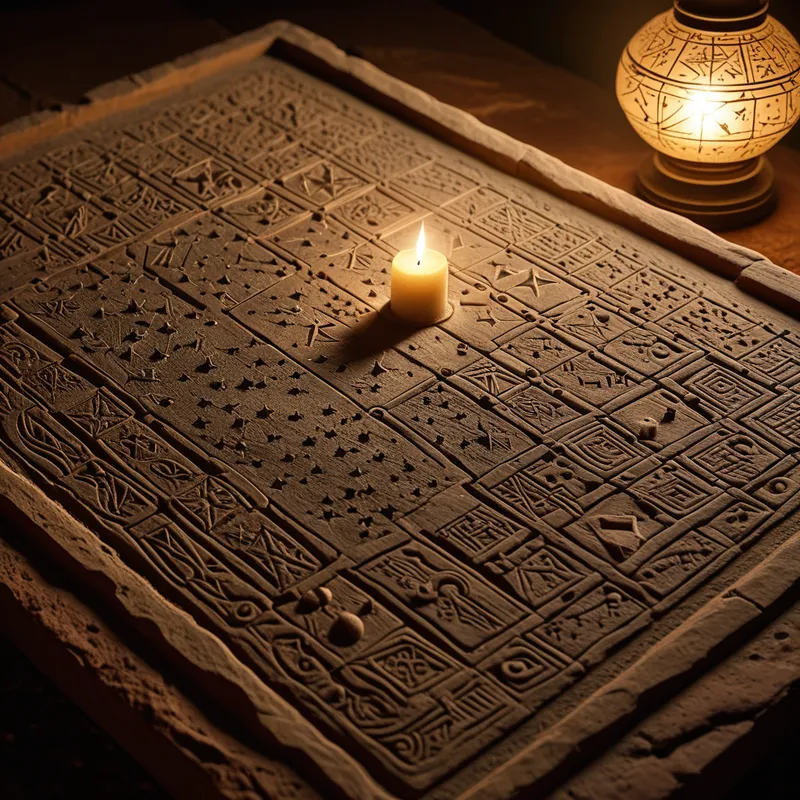
MUL.APIN is not a single narrative myth like the Enūma Eliš, but a living, breathing mythos encoded in a technical document. It emerged from the heart of Mesopotamian civilization, a product of the ummânū of the first millennium BCE. These scholar-priests were the bridge between the divine and the administrative. Their task was to discern the will of the gods—the me—written in the heavens, to ensure the king's reign was harmonious with cosmic law and to guide the agricultural and ritual calendar.
The text was passed down through rigorous scribal training, copied and recopied on durable clay tablets. Its societal function was profoundly practical and profoundly sacred. It was a farmer's almanac, a priest's ritual timetable, and a king's guide to sovereignty all in one. By knowing the heliacal rising of certain stars, one knew when to sow barley. By understanding the paths of the gods, one could perform the correct rites to appease them. In a world where the state's legitimacy was derived from divine order, MUL.APIN was the operating manual for reality itself. It transformed the terrifying, capricious heavens into a legible, predictable text, making the cosmos a partner in civilization rather than an opponent.
Symbolic Architecture
At its core, MUL.APIN is a myth about the imposition of cognitive structure onto the formless. The primordial chaos of the heavens represents the undifferentiated psyche—a swirl of potentials, fears, instincts, and possibilities with no internal governance.
The act of observation is the first act of creation. To name a star is to call a fragment of chaos into the service of consciousness.
The three Paths—of Anu, Enlil, and Ea—symbolize the fundamental tripartite structure of reality and the self. Anu represents the transcendent principle, the realm of ideals, laws, and overarching patterns (the Superego). Enlil represents the executive function, the active force that organizes and commands in the manifest world (the Ego). Ea represents the deep, fluid source of wisdom, the unconscious, and instinctual knowing (the Id). A healthy psyche, like an ordered cosmos, requires all three roads to be mapped and respected.
The MUL.APIN itself, the Plow Star, is the ultimate symbol of this psychic work. The plow does not create the earth; it cuts into the fertile but wild darkness, turning it over, making it ready for the seed of intention and the harvest of meaning. It is the tool of conscious effort applied to the soil of the unconscious.
The Dreamer's Resonance
When the archetypal pattern of MUL.APIN stirs in the modern dreamer, it often manifests in dreams of intricate maps, complex but elegant machinery, celestial navigation, or discovering a forgotten, authoritative book of rules. There is a somatic sensation of things "clicking into place," of a subtle, internal alignment.
The psychological process at work is one of nascent self-regulation and the birth of inner authority. The dreamer is in a phase where life feels chaotic, directionless, or emotionally overwhelming—a personal Tiamat. The dreaming culture.") psyche is initiating the work of the Babylonian scribe: it is beginning to observe the chaotic movements of inner life (moods, impulses, fears) and seeks to identify their patterns and cycles. This is not about control, but about comprehension. The dream may present a puzzle or a code to decipher, reflecting the mind's attempt to translate raw experience into a personal, meaningful narrative. It is the prelude to taking responsibility for one's own inner cosmos.

Alchemical Translation
The individuation process modeled by MUL.APIN is the alchemy of orienteering. It is the transition from being lost in the interior wilderness to becoming the cartographer of one's own soul.
The first stage is the Acknowledgment of Chaos—the Tiamat within. One must confront the fact that the inner world is not inherently ordered. The second is the Assumption of the Observer—the station of the priest-scribe. This is the commitment to non-judgmental self-witnessing, to tracking the "heliacal risings" of one's own passions and the "settings" of one's depressions.
The goal is not to stop the celestial motion, but to learn its grammar, so one may write one's own destiny in collaboration with fate.
The third and ongoing stage is the Drawing of the Map. This is the active work of therapy, journaling, art, or any practice that externalizes and structures inner content. One identifies their personal "Path of Enlil" (conscious duties and actions), honors their "Path of Ea" (dreams and intuitive wisdom), and aspires to their "Path of Anu" (guiding principles and values). The final transmutation is becoming the living MUL.APIN—a human being in whom the cosmic order is reflected. One's life, with its seasons, cycles, and crises, is no longer a series of random blows, but a coherent, navigable text. One becomes both the starfield and the scholar, the mystery and the map, dwelling in the profound peace that comes not from mastering chaos, but from conversing with it in the sacred language of pattern and time.
Associated Symbols
Explore related symbols from the CaleaDream lexicon: