Māui Myth Meaning & Symbolism
The myth of the demigod Māui, a trickster-hero who defied the gods to shape the world for humanity through cunning, courage, and profound transformation.
The Tale of Māui
Listen. In the time before time, when the sky lay heavy upon the earth and the sun raced too quickly across the dome of heaven, there was a child born of the gods and cast away by his mortal mother. She, seeing his premature birth, wrapped him in a knot of her topknot and set him adrift on the salt sea. But the sea is not cruel; it is a womb. The waves did not swallow him. They carried him to the shore, where the gods themselves, the unseen ones, took pity. They wrapped the infant in seaweed and bore him to the undersea halls, where he was raised on stories of the deep and the secret names of things.
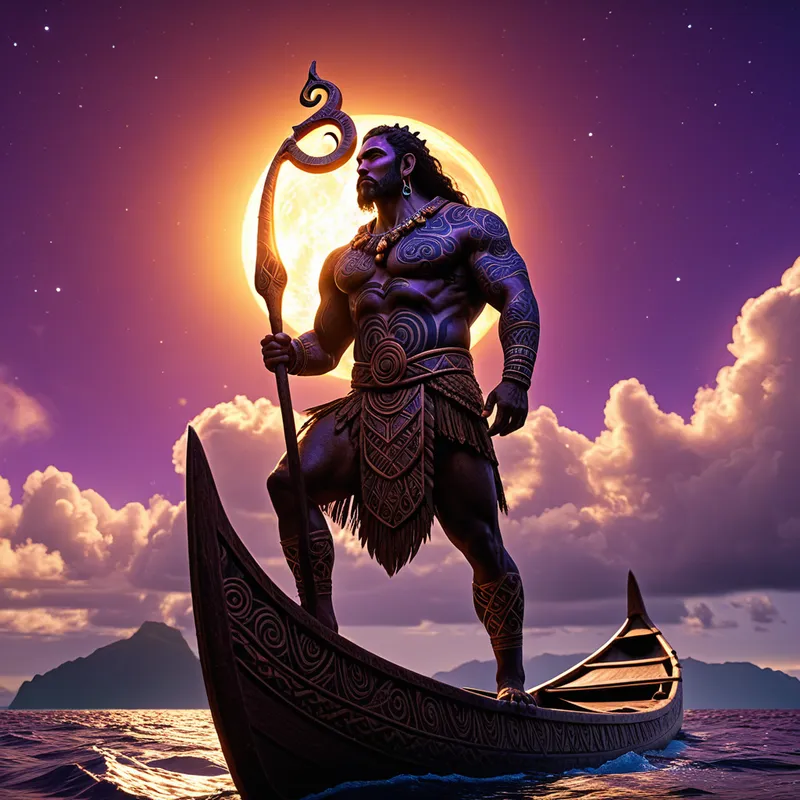
He returned not as a babe, but as Māui-tikitiki-a-Taranga, Māui-of-the-topknot-of-Taranga, a boy with a laugh that held the mischief of eels and eyes that saw the seams of the world. He found his mother, Taranga, and his brothers, who mocked him for his strange ways. They would go fishing in their great canoe, and they would leave him behind. But Māui was not one to be left. Hiding in the hull, he waited until the canoe was far from land, then revealed himself. His brothers were furious, but they had no bait. Māui smiled, struck his own nose until blood flowed, smeared it on his magic fishhook, Manaiakalani, carved from the jawbone of an ancestor, and cast his line into the endless blue.
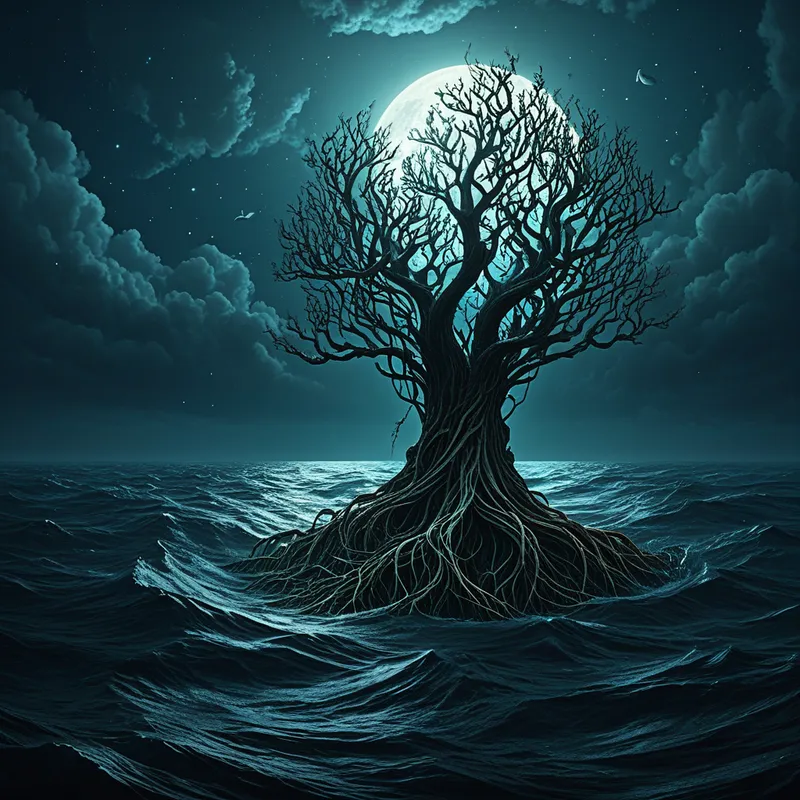
He did not call for fish. He called for land. The line went down, down, into the abyssal dark, until it caught. He pulled. The sea boiled. The brothers strained. And from the depths, he hauled up not a fish, but Te Ika-a-Māui, the Great Fish of Māui, an immense, living continent. But his brothers, in their greed and fear, hacked at the great fish before the karakia, the incantations, were complete. And so the fish thrashed, and its flesh rose into mountains and valleys, forever scarred.
Yet Māui’s work was not done. The sun, Tamanuiterā, flew too fast across the sky, leaving no time for work, for cooking, for life. So Māui took the ropes woven from his sister's hair, ropes stronger than any fiber on earth, and with his brothers, he journeyed to the pit where the sun rose. They lay in wait, and as the first blazing limb emerged, they lashed it fast. The sun roared and fought, burning the ropes, but Māui stood firm. With his sacred club, the Mere Pounamu, he struck the sun until it lay wounded and subdued. "Move slowly," Māui commanded, "so that my people may live." And the sun, bound and beaten, agreed.
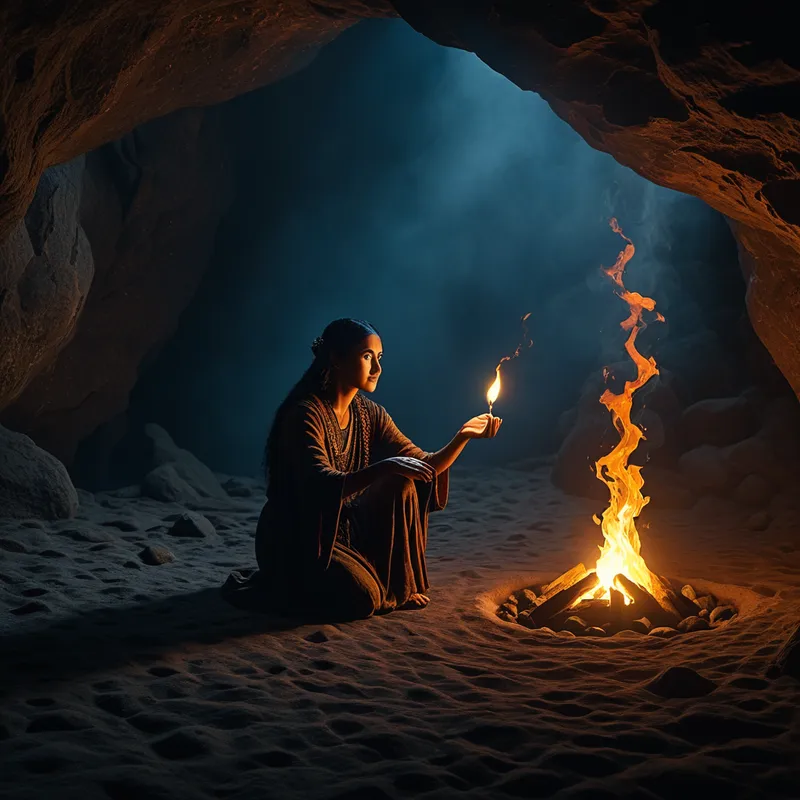
His greatest theft, however, was from the belly of the earth itself. In the cold, dark times, humanity had no fire. It was held by Mahuika, the ancient fire-goddess, his ancestress. Māui went to her and asked politely for a flame to warm his people. She, kindly, plucked a fingernail of fire and gave it to him. He took it, let it die in a stream, and returned. Again and again he asked, and again and again she gave, until only the fire in her last toenail remained. Then she saw his trickery. In a rage, she hurled the last flame at him, setting the world ablaze. Māui, in desperation, called upon the rain and the rivers to quench the fire, saving but a single spark hidden in the kaikōmako tree. And from that hidden spark, he gave fire back to the world, a stolen gift, now forever ours.
Cultural Origins & Context
The myth of Māui is the backbone of the Polynesian narrative universe, a constellation of stories scattered like stars across the vast Pacific, from Hawaiʻi to Aotearoa (New Zealand), from Tahiti to the Cook Islands. These were not mere bedtime stories but the foundational whakapapa and mātauranga of a people. Recited by tohunga and elders, the tales of Māui served multiple vital functions. They were cosmological maps, explaining the origins of islands, winds, and celestial rhythms. They were pedagogical tools, teaching values of ingenuity (māia), persistence, and the proper relationship with the gods and nature. Most importantly, they encoded the identity of a voyaging people. Māui, the fisherman of land, is the archetypal navigator, the one who brings forth solid ground from the featureless ocean—a perfect metaphor for the greatest human migration in history, the discovery and settlement of the Pacific.
Symbolic Architecture
Māui is the ultimate archetype of the liminal trickster. He is not a pure hero in the classical sense; he is a catalyst, an agent of chaotic creativity. His birth—discarded yet saved by the gods—symbolizes the potential within the rejected, the hidden spark of divinity in the seemingly insignificant. His tools are not brute strength but intelligence and sacred objects: the jawbone hook, his grandmother's jawbone, a symbol of using the wisdom of the ancestors (tūpuna) to create the future.
The trickster does not destroy the old world; he forces it to reveal its hidden possibilities, bending its rules to serve a new, emergent order.
His acts are Promethean thefts for the benefit of humanity: stealing fire, slowing the sun, fishing up land. Each is an act of cosmic rebellion against a static, often oppressive, divine order. He negotiates a better deal for mortals, introducing time, warmth, and habitable space. Psychologically, Māui represents the rebellious, inventive spirit of the ego consciousness that dares to challenge the entrenched patterns of the unconscious (the gods, the established order) to win greater consciousness and capability for the individual and the collective.
The Dreamer's Resonance
When the pattern of Māui stirs in the modern psyche, it often manifests in dreams of ingenious problem-solving, defiant acts against overwhelming "authorities" (a boss, a system, an internal critic), or pulling something immense and transformative from a depth—be it the ocean, a cave, or a dark forest. The somatic feeling is one of tense, creative strain: the pull on the fishing line that threatens to capsize the boat, the heat of the stolen flame burning the fingers. This is the psyche working on a profound renegotiation.
You may dream of finding a simple, overlooked tool that holds immense power (the jawbone hook), symbolizing an undervalued aspect of your own heritage or skill. Or you may dream of tricking a powerful, ancient figure (Mahuika) to get what you need, reflecting a necessary, if uncomfortable, cunning required to access your own inner fire or passion from a guarded, perhaps wounded, part of yourself. The dream is signaling that a phase of rebellious, shape-shifting ingenuity is required to bring new "land"—new stability, new potential—into the geography of your life.
Alchemical Translation
The individuation process, the journey toward psychic wholeness, is not a gentle path of acceptance alone. It requires a Māui-phase: a conscious, cunning rebellion against the inner gods that limit us. These are the tyrannical "suns" of our neuroses that race through our days leaving no time for depth, the "cold" of repressed vitality (the withheld fire), and the oceanic void of potential that seems to offer no solid ground.
To become oneself, one must first steal the fire from one's own guarded depths and be willing to face the conflagration of transformation that follows.
The alchemical work is in using the Manaiakalani—the hook of focused intention and ancestral wisdom (our innate talents and deep instincts)—to fish up the contents of the unconscious and give them form in the world. We must "slow the sun"—impose conscious structure on the compulsive, rapid cycles of thought and behavior. We must endure the wrath of Mahuika, the fear and rage of the psyche when its long-held energies (like old grief or anger) are finally accessed and brought to light. Māui’s journey teaches that the gift of true life—fire, time, land—is never merely given by the established order. It must be won, through a blend of respect, trickery, courage, and a willingness to harness the very chaos one unleashes. The goal is not to defeat the gods, but to transform our relationship with them, creating a world within and without where humanity can truly dwell.
Associated Symbols
Explore related symbols from the CaleaDream lexicon: