Mount Sumeru's Edge Myth Meaning & Symbolism
A myth of a deity who, reaching the edge of the universe, discovers the true nature of reality is not a wall, but a mirror of the mind.
The Tale of Mount Sumeru's Edge
Listen, and hear of the journey that begins where all journeys end.
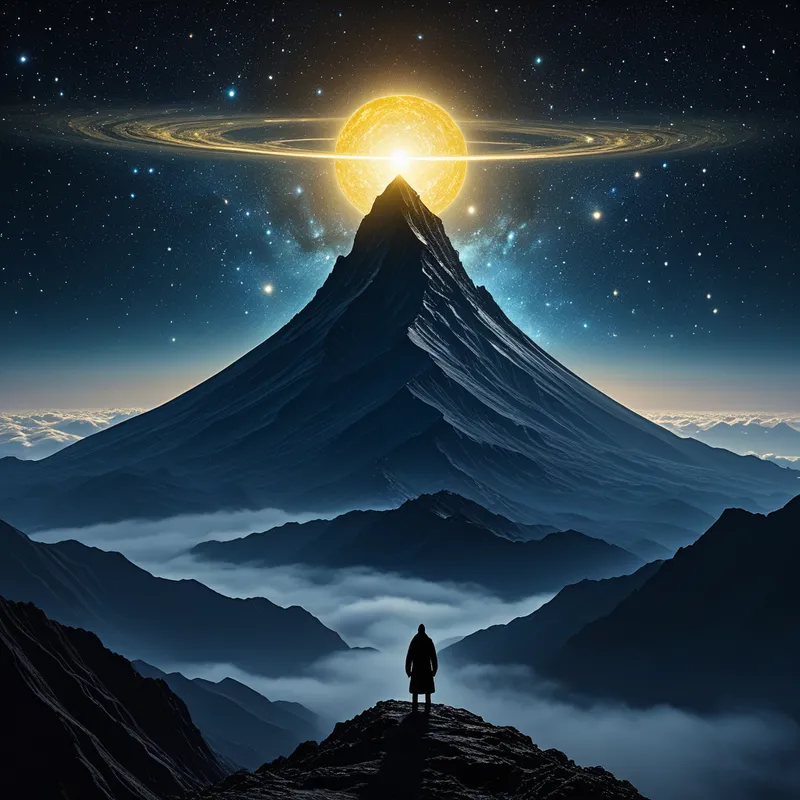
In the fathomless dark before time, there stands Mount Sumeru. Its base is rooted in the primordial waters, its golden flanks rise through realms of desire and form, and its peak pierces the highest heavens where the devas dwell in light and music. It is the axis of ten thousand worlds, the spine of reality itself. All things are arranged around it; to know Sumeru is to know the cosmos.
But one among the devas, a being of luminous intellect and restless spirit, was not content. Gazing from the celestial terraces, a question burned: What lies beyond? Not beyond the mountain’s peak, for that is the abode of the great Brahma. No, the question was of the horizon. What lies beyond the outermost ocean that rings the mountain’s base, beyond the last Cakravāla mountain range that holds the cosmic waters in its stony grasp?
Driven by a yearning no heavenly pleasure could quell, the deity descended. Down through the realms of radiant form, past the tumult of the desire realm where asuras warred and humans toiled, down to the very root of the world. There, at the base of Sumeru, stretched the vast, black, silent ocean. For eons, the deity traveled across its featureless expanse, a single point of light moving over infinite dark water, until at last, the far shore appeared.
It was not a shore of sand, but a wall. A titanic, seamless cliff of iron-dark rock, smooth as polished metal, curving away into eternity in both directions: the ultimate Cakravāla, the edge of the world-system. The deity had reached the limit.
Heart pounding with a mix of triumph and dread, the deity ascended the impossible face. Up and up, for time beyond measure, until the wind of the outer void screamed in their ears. At the summit of that final rim, they stood. Before them lay… nothing. Not darkness, not light, but a sheer, absolute absence, a void so profound it swallowed sight and thought.
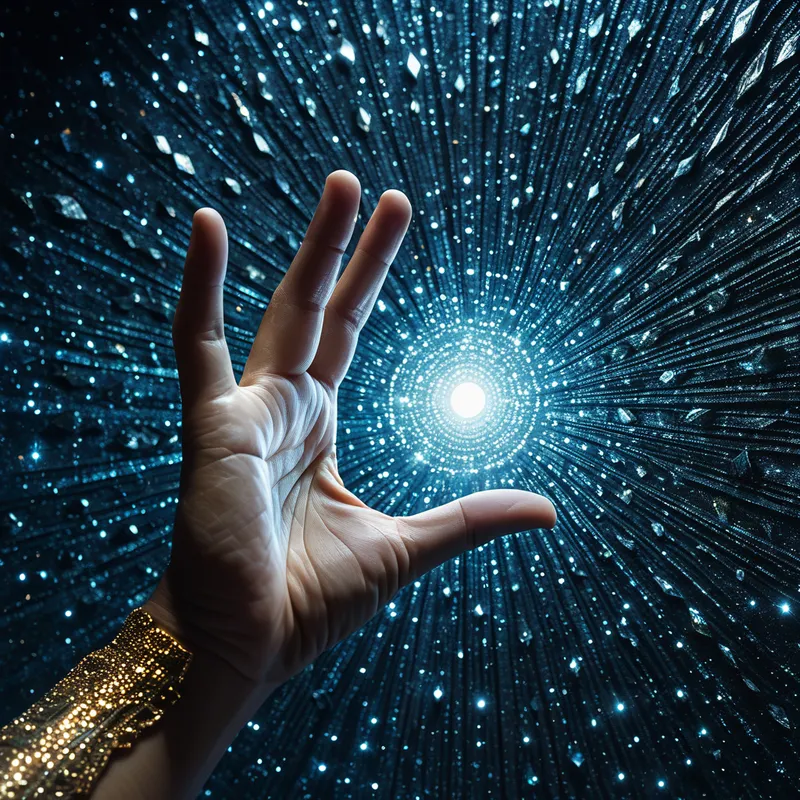
And there, at the very precipice of existence, the deity did the only thing left to do. They reached out a hand and placed their palm against the wall of the world.
The stone was cold. And then, it was not stone. Under their touch, it shimmered, becoming clear as diamond, then as reflective as a perfect mirror. The deity stared into it, expecting to see their own glorious, anxious face. But they did not.
Instead, in the mirror-wall, they saw Mount Meru itself, in its entirety, from base to peak. They saw the ocean they had crossed. They saw the heavens they had left. They saw the entire, intricate, beautiful, and terrible cosmos—not arrayed before them, but contained within the reflection. The edge was not a barrier keeping something out. It was a surface revealing what was already, and had always been, within.
The deity’s questing spirit stilled. The question dissolved. With a breath that was neither a sigh nor a laugh, but something utterly new, they turned away from the void, and began the journey home. Not back to the heavens, but into the heart of the mountain they now understood.
Cultural Origins & Context
This profound narrative is not found in a single sutra but is woven from the cosmological descriptions present in Abhidharma literature and later commentarial traditions. It serves as a philosophical and meditative parable. It was likely told by monastic teachers to advanced students grappling with the nature of perception and the limits of conceptual thought. Its societal function was not to explain geography, but to map the psyche. The detailed cosmology of Mount Sumeru and its surrounding continents and seas provided a grand, symbolic architecture for understanding the scale of samsara and the stages of the path to liberation. This particular tale of the edge acts as a capstone to that education, challenging the very framework it uses, pointing the student beyond the map to the territory of direct, non-conceptual insight.
Symbolic Architecture
Mount Sumeru is the ultimate symbol of order, hierarchy, and the structured cosmos. It represents the psyche in its conditioned state: the layered strata of our desires, our forms, our mental constructs, and our highest spiritual aspirations. The journey to its edge is the journey of consciousness to the very limits of its own known universe.
The edge of the world is not a place, but the limit of the mind that perceives it.
The deity represents the inquiring intellect, the aspect of consciousness that seeks final answers in the external, objective field. The Cakravāla wall is the ultimate boundary—the line between the knowable and the unknowable, the conditioned and the unconditioned, samsara and nirvana. The critical turn is the discovery that this boundary is reflective. It does not hide a secret external reality; it reveals that the entire cosmos one has been seeking to transcend is, in fact, a projection of one’s own perceptual and cognitive apparatus. The return journey is not a retreat, but a re-entry with transformed vision: the mountain is no longer an external object to be scaled or understood, but is recognized as the very substance of the seeker’s being.
The Dreamer's Resonance
When this myth stirs in the modern unconscious, it often manifests as dreams of reaching a literal or metaphorical limit. A dreamer may find themselves at the end of a road, the top of a ladder that goes no higher, or facing a vast, blank wall at the terminus of an infinite hallway. The somatic feeling is one of profound frustration mixed with awe—a “cosmic claustrophobia.” This is the psyche signaling that a long-held model of reality—a career path, a self-concept, a worldview—has been exhausted. The exploration of the known world (the personal Mount Sumeru of one’s life structure) is complete. The dream presents the edge, the crisis point. The psychological process is one of contained confrontation with the limit of one’s current ego-identity. The dream often ends at the wall, because the final act—the touching and the transformation—is the work of waking integration.

Alchemical Translation
The myth models the pinnacle of the individuation process: the confrontation with the Self as both the boundary and the boundless. Our personal Mount Sumeru is the ego’s carefully constructed identity, with its base in the unconscious (the dark ocean) and its peak in our ideals and spiritual goals. We spend a lifetime exploring and fortifying this mountain.
The alchemical work begins when, often through crisis or deep inquiry, we are driven to its edge—to the point where our identity, our understanding, our very sense of “my world” ends. We face the shadow of the unknown, which feels like a void. The instinct is to breach it, to find the next external truth.
The alchemical gold is not found by breaking the vessel, but by realizing you are the vessel, and the alembic, and the prima materia all at once.
The transmutation occurs in the mirror-moment. It is the shocking, humbling, liberating realization that the limit is not “out there.” The wall that seems to confine you is the surface of your own totality. The entire struggle, the majestic mountain of your life with all its triumphs and failures, is seen as an internal landscape. This is the unio mentalis, the mental union. The return journey is the integration of this realization. You do not abandon your life (the mountain); you re-inhabit it with the knowledge that it is not separate from the boundless consciousness that perceives it. The explorer archetype completes its quest not by conquering a new land, but by coming home to the true scale of the kingdom that was always, and innately, theirs.
Associated Symbols
Explore related symbols from the CaleaDream lexicon: