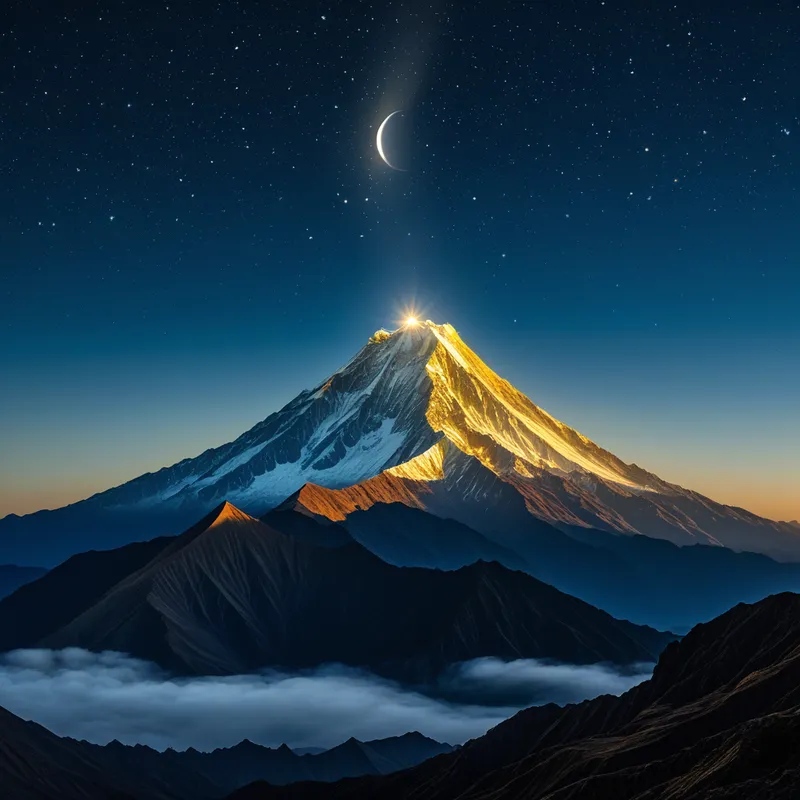
Mount Meru/Sumeru Myth Meaning & Symbolism
The myth of the golden mountain at the universe's center, a divine axis around which all worlds, gods, and time revolve in sacred order.
The Tale of Mount Meru/Sumeru
Listen. Before the first name was spoken, before the first breath was drawn, there was the Churning. The great serpent Vasuki was coiled around the spine of the world, and gods and demons pulled at his ends, turning the mountain-churner in the milky ocean of potential. From that tumult of opposites, from that divine friction, it arose: Mount Meru.
It is not a mountain of mere stone. It is the first thought of order, crystallized. Its roots plunge deep into the infernal realms, through soils of suffering and darkness. Its trunk, our mortal world, clings to its middle slopes. And its peak, sheathed in immortal gold and jewels, pierces the highest heavens. Here, in palaces that defy mortal geometry, dwell the Devas. Here sits Indra in his city of Amaravati, where the wish-fulfilling tree Parijata blooms, and the celestial elephants spray the waters of life.
The mountain is the axis. The sun, the moon, and all the stars are not balls in a void—they are luminous chariots that circle Meru, painting day and night upon the concentric continents that ring its base like lotus petals. To the south lies our world, Jambudvipa, the Rose-Apple Land, a place of both sorrow and the potential for awakening. Time itself is measured by Meru’s shadow; a kalpa, an acon, is but a single day in the life of the gods upon its summit.
But this order is not static. It is a living equilibrium, a breathing mandala. Demonic forces, the Asuras, eternally seek to storm the slopes, to claim the nectar of immortality for themselves. Their battles with the Devas shake the foundations of the worlds. Yet the mountain stands. It is the still point in the turning world, the unwavering pillar around which the drama of creation, preservation, and destruction endlessly, beautifully, unfolds. It is the silent witness, the immutable center to which all paths, knowingly or not, ultimately lead.
Cultural Origins & Context
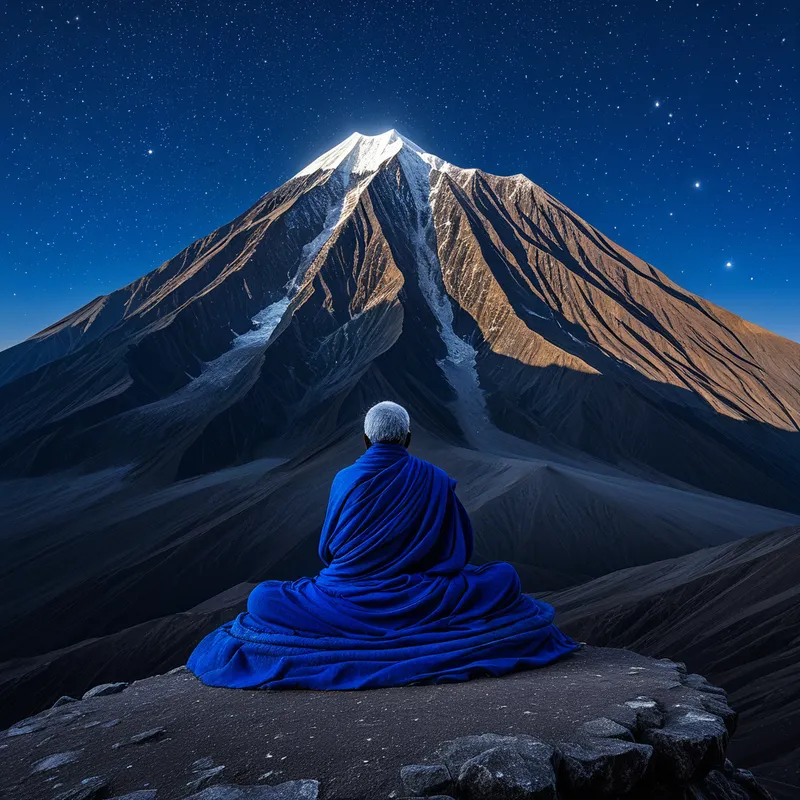
The myth of Mount Meru is not a single story but a foundational cosmological framework that permeates the sacred geography of Hinduism, Buddhism, and Jainism. Its earliest seeds are found in the Vedas as a vague "world pillar," but it blossoms into full detail in the Puranas, the Mahabharata, and in Buddhist Abhidharma literature.
It was a myth told by sages to kings, painted on temple walls, and described by monks to lay devotees. Its function was profound: to provide a complete, coherent model of the universe that was also a moral and spiritual map. It situated the human realm not as the center of all things, but as a specific, meaningful location within a vast, layered cosmos of cause and effect (karma) and potential liberation (moksha or nirvana). Knowing one's place on the slopes of Meru was to understand one's spiritual station and the direction of the arduous climb ahead.
Symbolic Architecture
Mount Meru is the ultimate symbol of the axis mundi, the central pillar that connects Heaven, Earth, and the Underworld. It represents the principle of order (dharma) emerging from chaos. But its psychology runs deeper.
The mountain is not outside, but within. It is the spine of the psyche, the vertical axis of consciousness itself.
Its base, anchored in the underworld, symbolizes the unconscious, the repressed, the instinctual drives and primal fears we often ignore. The mortal world on its slopes is the ego, our conscious identity, navigating the plains and forests of everyday life. The celestial peak represents the Self—the transcendent, unified center of the total personality, often experienced as a numinous, divine connection. The four colored sides (gold, silver, lapis, crystal) represent the integration of different qualities or psychological functions into a stable, radiant whole.
The eternal battle between Devas and Asuras on its slopes is the internal conflict between our "higher" aspirations (clarity, compassion, order) and our "lower" impulses (anger, greed, chaos). The mountain does not take sides; it is the arena, the necessary structure within which this conflict—essential for growth—takes place.
The Dreamer's Resonance
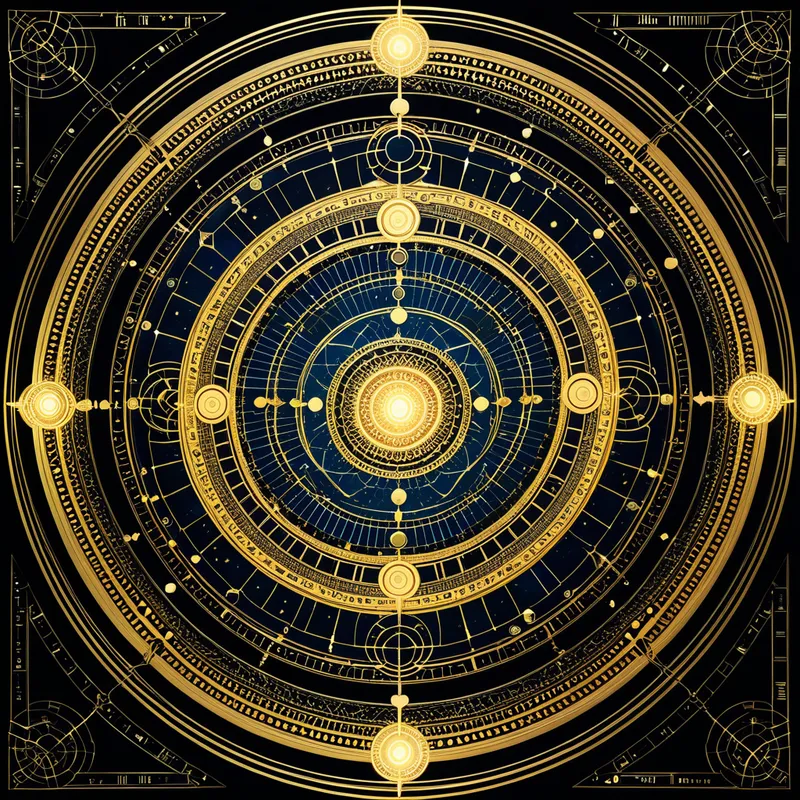
When the image of Mount Meru arises in a modern dream, it rarely appears as a literal golden peak. Instead, the dreamer may encounter a towering skyscraper of impossible height, a vast and intricate corporate ladder, a monumental staircase in a decaying mansion, or a terrifyingly steep cliff they must ascend. The somatic feeling is one of both awe and vertigo—a pull towards a sublime summit coupled with a dread of the abyss below.
This dream signals a profound process of recentering. The psyche is attempting to establish or rediscover its own axis. The dreamer may be feeling spiritually adrift, morally confused, or pulled apart by competing life demands. The mountain-dream is the unconscious presenting a map for re-integration. The struggle to climb, the fear of falling, the discovery of different "levels" or "terraces" within the dream—all these are symbolic representations of the hard, vertical work of aligning one's conscious life with deeper, often neglected, values and truths. It is a call to build an inner structure that can withstand the churning of external and internal chaos.
Alchemical Translation
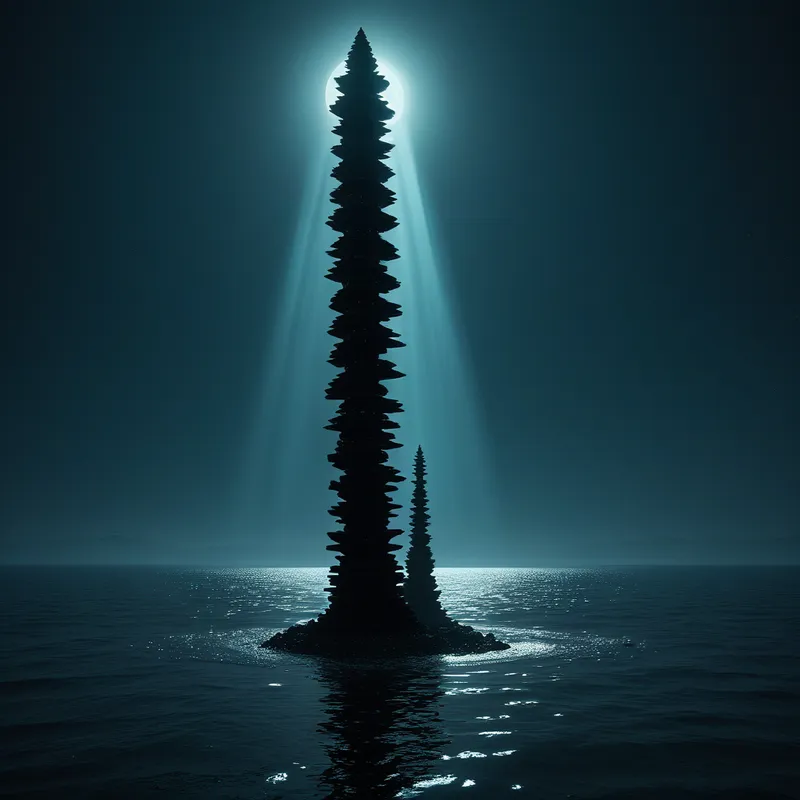
The individuation process, the alchemical journey of becoming whole, is perfectly modeled by the Meru myth. We begin in the churning ocean of the unconscious, a state of undifferentiated potential and turmoil. The first task is to "find the mountain"—to identify that central, enduring core of values and purpose within oneself, around which everything else can be organized.
The alchemical work is the churning. The gold of the Self is not given; it is extracted from the base metal of the personality through sustained, often difficult, effort.
The ascent is the labor of integration. Confronting the "Asuras" in our own shadow—the anger, pettiness, and fear we deny—is the work of the lower slopes. Refining the "ego" on the middle slopes involves aligning our daily actions (karma) with our deeper knowing. Each step requires sacrifice, the letting go of attachments that weigh us down.
Reaching the "peak" is not an arrival at a static destination, but the achievement of a perspective. It is the realization that the center you sought was within you all along, the still point from which you can observe the turning worlds of your own psyche—thoughts, emotions, drives—without being overthrown by them. You become the axis. The sun and moon of your inner opposites (masculine/feminine, conscious/unconscious, light/dark) now orbit in harmonious relation around this stable center. You have built your own Meru, and in doing so, have found your place in the cosmos.
Associated Symbols
Explore related symbols from the CaleaDream lexicon: