
Mount Kailash as Axis Mundi
A sacred mountain revered as the spiritual center of the universe, connecting the earthly realm with the divine in Tibetan Buddhist cosmology.
The Tale of Mount Kailash as Axis Mundi
In the beginning, before the worlds were fully formed, a great stillness settled upon the high plateau of the earth. From this stillness, a profound intention arose—a need for a center, a fixed point around which the chaos of manifestation could orient itself and find meaning. This intention took form not as a living creature, but as a mountain. It did not erupt from the earth in violence, but emerged from the depths of consciousness itself, rising with the solemn, inevitable grace of a truth being spoken for the first time. This was Mount Kailash, Axis Mundi.
To the human eye, it appears as a majestic, snow-clad peak in the remote western reaches of the Tibetan Plateau, its four sheer faces sculpted as if by divine geometry. But to the inner eye of the awakened, it is the immovable hub of the cosmic wheel. It is said that the mountain’s roots plunge deep into the darkest, most foundational layers of reality, anchoring in the underworld realms. Its midsection, the visible mountain of black rock and white snow, stands firmly in our earthly realm, the world of form and suffering. And its summit, perpetually shrouded in cloud and mystery, pierces the canopy of the sky to touch the pure, luminous realms of the gods. All existence is arranged around it; the sun, moon, and stars are said to circle its summit in homage.
The great bodhisattva of compassion, Chenrezig (Avalokiteshvara), is believed to have his celestial abode upon its slopes. The mountain is not a passive monument, but a living, breathing vortex of spiritual energy. The sacred Mansarovar Lake, a turquoise mirror at its southern foot, holds its perfect reflection, completing the circuit between above and below. To circumambulate, or perform a kora, around its base is to trace the very circumference of the universe, to walk the path that binds all realms together. Every step on that stony path is a step taken around the center of one’s own being and the center of all that is.
Cultural Origins & Context
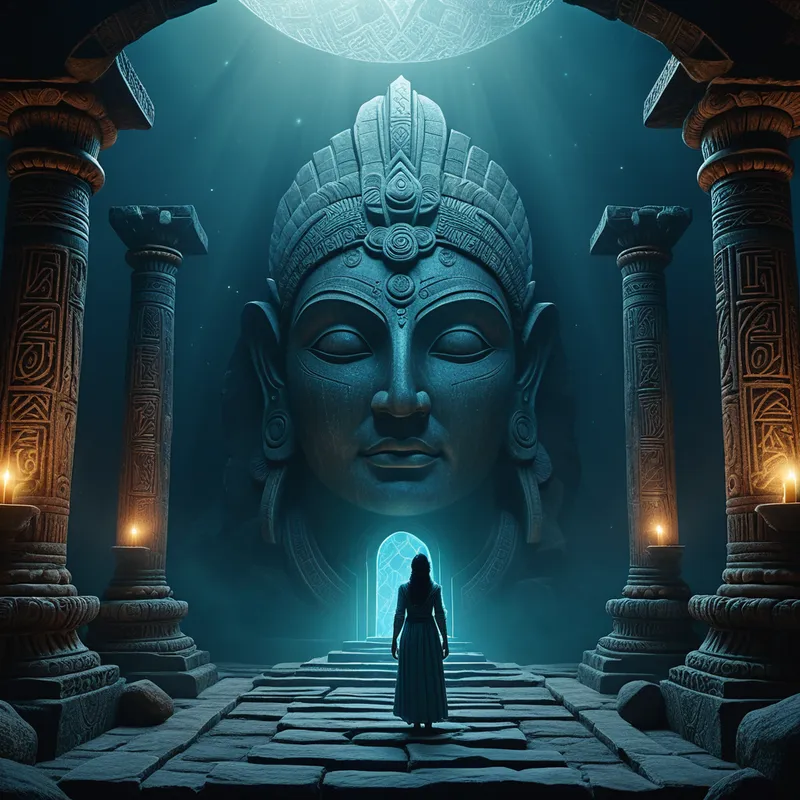
The veneration of Mount Kailash as the world axis is a profound layer in a palimpsest of belief. Its sacred status predates recorded history, likely originating in the ancient Bon tradition of Tibet, where it was known as Yungdrung Gutsek, the "Nine-Stacked Swastika Mountain," a spiritual fortress and the seat of celestial power. With the arrival and flourishing of Buddhism in Tibet from the 7th century onwards, the mountain was seamlessly integrated into the Buddhist cosmological map, retaining its central position but being reinterpreted through a Buddhist lens.
In Tibetan Buddhist cosmology, the universe is often described as a vast, intricate mandala—a symbolic diagram of the cosmos and the enlightened mind. Mount Kailash sits at the very heart of this mandala. It is identified as the legendary Mount Meru (or Sumeru) described in ancient Buddhist texts, the axial pillar of the entire world-system. This is not a geographical claim but a metaphysical one. The mountain’s physical remoteness and inaccessibility—no mortal is permitted to climb its summit—reinforce its symbolic function. It exists at the edge of the human world, pointing insistently beyond it. It is a fact of the landscape that simultaneously denies the supremacy of the merely physical, asserting instead a psychic and spiritual geography where the inner and outer worlds converge.
Symbolic Architecture
The architecture of this myth is one of verticality and centering. The axis mundi is the ultimate symbol of order, the still point in the turning world. It provides a coordinate in the chaos of existence, answering the most fundamental human questions: Where am I? and Where is the center?
The mountain is not merely a location, but a function of consciousness. It represents the potential for the individual psyche to become a stable conduit between the instinctual depths, the egoic present, and the transcendent heights of the Self.
Its four faces, aligned almost perfectly with the cardinal directions, symbolize the totality of the manifest world, with the axis rising from its center. The ritual of the kora is the architectural practice of this symbolism; a circular path (the wheel of samsara, the cycle of existence) is navigated with the eternal, unchanging center (the potential for nirvana, liberation) always to one’s right, the side of honor and virtue. The mountain is both the goal and the path, the center one circles and the presence one carries within.
The Dreamer's Resonance
To encounter the myth of Kailash in the inner landscape is to experience a profound call to orientation. In the psyche, chaos and diffusion are the default states. The ego, buffeted by conflicting desires, fears, and influences, often feels adrift. The Axis Mundi archetype emerges in dreams, visions, or moments of crisis as a powerful symbol of the need for a central, organizing principle.
It may appear as a towering, immovable structure in a shifting dreamscape, a brilliant light at the center of a psychic storm, or a deep, unwavering conviction that arises during meditation. It resonates with the part of the soul that seeks not escape from the world, but a meaningful place within it—a connection to something that grounds and elevates simultaneously. The mountain does not promise an easy ascent, but it does promise a center from which all journeys, both inward and outward, can begin with purpose. It answers the disorientation of modern life with an ancient, vertical imperative: find your axis, and from that stillness, engage with the turning world.
Alchemical Translation
The psychological alchemy of the Axis Mundi involves the transformation of scattered psychic energy into a coherent, directed force. It is the process of centroversion, the movement of the personality around a new, more authentic center of gravity that is no longer the fragile ego, but the more durable and encompassing Self.
The pilgrimage to Kailash, whether physical or imaginal, is an alchemical opus. The arduous journey to the remote land mirrors the confrontation with the unconscious. The circumambulation is the circumambulatio, the sacred circling that contains, heats, and transforms base consciousness. The unwavering presence of the mountain is the lapis philosophorum, the philosopher’s stone—the symbol of indestructible, transcendent wholeness achieved through the ordeal.
To integrate this symbol is to perform an inner kora. It is to consciously acknowledge all aspects of one’s being—the shadowy depths (the underworld roots), the complex reality of daily life (the earthly slopes), and the highest aspirations (the celestial summit)—and to recognize them as connected parts of a single, vertical reality. The axis is not achieved by escaping one’s humanity, but by becoming the conduit through which the divine touches the earthly, and the earthly aspires to the divine.
Associated Symbols
Explore related symbols from the CaleaDream lexicon:
- Mountain — The primordial symbol of aspiration, spiritual ascent, and immutable truth, representing the challenging journey toward higher consciousness.
- Axis — The central, unmoving line around which all rotation and transformation occurs, symbolizing the core principle of order within apparent chaos.
- Cosmic Connection — The profound link between the individual soul and the vast structure of the universe, suggesting that one’s inner state mirrors celestial order.
- Journey — The transformative passage, often arduous and purposeful, that is required to approach a sacred center or achieve a state of wholeness.
- Circle — The symbol of totality, cycles, and containment, representing the ritual path of integration that orbits an eternal, central truth.
- Temple — A constructed sacred space that mirrors cosmic order, serving as a deliberate intersection point between the human and the divine realms.
- Mirror — A surface for reflection, revealing the hidden unity between the outer world and the inner self, as the sacred lake reflects the mountain.
- Bridge — A structure that connects separated realms, enabling passage and communication between the earthly, the human, and the transcendent.
- Center — The still, essential point from which all meaning and structure radiates, representing the core of identity and the universe.
- Root — The hidden, foundational source of stability and nourishment, anchoring the visible form to the deep, unseen layers of reality.
- Summit — The ultimate goal or point of revelation, representing the achievement of perspective, clarity, and communion with the highest principles.
- Stone — The symbol of permanence, endurance, and the foundational substance of reality, representing the indestructible nature of sacred truth.