Mount Fuji Myth Meaning & Symbolism
A goddess of eternal life offers immortality to a mortal emperor, but her gift is stolen, leading to a divine sacrifice that creates Japan's sacred mountain.
The Tale of Mount Fuji
Listen, and hear the story of the mountain that is not a mountain, but a sleeping goddess and a stolen promise.
In the age when the gods walked just beyond [the mist](/myths/the-mist “Myth from Celtic culture.”/), there lived a celestial maiden named Konohanasakuya-hime. Her name meant “Blossoming-Tree Princess,” and where she stepped, flowers burst from stone and cherry trees bloomed in winter. She was a spirit of eternal, flourishing life, dwelling in the high, pure realms. Far below, in the mortal realm, ruled an emperor named Emperor Keikō. He was mighty, but he was flesh, and he feared the creeping shadow of age and death. He heard tales of [the immortal](/myths/the-immortal “Myth from Taoist culture.”/) maiden and embarked on a perilous journey to the edge of [the world](/myths/the-world “Myth from Tarot culture.”/), where [the sky](/myths/the-sky “Myth from Persian culture.”/) meets [the sea](/myths/the-sea “Myth from Greek culture.”/), to seek her.
He found her on a windswept crag, more radiant than the sun on snow. “Great Emperor,” she said, her voice like wind through bamboo, “you seek what cannot be taken, only given.” Moved by his mortal yearning, she performed a sacred rite. From the essence of her divine being, she wove a silken scroll inscribed with secret, life-giving characters—the Fushi no Kusuri. “This holds the secret of eternal life,” she whispered. “Guard it with absolute purity of heart. If avarice or fear touches it, its power will become a curse.”
The emperor, awestruck, bore the scroll back toward his palace. But the journey was long, and human frailty is a heavy burden. Camped at the foot of what was then merely a vast, smoldering plain, he was overcome not by greed, but by a desperate, clutching fear. ‘What if it is lost? What if it is stolen?’ His hands trembled. In his anxious haste to secure the divine gift, he fumbled the silken scroll. It tumbled from its case and fell onto the volcanic earth.
The moment the sacred script touched the ground, the world groaned. The scroll did not burn; it was consumed by a different fire. It dissolved into a raging, white-hot energy that sank into the very bones of [the earth](/myths/the-earth “Myth from Hindu culture.”/). The plain erupted. Not with mere lava, but with the paradoxical essence of the gift itself: the fire of eternal life, now twisted by mortal fear into an endless, destructive eruption. The emperor fled, the promise of immortality replaced by the spectacle of immortal devastation.
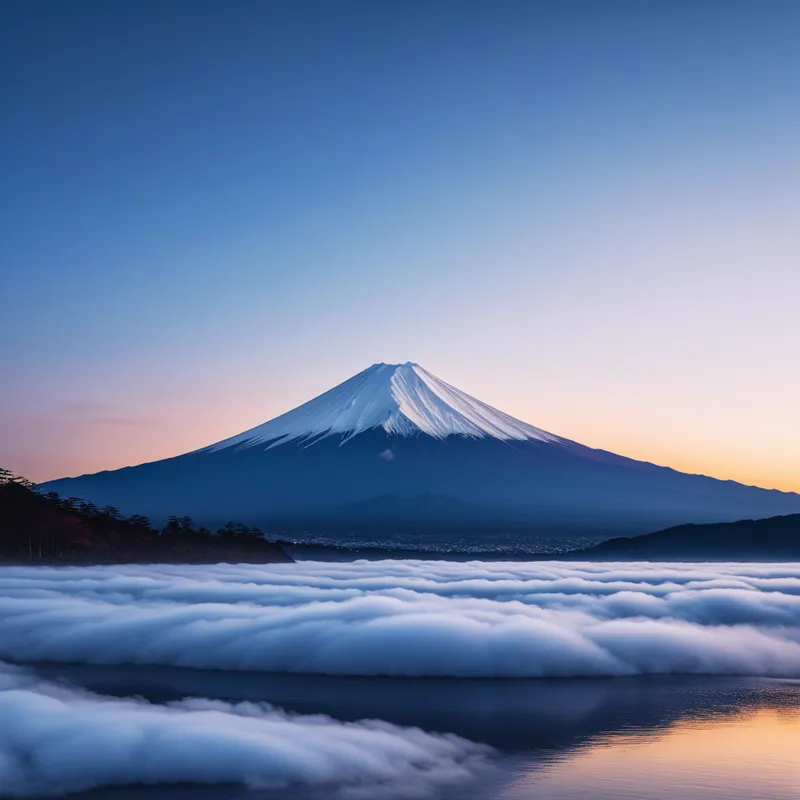
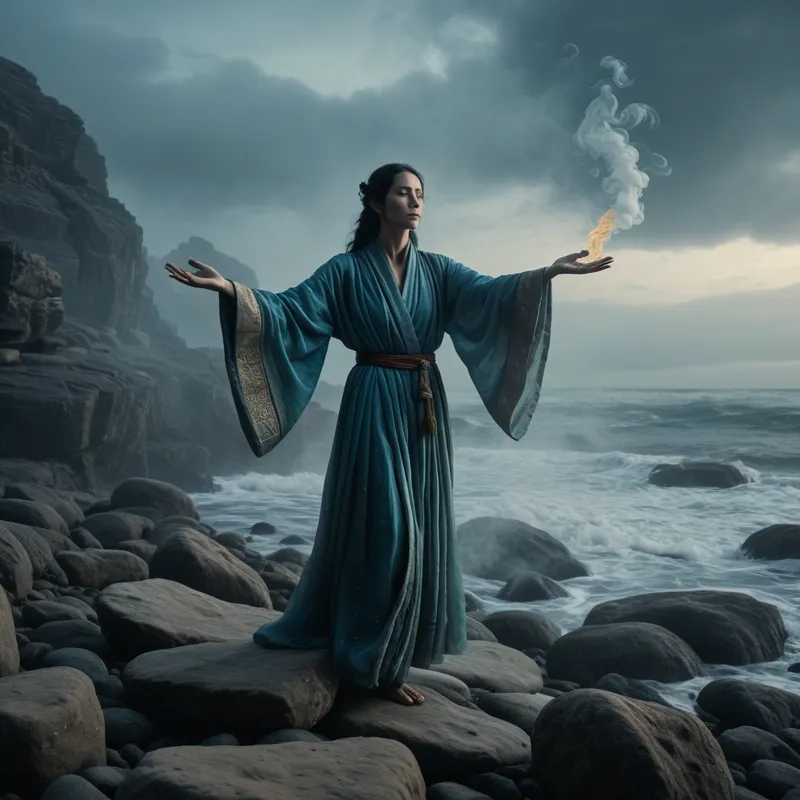
Konohanasakuya-hime felt the perversion of her gift like a wound in her spirit. She saw the eternal fire raging, a beacon of torment that would scorch the land forever. Her choice was not one of anger, but of profound responsibility. She descended from her celestial home. Standing before the pillar of fire and ash, she did not attempt to quell it with a greater power. Instead, she offered herself. She spoke words of binding and calming, and then she became. Her divine form stretched and settled, her flowing robes turning to forested slopes, her radiant skin to layers of snow and rock. She laid herself upon the raging vent, a living, eternal lid of coolness and peace. The fire, contained by her sacrifice, slept. The incessant eruption ceased, leaving behind the most perfect, serene, and majestic form: a dormant volcano, a silent guardian. The mountain was named Fuji, from her immortal essence. She did not destroy the fire; she married it. The eternal life she offered became the eternal mountain, a symbol not of endless burning, but of achieved stillness.
Cultural Origins & Context
The myth of Konohanasakuya-hime and the origin of Mount Fuji is woven from strands of Shinto animism, where all natural phenomena are imbued with spirit (kami), and later Buddhist influences that framed narratives of sacrifice and compassion. It was not a single, canonical text but a living oral tradition, told by traveling storytellers, miko, and village elders. Its primary societal function was etiological—explaining the awe-inspiring, dominant geographical feature of central Japan—but on a deeper level, it served as a moral and psychological anchor.
The tale reinforced core cultural values: the sacredness of gifts and the grave consequences of mishandling divine trust (kegare). It explained the mountain’s dual nature: its breathtaking beauty and its latent, destructive power. As Fuji became a central pilgrimage site for both Shinto and Buddhist ascetics, the myth provided the narrative framework for the climb. Pilgrims weren’t just hiking a mountain; they were walking on the body of a goddess, retracing the path of the emperor’s failed quest, and seeking not physical immortality, but spiritual awakening through arduous journey and purification.
Symbolic Architecture
At its [heart](/symbols/heart “Symbol: The heart symbolizes love, emotion, and the core of one’s existence, representing deep connections with others and self.”/), this is a myth about the containment and transformation of raw, primal [energy](/symbols/energy “Symbol: Energy symbolizes vitality, motivation, and the drive that fuels actions and ambitions.”/). The Fushi no Kusuri represents pure, unintegrated potential—[the Self](/myths/the-self “Myth from Jungian culture.”/) in its divine, unmanifest state. The emperor’s fear is [the ego](/myths/the-ego “Myth from Jungian culture.”/)’s inevitable [reaction](/symbols/reaction “Symbol: A reaction in a dream signifies the subconscious emotional responses to situations we face, often revealing our coping mechanisms and fears.”/) to encountering the numinous; it seeks to possess and control it, which immediately corrupts its [nature](/symbols/nature “Symbol: Nature symbolizes growth, connectivity, and the primal forces of existence.”/).
The gift of the gods becomes a curse in the hands of a consciousness not yet ready to receive it.
The resulting volcanic [eruption](/symbols/eruption “Symbol: A sudden, violent release of pent-up energy or emotion from beneath the surface, often representing transformation or crisis.”/) symbolizes the [psyche](/myths/psyche “Myth from Greek culture.”/) in a state of uncontained [inflation](/symbols/inflation “Symbol: A dream symbol representing feelings of diminishing value, loss of control, or expansion beyond sustainable limits in one’s life or psyche.”/) or traumatic [eruption](/symbols/eruption “Symbol: A sudden, violent release of pent-up energy or emotion from beneath the surface, often representing transformation or crisis.”/)—what we might call a psychic [emergency](/symbols/emergency “Symbol: Emergency signifies urgent situations that require immediate action or response, often representing feelings of panic or anxiety in waking life.”/), where unconscious contents burst forth with destructive force. Konohanasakuya-hime’s sacrifice is the critical archetypal [movement](/symbols/movement “Symbol: Movement symbolizes change, progress, and the dynamics of personal growth, reflecting an individual’s desire or need to transform their circumstances.”/). She does not battle the fire; she embraces and contains it. She represents [the principle](/symbols/the-principle “Symbol: A fundamental truth, law, or doctrine that serves as a foundation for a system of belief, behavior, or reasoning, often representing moral or ethical standards.”/) of the vas or the sacred [vessel](/symbols/vessel “Symbol: A container or structure that holds, transports, or protects something essential, representing the self, emotions, or life journey.”/). The [mountain](/symbols/mountain “Symbol: Mountains often symbolize challenges, aspirations, and the journey toward self-discovery and enlightenment.”/) that forms is the ultimate [symbol](/symbols/symbol “Symbol: A symbol can represent an idea, concept, or belief, serving as a powerful tool for communication and understanding.”/) of this alchemical [achievement](/symbols/achievement “Symbol: Symbolizes success, mastery, or reaching a goal, often reflecting personal validation, social recognition, or overcoming challenges.”/): the perfect, stable [integration](/symbols/integration “Symbol: The process of unifying disparate parts of the self or experience into a cohesive whole, often representing psychological wholeness or resolution of internal conflict.”/) of opposites. Fire ([passion](/symbols/passion “Symbol: Intense emotional or physical desire, often linked to love, creativity, or purpose. Represents life force and deep engagement.”/), energy, unconscious drive) and Ice/[Stone](/symbols/stone “Symbol: In dreams, a stone often symbolizes strength, stability, and permanence, but it may also represent emotional burdens or obstacles that need to be acknowledged and processed.”/) ([consciousness](/symbols/consciousness “Symbol: Consciousness represents the state of awareness and perception, encompassing thoughts, feelings, and experiences.”/), form, [stability](/symbols/stability “Symbol: A state of firmness, balance, and resistance to change, often represented by solid objects, foundations, or steady tools.”/)) are united in a single, majestic form. It is the [symbol](/symbols/symbol “Symbol: A symbol can represent an idea, concept, or belief, serving as a powerful tool for communication and understanding.”/) of the realized Self—dormant yet potent, serene yet powerful, a sacred geometry imposed upon [chaos](/symbols/chaos “Symbol: In Arts & Music, chaos represents raw creative potential, uncontrolled expression, and the breakdown of order to forge new artistic forms.”/).
The Dreamer’s Resonance
When this mythic pattern stirs in the modern dreamer, it often manifests not as a literal mountain, but as imagery of overwhelming, eruptive energy that requires containment. One might dream of a house on fire that cannot be extinguished, of a terrifying but awe-inspiring geyser, or of being given a precious, glowing object that begins to melt or burn in one’s hands.
Somatically, this can correlate with experiences of anxiety attacks, sudden surges of anger, or feelings of being “volcanic”—full of pressure with no release valve. Psychologically, the dreamer is at the point where a powerful new psychic content (a talent, a trauma, a deep love, a spiritual insight) has erupted into consciousness. The ego is in the position of Emperor Keikō: terrified, trying to manage something too vast for it, and failing. The dream is presenting the archetypal solution: not more control, but a radical act of self-sacrifice. The ego must learn to “become the mountain”—to offer its own structure to contain and transform the energy, rather than be consumed by it.
Alchemical Translation
The individuation process modeled here is the transmutation of a complex (the eruptive, autonomous psychic energy) into a complexio oppositorum (the union of opposites in the Self).
[The first stage](/myths/the-first-stage “Myth from Alchemical culture.”/) is the Gift and [the Fall](/myths/the-fall “Myth from Biblical culture.”/): The Self offers a glimpse of wholeness (the elixir). The ego, in its immature state, immediately tries to claim it as its own possession, triggering a psychic catastrophe. In life, this is the brilliant idea that leads to burnout, the relationship that becomes obsessive, the spiritual awakening that causes a breakdown.
The second stage is the Eruption: The repressed or unintegrated energy runs rampant, threatening to destroy the existing psychic landscape. This is a necessary, if painful, [nigredo](/myths/nigredo “Myth from Alchemical culture.”/)—the darkening. The old order must be challenged.
The mountain is not built by avoiding the fire, but by sitting upon it until both find a new, shared form.
The final, alchemical stage is the Sacrificial Containment: This is the work of individuation. It requires the conscious ego to enact the role of Konohanasakuya-hime. Instead of fighting the emotion, the obsession, or the trauma, one must consciously “sit with it.” One must offer one’s own awareness as a stable, non-reactive container. This is active meditation, deep therapy, or committed artistic expression—the practices that allow the eruptive energy to be slowly cooled, shaped, and integrated. The result is not the elimination of the fire, but its dormancy as a source of warmth and power. The individual does not become inert, but like Fuji, achieves a poised stillness that contains immense depth and potential. They become a landmark of their own soul.
Associated Symbols
Explore related symbols from the CaleaDream lexicon: