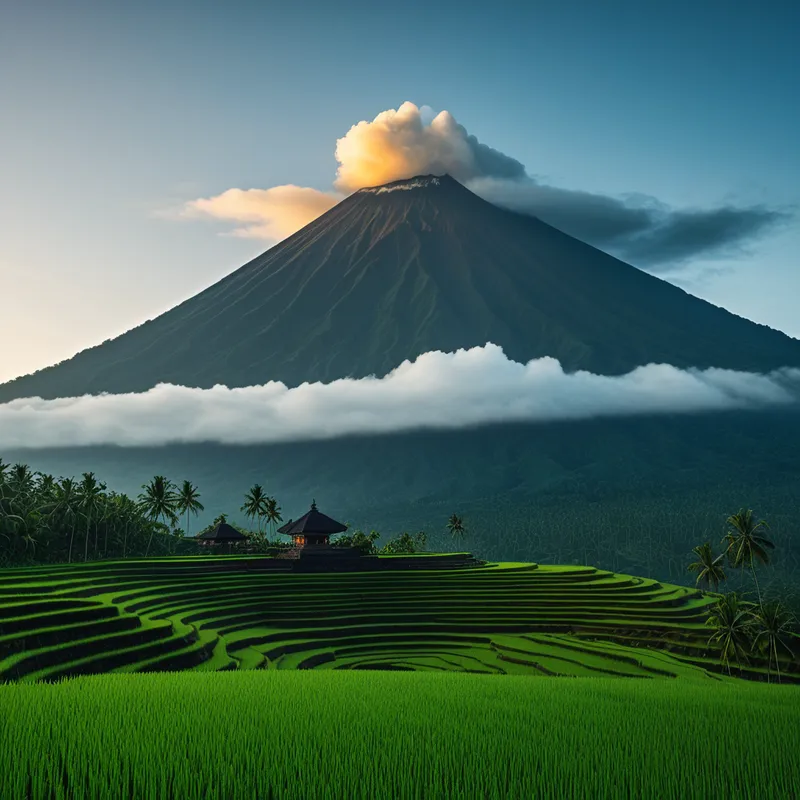
Mount Agung Sacred Volcano Myth Meaning & Symbolism
A Balinese myth where the gods, angered by human hubris, shatter the world mountain, forcing humanity to rebuild a sacred axis between heaven and earth.
The Tale of Mount Agung Sacred Volcano
In the time before time, when the world was young and the gods walked close to the earth, there stood a mountain that was the axis of all things. It was called Mount Agung, and it was not merely stone and soil, but the very spine of the island, the pillar that held up the dome of the sky. Its peak was the throne of the gods, a place where the mists of Swah Loka kissed the earth. Below, in the realm of men, Bhuwah Loka, life was in perfect dharma. The rivers ran clear, the rice grew tall, and the people offered their gratitude with fragrant smoke and the sound of gamelan, their lives oriented to the sacred peak.
But the human heart is a restless sea. A shadow grew—a whisper of pride, a forgetting. Some began to believe the bounty was theirs by right, not by grace. They turned their eyes from the mountain, building their homes and their lives askew, no longer aligned with the cosmic axis. The offerings grew scant, the prayers hollow. The harmony of the three worlds—the heavens, the earth, and the underworld—began to fray.
The gods convened in a storm of silent fury upon Agung’s summit. Sang Hyang Widhi witnessed the discord. The great deity Batara Kala stirred in the depths. The sacred connection, the Sumeru of this island, was being profaned by neglect. A decision was made, not in malice, but in the terrible necessity of cosmic law. The bond must be severed, so that it might be remade with conscious reverence.
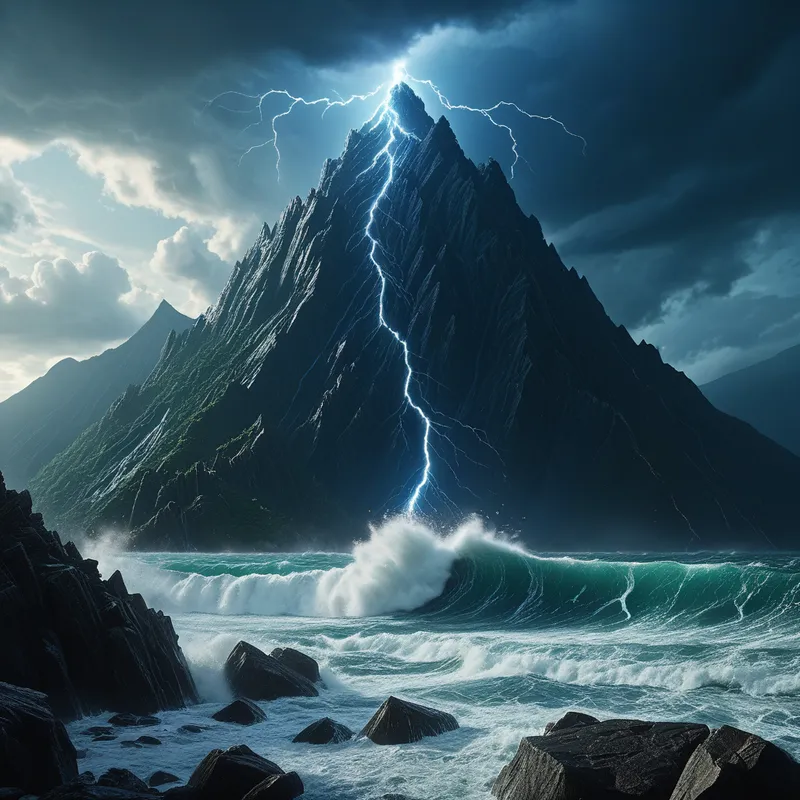
The sky darkened, not with clouds, but with divine absence. Then came the sound—a deep, groaning tear from the very heart of the world. With a cataclysm that shook the foundations of Bhur Loka, the peak of mighty Agung was struck. The gods themselves sheared it from its base. The crown of the world, the divine seat, shattered into colossal fragments that crashed into the surrounding sea, creating smaller islands, leaving Agung’s summit blunt and wounded. The axis was broken. The sky reeled, the earth trembled, and the people were cast into a profound darkness, not of night, but of spiritual desolation. Their world had lost its center.
From this abyss, a lesson was born in ash and terror. The survivors, humbled to their core, looked upon the wounded mountain not with fear, but with a new understanding. They had witnessed the cost of imbalance. Guided by priests and the whispers of their own chastened souls, they began the great work. They did not flee the mountain; they turned toward it. With immense toil and unwavering intent, they built the mother temple of Besakih, a staircase of stone and faith ascending Agung’s southern slopes. Each temple courtyard, each ornate gate, each meticulously placed shrine, became a deliberate act of reconnection—a realignment of the human world with the divine. The mountain, though scarred, remained sacred. It was now a testament: the axis is not given, but chosen, and must be maintained through sacrifice, orientation, and ceaseless devotion.
Cultural Origins & Context
This foundational myth originates from the rich tapestry of Balinese Hinduism, a unique syncretism of Indian Hindu cosmology, Buddhist philosophy, and indigenous Austronesian animism. It is not a single, fixed text but a living narrative embedded in the lontar (palm-leaf manuscripts), temple reliefs, and, most importantly, the oral traditions maintained by the Brahmana priests and village elders. The story is told during temple ceremonies (odalan) and lifecycle rituals, not as mere history, but as a perpetual reminder of cosmic geography.
Its societal function is profoundly practical and psychological. It explains the literal topography of Bali—the central dominance of Agung and the scattering of smaller islands. More critically, it encodes the core Balinese worldview of Rwa Bhineda and the necessity of Banten. The myth justifies the immense social effort required to maintain thousands of temples and perform daily offerings. It teaches that societal order (dharma) is a conscious, collective construction aligned with natural and supernatural law, and that hubris (adharma) leads to catastrophic disintegration. The mountain is both a physical landmark and a moral compass.
Symbolic Architecture
At its heart, the myth of Mount Agung is a profound drama of the Axis Mundi—its violation, destruction, and conscious restoration. The mountain symbolizes the connecting principle between different levels of reality: the unconscious (the earth/underworld), the conscious ego (the human realm), and the transcendent Self or divine (the heavens).
The shattered peak is the fractured psyche that has lost connection to its own sacred center, its inner authority.
The act of the gods is not arbitrary cruelty but a symbolic representation of the necessary enantiodromia—the emergence of the opposite. When conscious attitude becomes too one-sided (here, human arrogance and neglect), the unconscious psyche erupts in a compensatory, often devastating, correction. The volcanic eruption in the myth (and in reality) is the perfect symbol for this unconscious upwelling of powerful, transformative energy that destroys an old, rigid structure. The building of Besakih represents the ego’s arduous, post-cataclysm task: to rebuild a relationship with the transcendent not through naive innocence, but through hard-won wisdom and deliberate ritual—the architecture of the soul.
The Dreamer's Resonance
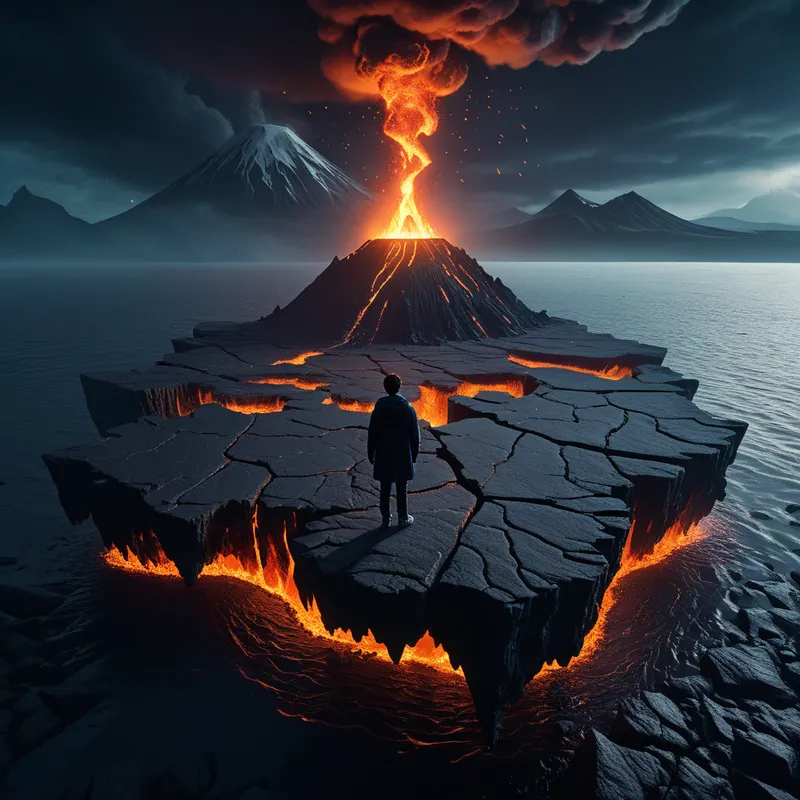
When this myth pattern erupts in the modern dreamscape, the dreamer is often experiencing a profound crisis of orientation. Dreams of earthquakes, crumbling personal "mountains" (careers, relationships, identities), or being lost in a landscape with no center signal that the psyche’s foundational structures are undergoing tectonic shift. The somatic feeling is often one of vertigo, groundlessness, or a deep, unsettling tremor in the gut.
This is the process of what James Hillman called "psychologizing the literal." The external world hasn’t necessarily collapsed, but the internal structures that gave it meaning and order have. The dream is initiating a katabasis—a descent. The dreamer is being forced to confront their own "neglect of the sacred"—perhaps the neglect of their inner life, their values, or their true calling. The fiery destruction in the dream is not merely punishment; it is the psyche’s fierce, purgatorial attempt to burn away the inauthentic and make space for a reorientation to a more central, truthful Self.
Alchemical Translation
The alchemical journey mirrored in this myth is the transition from Nigredo (blackening, chaos, dissolution) to Albedo (whitening, purification, new order). The initial state is one of presumed order, but it is an order built on ignorance or hubris—the unconscious alignment. The divine strike is the Nigredo, the devastating but necessary separatio that breaks apart the contaminated whole.
The sacrifice is not of a thing, but of a state of being—the comfortable, misguided ego-structure.
The long, laborious rebuilding of the temple is the Albedo and the beginning of Citrinitas (yellowing, illumination). This is the individuation process: the conscious, brick-by-brick construction of a personality oriented toward the Self. Each "temple courtyard" is a new complex integrated, each "gate" a boundary properly set, each "offering" a symbolic act of valuing the transcendent. The goal is not to return to the naive pre-cataclysm state, but to achieve a conjunctio—a sacred marriage—at a higher level. The individual becomes, like Besakih, a living axis: grounded in the earthly reality of their life, yet consciously aligned with the transpersonal depths and heights, capable of containing the sacred fire without being consumed by it.
Associated Symbols
Explore related symbols from the CaleaDream lexicon:
- Volcano — The myth's central symbol of transformative, purgatorial power from the depths, representing both divine wrath and the potential for rebirth from ash.
- Mountain — The archetypal Axis Mundi, the connecting pillar between heaven, earth, and underworld, whose stability is the prerequisite for cosmic and psychological order.
- Temple — The human-made structure of conscious devotion and ritual, symbolizing the ego's arduous work to rebuild a sacred connection after a spiritual catastrophe.
- Sacrifice — The core lesson of the myth; not merely ritual offering, but the sacrifice of human hubris and the comfortable illusion of self-sufficiency to restore balance.
- Order — The state of dharma or cosmic balance that is the myth's initial condition and ultimate goal, representing psychic integration and right relationship with all layers of reality.
- Earth — The realm of the human and the material, which must be properly oriented toward the sacred, and which trembles when that connection is broken.
- Sky — The realm of the gods and the transcendent, the source of the cataclysmic judgment that forces a necessary re-evaluation of one's place in the cosmos.
- Ritual — The prescribed, repetitive actions (like building Besakih) that serve to maintain the hard-won connection, symbolizing the daily practices that sustain psychological wholeness.
- Shadow — The neglected, arrogant aspect of humanity that grows when the sacred is ignored, ultimately provoking the destructive eruption from the unconscious.
- Rebirth — The promise after the destruction; the new consciousness and societal order that emerges from the ashes of the old, more resilient and reverent.
- Lightning — The divine instrument of severance, representing a sudden, illuminating, and destructive insight that shatters an outdated worldview.
- Journey — The collective human journey from ignorance through catastrophe to wisdom, mirrored in the individual's psychological path of disintegration and reintegration.