
Mother of the Forest Myth Meaning & Symbolism
The myth of the primordial spirit who is the soul of the Amazon, embodying its life, its wrath, and its ultimate, healing wisdom.
The Tale of Mother of the Forest
Listen. Beneath the ceaseless chorus of howler monkeys and the whisper of a million leaves, there is a heartbeat. It is slow, deep, older than the rivers. This is the pulse of the Mother of the Forest.
In the time before time, when the world was still soft and dreaming, she awoke from the dark, fertile earth. She was not born, she became. From the mycelial threads stitching the soil, from the sap rising in the first great trees, from the breath of the first jaguar, her consciousness coalesced. She is the green thought behind every growing thing. Her body is the labyrinth of roots, her voice the wind in the canopy, her gaze the dappled light that falls upon the forest floor.
For eons, she dreamed the world into being, and the people, the Children of the Vines, lived within her dream. They knew the rules: take only what you need, give thanks for everything, and never, ever take more than the forest can give. They spoke to her in the rustle of leaves, felt her blessing in the ripe fruit, her warning in the sudden stillness before a storm.
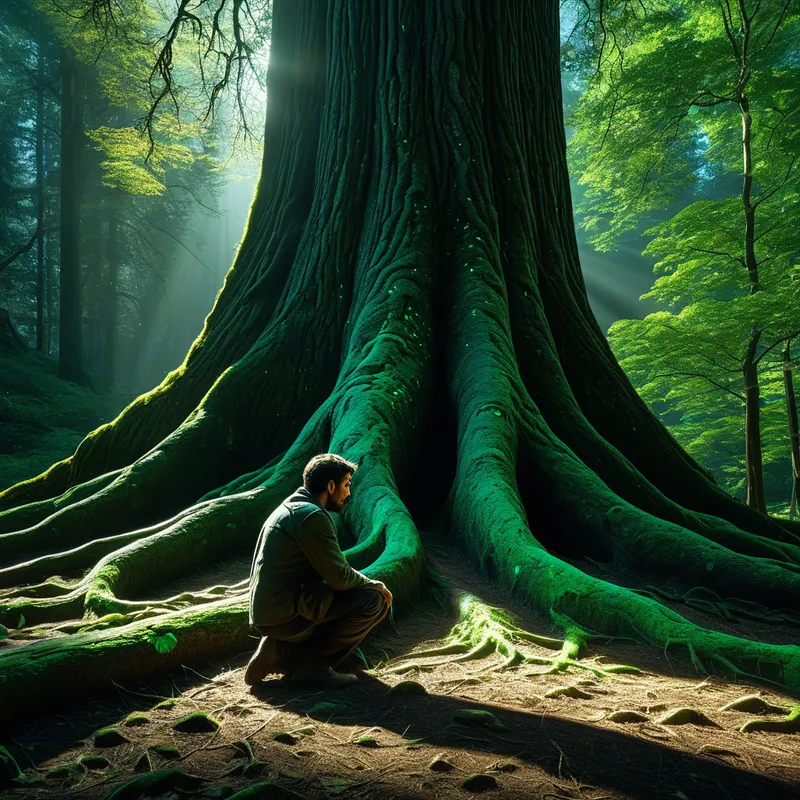
But then came a man, a hunter of great skill but hollow heart. His name is lost, remembered only as He-Who-Did-Not-See. Driven by hunger for more—more meat, more status, more—he ventured deep into a sacred grove, a place where the trees grew so close their trunks were like the walls of the Mother’s own chamber. There, he saw a tree unlike any other, its bark shimmering with a resin like solidified moonlight. It was the Arvore do Coração, the Heart-Tree.
He saw only a prize. He did not see the pulse within the wood, did not hear the low hum that vibrated in his teeth. He raised his stone axe. The first blow rang out, a sound of shocking violence in the holy silence. A tremor passed through the earth. The second blow sank deep, and from the wound, not sap, but a thick, dark fluid welled forth, smelling of iron and wet soil. The third blow never fell.
The grove erupted. The air grew thick and heavy, pressing on his lungs. The light died, not to darkness, but to a deep, oppressive green gloom. Vines, moving with purpose, snaked around his ankles. From the wounded Heart-Tree, a form began to emerge—not a beast, but the forest itself given shape and intent. The Mother of the Forest stood before him, towering, her form shifting between woman, tree, and jaguar. Her eyes were pits of ancient, furious life.
He was not struck down. He was enfolded. Vines lifted him, constricting, pulling him into the embrace of the great trees. Bark began to creep over his skin, roots to seek the spaces between his toes. The forest was not killing him; it was taking him back, absorbing him into the great, dreaming body from which he had foolishly thought himself separate. In that moment of terrifying unity, he felt it all—the pain of every felled tree, the fear of every hunted creature, the vast, interconnected web of life he had violated. He understood his smallness, his belonging, and his profound error.
And then, as suddenly as it began, the pressure ceased. The vines loosened. The green gloom lightened. He lay on the forest floor, gasping, the bark receding from his skin like a bad dream. The Heart-Tree stood, its wound sealed over with a strange, luminous moss. The Mother was gone, but her presence lingered, a whisper on the air: "You are not outside me. You are of me. Remember."
The hunter returned to his people a changed man. He could no longer speak of hunting, but only of listening. He became the first Pajé, the one who remembers the connection, who heals by reminding others that they, too, are within the Mother’s dream.
Cultural Origins & Context
This myth is not a singular story with a fixed text, but a living narrative current flowing through many Amazonian cultures, including the Yanomami, Shuar, and Shipibo-Conibo. It is a foundational cosmogonic narrative that establishes the fundamental ontology of the world: the rainforest is not a resource, but a conscious, sentient being.
The tale is traditionally passed down orally by elders and shamans (Pajés) during rituals, initiations, and times of ecological or social crisis. Its function is multifaceted: it is a moral compass enforcing sustainable practice, a theological framework explaining the spirit-inhabited world (animism), and a psychological map for understanding the consequences of human arrogance (hubris). The story encodes the essential law of the jungle: reciprocity. To take without seeing, without gratitude, is to invite the dissolution of the self.
Symbolic Architecture
At its core, the myth of the Mother of the Forest is a profound exploration of the psyche’s relationship to the Great Mother archetype, in both her nurturing and her terrifying aspects.
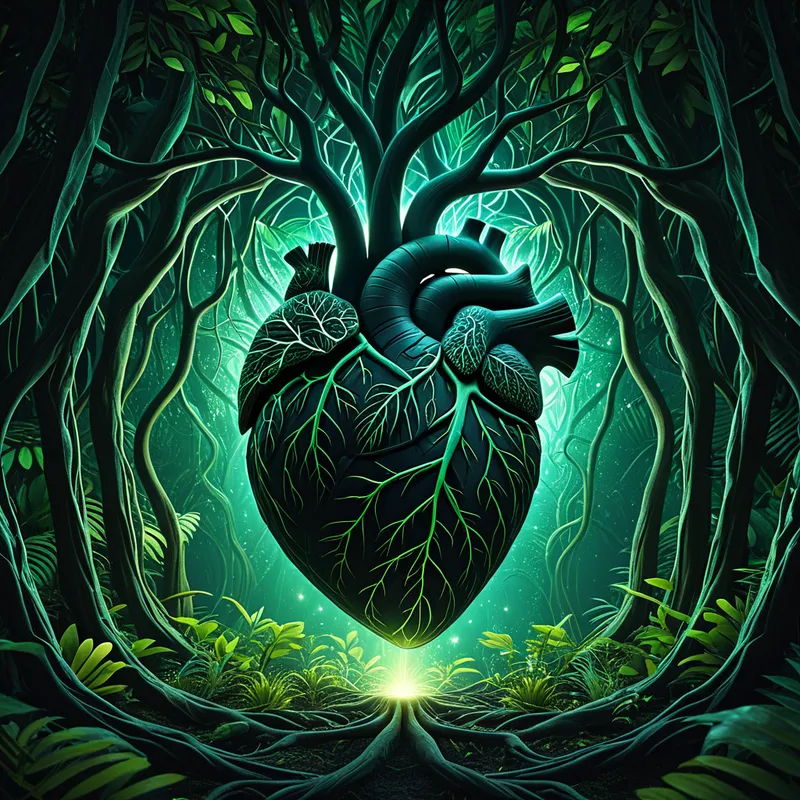
The Mother of the Forest is the ultimate reality of the interconnected Self, the psychosomatic matrix from which individual consciousness sprouts and into which it can be reabsorbed.
The Heart-Tree symbolizes the central axis, the axis mundi, connecting the human realm to the divine. To wound it is to attack the very principle of life and connection. The hunter, He-Who-Did-Not-See, represents the nascent ego in its most primitive state: identified solely with its own hunger and agency, utterly blind to the larger network of life that sustains it. His axe is the tool of differentiation turned to violence, the intellect used to sever rather than to understand.
The Mother’s response—absorption, not annihilation—is key. She represents the unconscious itself. When the conscious ego (the hunter) acts in a way that profoundly violates the laws of the whole Self (the ecosystem), the unconscious does not simply punish it; it seeks to reclaim it, to dissolve its rigid boundaries and remind it of its fundamental belonging. The experience of being turned to wood is the ultimate somatic metaphor for psychic rigidity, for being frozen in one’s own isolated perspective.

The Dreamer's Resonance
When this myth stirs in the modern dreamer, it often surfaces during periods of profound disconnection—from nature, from the body, from a sense of purpose. To dream of a vast, sentient forest that feels watchful or of becoming entangled in roots and vines is to encounter the Mother of the Forest archetype.
The somatic process is one of constriction and subsequent release. The dreamer may feel paralyzed, suffocated, or physically merged with their environment, mirroring the hunter’s enfoldment. This is not a nightmare of external attack, but a profound internal correction. The psyche is applying pressure to an over-inflated or isolated ego-structure, forcing a confrontation with what has been ignored or exploited—often one’s own instinctual life, creative energy, or physical health. The resolution, if the dream allows it, is not escape, but the shocking, humbling realization of interdependence. The dreamer awakens not with fear, but with a strange, earthy gratitude, a felt sense of being part of rather than apart from.
Alchemical Translation
The myth models the alchemical process of solve et coagula—dissolve and coagulate—applied to the modern journey of individuation. The goal is not to escape the Mother, but to consciously recognize and relate to her, transforming a blind, potentially devouring connection into a sacred, reciprocal one.
Individuation is not about leaving the forest, but about learning to see the trees, the vines, and the dark soil as parts of the same living body that includes you.
The hunter’s initial state is coagula gone wrong: a hardened, isolated ego-identity. His violent act triggers the solve: the deconstructing, enfolding power of the unconscious (the Mother) dissolves his rigid boundaries. This is the terrifying but necessary nigredo, the dark night of the soul where one faces the consequences of one’s separateness.
His transformation into the first Pajé represents the new coagula. He re-coagulates, not as a separate hunter, but as a mediator, a conscious bridge between the human village (the realm of differentiated consciousness) and the sentient forest (the unconscious, the Self). He has gained seeing. For us, this translates to the development of what we might call ecological consciousness within the psyche: the ability to perceive the needs of the larger Self, to listen to the instincts and intuitions (the rustle in the leaves), and to act with reciprocity. We are called to put down the axe of ruthless exploitation—of our own energies, of others, of the planet—and to pick up the role of the healer who remembers the connection. In doing so, we do not lose our individuality; we ground it in the only reality that can ultimately sustain it: the living, dreaming, all-encompassing body of the world.
Associated Symbols
Explore related symbols from the CaleaDream lexicon: