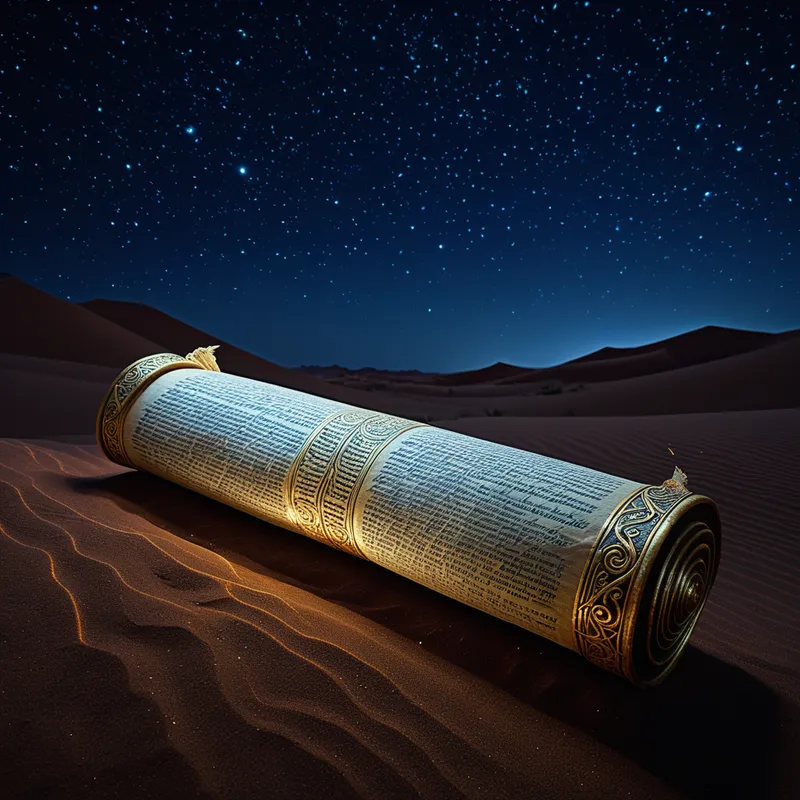
Moth and Rust Myth Meaning & Symbolism
A parable warning against storing treasures on earth, where moth and rust consume, pointing toward the eternal treasures of the spirit.
The Tale of Moth and Rust
Listen. The wind does not whisper in the marketplace, where coins clink and silks rustle. It speaks in the storerooms, in the locked chambers of the heart. It carries a tale not of kings and prophets, but of silence and slow consumption.
There was a man whose soul became a granary. He looked upon his fields, heavy with grain, and his spirit swelled. He looked upon his coffers, brimming with silver shekels, and his heart grew firm as stone. “I am secure,” he said to the silent walls of his treasury. “I have built barns for my abundance. My future is a fortress.”
And so he built. Not barns of wood and mud, but vaults within his own being. He stored his joy in the gleam of a new coin. He stored his peace in the weight of a measured sack. He stored his very name in the admiration of his neighbors, who saw his full barns and called him blessed. His treasure was not gold alone, but the certainty it promised—a tomorrow identical to today, a life defended from the howling void of chance.
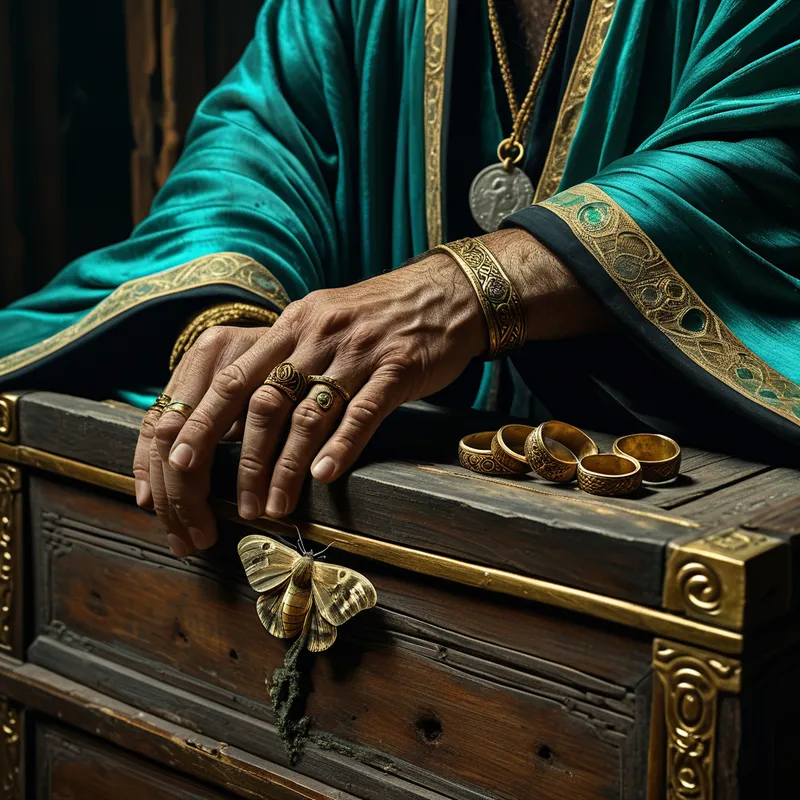
But in the deep places, where the lamplight does not reach, other workers toiled. From the folds of his finest linen, stored in cedar chests to scent his wealth, came a faint fluttering. Not a sound to wake a man, but a whisper of wings softer than a sigh. The moth emerged, a creature of shadow and appetite, and where it walked it did not roar or rend. It kissed the threads with its hunger, and where it kissed, holes appeared—tiny windows into nothingness. The garment, meant to proclaim his status, became a lacework of absence.
And from the stone of the foundation, from the very air heavy with the breath of the earth, came a patient, thirsty presence. Rust. It did not attack with flame or hammer. It courted the iron lock on his strongbox, the head of the nail in his barn door. With a lover’s slow persistence, it transformed strength into a brittle, red powder. The lock that secured his world became a stain on his fingers. The nail that held his structure firm crumbled at a touch.
The man would visit his treasury, and at first, he saw only the whole. The gleam of silver, the pile of cloth. But one day, he lifted a robe and the light streamed through it, a constellation of tiny voids. He took a coin and its face was blurred under a crimson crust. A slow, cold understanding seeped into him, quieter than the moth, more patient than the rust. His fortress was besieged by time itself. His treasure was not being stolen; it was un-becoming. It was returning, molecule by molecule, whisper by whisper, to the dust from which it came. The granary of his soul was filled with the echoes of feasts already digested by the world.
Cultural Origins & Context
This is not a myth of the temple mount, but of the human heart, spoken by a voice that walked the dust of Galilee. It originates from the Sermon on the Mount, a radical discourse recorded in the Gospel of Matthew. The speaker, Jesus of Nazareth, was a teacher addressing an agrarian society intimately familiar with the twin destroyers of material security: the clothing-moth (Tineola bisselliella) and the oxidation of metal.
Told not in royal courts but on hillsides to peasants, fishermen, and the dispossessed, its function was profoundly subversive. It directly challenged the tangible markers of blessing and social stability in the Ancient Near East—agricultural surplus and wealth in coinage. In a culture where wealth was often seen as a sign of divine favor (a theme in the older Torah), this parable inverted the logic. It framed excessive, anxiety-driven accumulation as an act of profound folly, not because wealth was evil, but because it was tragically ephemeral. The parable was a mnemonic device, a stark, unforgettable image meant to reorient the listener’s fundamental axis of value from the horizontal plane of earth to the vertical dimension of heaven—from the temporal to the eternal.
Symbolic Architecture
The myth’s power lies in its choice of antagonists. They are not dragons or invading armies, but agents of inevitable, intimate decay.
The Moth symbolizes the hidden, internal corrosion of what we cherish. It works in darkness, on the soft, valuable, and personal—our reputations (fine linens), our cherished identities, the fragile fabrics of our achievements. It represents the anxiety that eats at joy, the doubt that unravels conviction, the slow forgetting that dissolves legacy. It is entropy applied to the psyche’s tapestries.
Where the moth works, it does not destroy, but reveals the inherent emptiness of that which cannot truly clothe the soul.
Rust symbolizes the external, inevitable corrosion of our structures of security and power. It attacks the hard, the metallic, the engineered—our financial systems, our careers, our physical strength, the institutions we trust to protect us. Rust is the law of thermodynamics in narrative form; all organized systems tend toward disorder. It is time made visible, the patient proof of our mortality and the ultimate fragility of all worldly empires.
Together, they form a complete portrait of anicca—impermanence. The “treasure” is any psychological investment where we attempt to store our sense of self, security, and meaning in that which is inherently subject to decay. The parable is less a warning about wealth and more a devastating diagnosis of misplaced worship.
The Dreamer's Resonance
When this myth stirs in the modern unconscious, it rarely appears as a biblical scene. Instead, the dreamer encounters the feeling of moth and rust.
One may dream of a prized possession—a diploma, a wedding ring, a first edition book—suddenly crumbling to dust in their hands, or being covered in a beautiful, alien patina. They may find themselves in a childhood home that is simultaneously familiar and eerily decayed, with wallpaper peeling in precise patterns. A common motif is the frantic attempt to store or protect something (often in a basement or attic) only to find the containers themselves are rotten, or that what’s inside has been transformed into something useless yet strangely aesthetic.
Somatically, this dream pattern correlates with a dawning awareness of a profound investment loss. This is not merely financial, but psychological: the realization that a long-held identity (“the successful one,” “the caregiver,” “the idealist”) is no longer tenable, that its material is threadbare. It signals the end of a naive projection of permanence onto a relationship, career phase, or self-image. The psyche, through the dream, is initiating the painful but necessary work of de-identification, dissolving the ego’s attachment to forms that are passing away. The accompanying emotion is often a deep, quiet grief mixed with a surreal sense of awe at the process of decay itself.

Alchemical Translation
In the alchemy of the soul, the parable of Moth and Rust is not a condemnation but a precise recipe for the nigredo, the blackening, the necessary first stage of dissolution.
The conscious ego builds its treasure house, its complex identity forged from achievements, relationships, and possessions. This is the prima materia—the raw, undifferentiated stuff of the personality. The work of individuation, however, requires that this conscious structure be broken down so that a more authentic, timeless Self can emerge. Moth and Rust are the archetypal agents of this separatio.
The spiritual imperative is not to flee from the moth and rust, but to learn their language. They are the ministers of a sacred deconstruction.
The “treasure in heaven” is the symbolic equivalent of the alchemical Lapis Philosophorum—the incorruptible gold of the integrated psyche. To store treasure there is to shift one’s center of gravity from the ego (which is of time and form) to the Self (which participates in the timeless). It means investing one’s life-energy not in building monuments, but in cultivating qualities that transcend the corrosive cycle: compassion, wisdom, creative love, and conscious presence.
The modern individual undergoes this alchemy when a life crisis—a job loss, an illness, a betrayal, the simple passage of years—acts as the moth and rust. The old treasures corrode. The pain of this process is the calcinatio, the burning away of dross. If one can endure this fire without desperately rebuilding the same vulnerable storehouses, the soul learns a new economy. It begins to value the breath over the banknote, the moment of connection over the lasting monument, the integrity of being over the appearance of having. One discovers that the only thing moth cannot eat and rust cannot corrupt is the light of consciousness itself, the silent witness that observes even the decay of all it once held dear. In that realization, the parable completes its work: the destruction of earthly treasure becomes the revelation of the soul’s true, immutable ground.
Associated Symbols
Explore related symbols from the CaleaDream lexicon: