Moses in the Wilderness Myth Meaning & Symbolism
A prophet flees Egypt, finds his calling in a burning desert, and returns to lead his people through a wilderness of doubt and revelation.
The Tale of Moses in the Wilderness
Listen, and hear the tale of the man between two worlds.
He was a prince in the house of reeds, nursed on the milk of slaves and the gold of [Pharaoh](/myths/pharaoh “Myth from Egyptian culture.”/). [Moses](/myths/moses “Myth from Biblical culture.”/) knew the cool marble of palaces and the hot, frantic pulse of a suppressed people—his people. But a violent act of defense turned him into a fugitive, a ghost fleeing across the border of the known world. The glittering Nile gave way to the relentless, sun-bleached expanse of Midian. Here, the only crown was a turban against the sun; the only scepter, a shepherd’s staff.
For forty years, [the desert](/myths/the-desert “Myth from Biblical culture.”/) worked upon him. It scoured away the prince, grain by grain, in the searing wind. It taught him the language of thirst, the patience of rock, the slow rhythm of leading stubborn flocks to sparse, hidden springs. He married, bore the mark of a simple life. The memory of Egypt faded to a distant, troubling dream.
Until the day the mountain spoke.
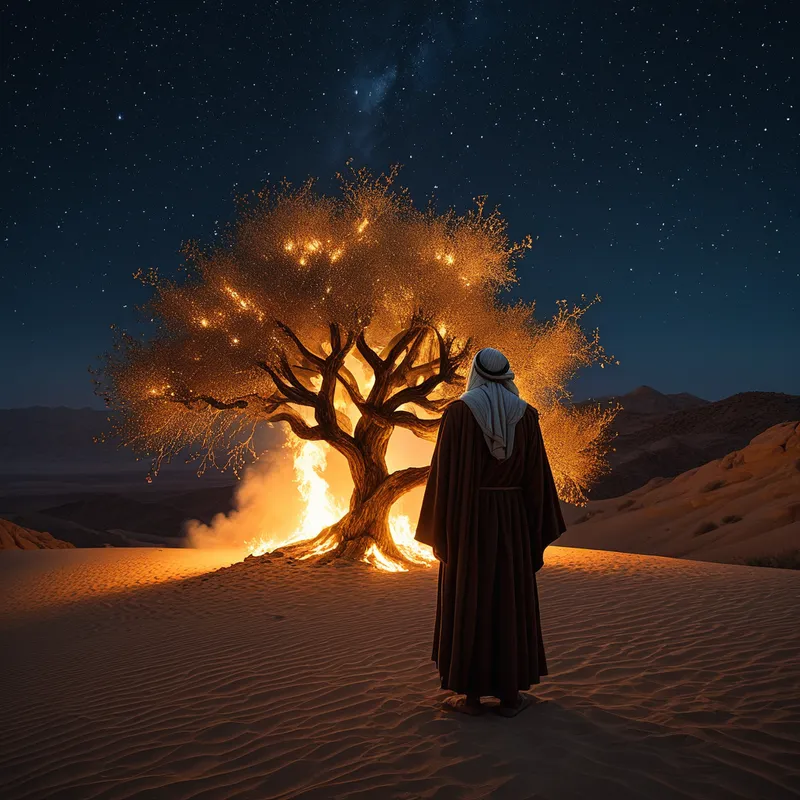
On the slopes of Horeb, he saw it: a thornbush, engulfed in flame yet not consumed. The fire danced with an impossible, living intelligence. A voice issued from the heart of the blaze, a sound that vibrated in the marrow of his bones: “Moses, Moses.” He hid his face, for he knew this was holy ground. The voice named itself: YHWH, the God of his forgotten fathers.
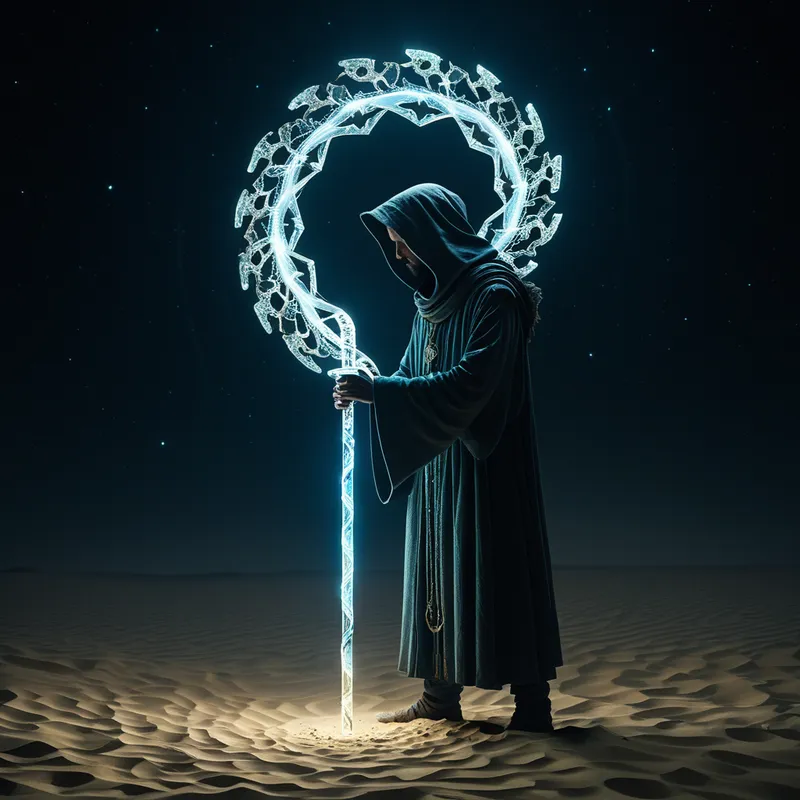
The command was terrifying, absurd: “Go back. Bring my people out.” Moses protested—a stammering man with a murderer’s past, unfit for palaces. But the voice was relentless. It gave signs: a staff that became a serpent, a hand that turned leprous and was cleansed. The very ground he stood on was consecrated by purpose. The exile was over. The return had begun.
But [the wilderness](/myths/the-wilderness “Myth from Biblical culture.”/) was not done with him. Leading a fractious, newly-freed people, Moses walked back into the desert, this time as a guide. He faced their hunger, and [manna](/myths/manna “Myth from Biblical culture.”/) fell like frost. He faced their thirst, and [water](/myths/water “Myth from Chinese culture.”/) burst from stricken rock. At the mountain’s peak, shrouded in a terrifying cloud of thunder and lightning, he received the covenant, [the law](/myths/the-law “Myth from Biblical culture.”/) etched by divine fire on tablets of stone.
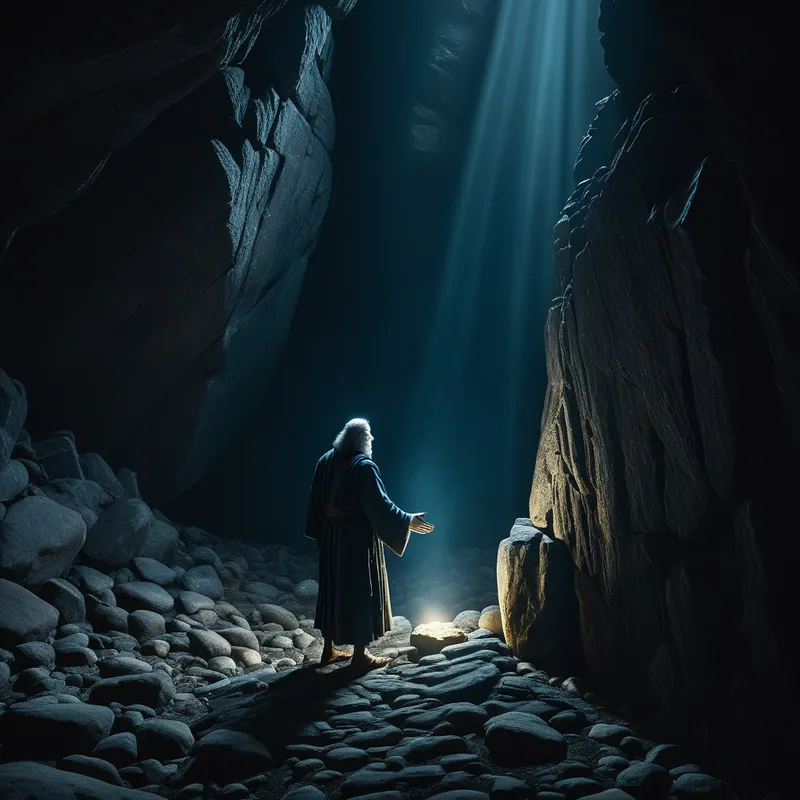
Yet the ultimate trial was intimacy. In a moment of desperate need, he begged to see the glory of YHWH. The answer was a profound paradox. He was placed in the cleft of a rock, shielded as the divine presence passed by. He did not see the face, for no mortal could. He saw only the back—the aftermath, the wake of glory. It was a revelation of presence in absence, of knowing only through the trace left behind. He descended, his own face shining with a reflected light so fierce he had to veil it from his people. The man who fled was gone. In his place stood the prophet, his very skin a testament to the wilderness and its holy, consuming fire.
Cultural Origins & Context
This narrative is the foundational epic of Israelite identity, woven from the Pentateuchal sources known as J, E, and P. It was not a single author’s creation but a living story, told and retold around campfires, recited at festivals, and codified by priestly scribes during and after the Babylonian Exile. Its primary function was etiological: to explain who [the Israelites](/myths/the-israelites “Myth from Abrahamic culture.”/) were—a people not defined by a land, but by a covenant forged in the desert with a God who chose them in their marginal state.
The wilderness setting is not incidental but central. For a people often under empire (Egypt, Babylon, Persia), the desert represented a liminal space of both deprivation and divine encounter. It was the place where the slave mentality of Egypt died, and the identity of a free people bound by law was born. The story of Moses served as the archetypal model for the nation’s own experience: called out of oppression, tested in the in-between, and guided toward a promised, though often elusive, future.
Symbolic Architecture
The [wilderness](/symbols/wilderness “Symbol: Wilderness often symbolizes the untamed aspects of the self and the unconscious mind, representing a space for personal exploration and discovery.”/) is the supreme [symbol](/symbols/symbol “Symbol: A symbol can represent an idea, concept, or belief, serving as a powerful tool for communication and understanding.”/) of the liminal. It is the psychic [landscape](/symbols/landscape “Symbol: Landscapes in dreams are powerful symbols representing the dreamer’s emotional state, personal journey, and the broader context of life situations.”/) where the constructed self—the Egyptian [prince](/symbols/prince “Symbol: A prince symbolizes nobility, leadership, and aspiration, often representing potential or personal authority.”/), the comfortable Midianite [shepherd](/symbols/shepherd “Symbol: A shepherd symbolizes guidance, protection, and the nurturing aspects of leadership, often reflecting the dreamer’s desire for direction or support.”/)—is stripped away, leaving the raw essence of the [soul](/symbols/soul “Symbol: The soul represents the essence of a person, encompassing their spirit, identity, and connection to the universe.”/) exposed to the elements and the divine.
The burning bush is the symbol of the numinous encounter that does not destroy the vessel. It represents the ego’s confrontation with a transformative energy from the unconscious that illuminates without annihilating.
Moses himself embodies the reluctant [prophet](/symbols/prophet “Symbol: A messenger or seer who receives divine revelations, often warning of future events or guiding moral direction.”/), the individual who must integrate a shattering transpersonal call into a personal [history](/symbols/history “Symbol: History in dreams often represents the dreamer’s past experiences, lessons learned, or unresolved issues that continue to influence their present.”/) of flaw and failure. His staff, the tool of his humble profession, becomes the [instrument](/symbols/instrument “Symbol: An instrument symbolizes creativity, communication, and the means by which one expresses oneself or influences the world.”/) of divine power—the [serpent](/symbols/serpent “Symbol: A powerful symbol of transformation, wisdom, and primal energy, often representing hidden knowledge, healing, or temptation.”/) of [chaos](/symbols/chaos “Symbol: In Arts & Music, chaos represents raw creative potential, uncontrolled expression, and the breakdown of order to forge new artistic forms.”/) tamed. The forty years signify a complete cycle of [incubation](/symbols/incubation “Symbol: A period of internal development, rest, or hidden growth before emergence, often associated with healing, creativity, or transformation.”/), a necessary [period](/symbols/period “Symbol: Periods in dreams can symbolize cyclical patterns, renewal, and the associated emotions of loss or change throughout life.”/) of forgetting and re-grounding before the [mission](/symbols/mission “Symbol: A mission in dreams represents one’s aspirations and goals, often linked to a sense of purpose or commitment.”/) can be received.
Most profound is the [vision](/symbols/vision “Symbol: Vision reflects perception, insight, and clarity — often signifying the ability to foresee or understand deeper truths.”/) of the “back” of God. This is the [psychology](/symbols/psychology “Symbol: Psychology in dreams often represents the exploration of the self, the subconscious mind, and emotional conflicts.”/) of indirect [revelation](/symbols/revelation “Symbol: A sudden, profound disclosure of truth or insight, often through artistic or musical means, that transforms understanding.”/). We cannot perceive the [source](/symbols/source “Symbol: The origin point of something, often representing beginnings, nourishment, or the fundamental cause behind phenomena.”/) of [the Self](/myths/the-self “Myth from Jungian culture.”/) directly; we can only comprehend it through its effects—through the traces it leaves in our lives, our relationships, and our creative acts. The shining face of Moses is the [human](/symbols/human “Symbol: The symbol of a human represents individuality, complexity of emotions, and social relationships.”/) [psyche](/myths/psyche “Myth from Greek culture.”/) permanently altered by this encounter, bearing a [radiance](/symbols/radiance “Symbol: A powerful symbol of illumination, divine presence, and inner awakening, often representing clarity, truth, and spiritual energy.”/) it must sometimes [veil](/symbols/veil “Symbol: A veil typically symbolizes concealment, protection, and transformation, representing both mystery and femininity across cultures.”/) for the ordinary world.
The Dreamer’s Resonance
When this myth stirs in the modern dreamer, it often signals a profound liminal crisis. To dream of wandering in a vast, featureless desert is to somatically experience the dissolution of old identities—a career, a relationship, a belief system. The body feels the thirst for meaning, the exhaustion of known paths.
Dreaming of a miraculous fire or a talking plant (a modern “burning bush”) points to a nascent, startling insight breaking through from the deeper psyche, an intuition or calling that feels both terrifying and sacred. The dreamer may awake with a sense of awe and dread, a “holy ground” feeling that something has been asked of them that they feel utterly unprepared to give. Resistance, like Moses’ stammer, manifests as dream scenarios of being mute, unable to speak the truth that has been revealed.

Alchemical Translation
The alchemy of the wilderness is the opus contra naturam—the work against one’s current nature. It is the process of individuation modeled in epic form.
First, the [nigredo](/myths/nigredo “Myth from Alchemical culture.”/) (blackening): the flight from Egypt. This is the necessary rupture, the conscious ego’s comfortable world incinerated by conflict or fate. One is cast into the “desert” of depression, loss, or existential confusion.
Second, the albedo (whitening): the forty years in Midian. This is the long, often tedious, work of simplification. The grandiose fantasies (the prince) are eroded. One tends to the simple, flock-like basics of life, developing patience and humility—[the vessel](/myths/the-vessel “Myth from Alchemical culture.”/) is cleansed and made plain.
Third, the citrinitas (yellowing): the encounter at the bush. The prepared vessel meets the transformative fire. The unconscious (the divine voice) issues its call to a specific, life-reorienting purpose. This is the illumination, the granting of the “staff” of one’s unique authority and power.
The final stage, the rubedo (reddening), is the return. It is Moses leading his people. The integrated self must now engage with the world, performing the difficult, often thankless work of translating inner revelation into outer law, structure, and leadership. The face shines, but the work is in the dusty, thirsty plains with a complaining populace. The alchemy is complete not in solitary enlightenment, but in the fraught, glorious, and imperfect task of bringing something of the promised land into being.
Associated Symbols
Explore related symbols from the CaleaDream lexicon: