Moses at the Burning Bush Myth Meaning & Symbolism
A shepherd encounters a bush that burns but is not consumed, hearing a voice that calls him to liberate his people and confront his destiny.
The Tale of Moses at the Burning Bush
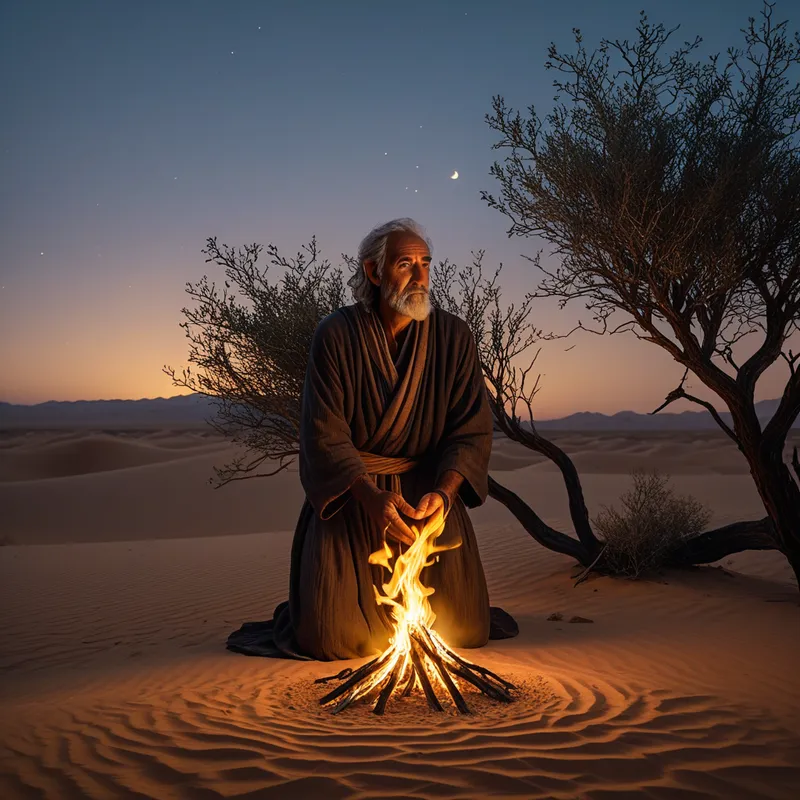
[The desert](/myths/the-desert “Myth from Biblical culture.”/) of Horeb is a place of bones and whispers. The sun, a merciless bronze disk, had baked [the world](/myths/the-world “Myth from Tarot culture.”/) into silence. Here, a man named [Moses](/myths/moses “Myth from Biblical culture.”/) tended another man’s flock, a prince turned shepherd, his past a buried scar and his future a featureless horizon of dust and rock.
He led the sheep beyond [the wilderness](/myths/the-wilderness “Myth from Biblical culture.”/), to the mountain of God. And there, in the thin, sharp air, a sight arrested him: a bush, a common desert thorn, was ablaze with fire. Yet it was not consumed. The flames leapt and danced in a golden, silent riot, but the leaves remained, green and whole. No crackle of devouring wood, only the profound, impossible spectacle of a fire that gives life instead of taking it.
“I will turn aside to see this great sight,” Moses said, his voice a dry rustle in the vast quiet. As he drew near, a voice called from the very heart of the flame. “Moses, Moses!”
“Here I am,” he replied, instinct overriding terror.
“Do not come near; put off your sandals from your feet, for the place on which you are standing is holy ground.” The voice was not in the air but within the ground, within his bones. It declared itself: “I am the God of your father, the God of Abraham, the God of [Isaac](/myths/isaac “Myth from Biblical culture.”/), and the God of [Jacob](/myths/jacob “Myth from Biblical culture.”/).” And Moses hid his face, for he was afraid to look upon the divine.
The voice spoke of seeing the misery of His people in Egypt, of hearing their cry. “I have come down to deliver them,” it thrummed. “Come, I will send you to [Pharaoh](/myths/pharaoh “Myth from Egyptian culture.”/) that you may bring forth my people, the children of Israel, out of Egypt.”
Terror flooded the shepherd. “Who am I that I should go to Pharaoh?” he protested. The voice answered not with qualifications but with presence: “I will be with you.” And when Moses asked for a name to give to the people, the voice from the fire uttered the unutterable, the essence of being itself: “YHWH. Thus you shall say to the people of Israel, ‘I AM has sent me to you.’”
The dialogue continued, a struggle between divine commission and human frailty. Moses pleaded his inadequacy, his slowness of speech. The fire did not waver. It appointed his brother Aaron as his mouthpiece. It promised signs: the staff that would become a serpent, the hand that would turn leprous and be cleansed. The unconsumed bush bore witness to a covenant renewed, a destiny imposed, and a man utterly, irrevocably transformed. The shepherd would not return to the flock. He would turn his face toward Egypt, carrying a fire in his heart that could not be put out.

Cultural Origins & Context
This foundational myth is embedded in the Torah, specifically the Book of Exodus. It originates from the oral and written traditions of ancient Israel, a people defining themselves in contrast to the imperial powers of the ancient Near East, particularly Egypt. The story functions as the pivotal origin myth for the prophet Moses and, by extension, for the liberation of the Israelite nation.
Scholars situate its narrative form within a corpus of “call narratives” common to prophetic literature (e.g., [Isaiah](/myths/isaiah “Myth from Abrahamic culture.”/), Jeremiah), establishing the legitimacy and divine authority of the prophet. Its societal function was multifaceted: it provided an etiological explanation for the sacred, unpronounceable name of God (YHWH); it framed national liberation as a divine imperative rather than a political revolt; and it modeled the archetype of the reluctant leader chosen by God, assuring later communities that divine calling transcends human readiness. Passed down through priestly and levitical storytellers, it served as a perpetual reminder that revelation occurs not in palaces but in the marginal spaces of the wilderness, to those who have turned aside to see.
Symbolic Architecture
The myth is a dense [matrix](/symbols/matrix “Symbol: A dream symbol representing the fundamental structure of reality, consciousness, or the self. It often signifies feelings of being trapped, controlled, or questioning the nature of existence.”/) of symbols speaking to the [psychology](/symbols/psychology “Symbol: Psychology in dreams often represents the exploration of the self, the subconscious mind, and emotional conflicts.”/) of vocation and encounter with the numinous. The [Bush](/symbols/bush “Symbol: The bush symbolizes hidden knowledge, nature’s beauty, and life cycles, often representing personal growth or challenges.”/) itself represents the manifest world, the ordinary [vessel](/symbols/vessel “Symbol: A container or structure that holds, transports, or protects something essential, representing the self, emotions, or life journey.”/) ([prima materia](/myths/prima-materia “Myth from Alchemical culture.”/)) that can contain and express the divine fire without being destroyed by it. It is the [symbol](/symbols/symbol “Symbol: A symbol can represent an idea, concept, or belief, serving as a powerful tool for communication and understanding.”/) of sustained [revelation](/symbols/revelation “Symbol: A sudden, profound disclosure of truth or insight, often through artistic or musical means, that transforms understanding.”/), of a sacred [reality](/symbols/reality “Symbol: Reality signifies the state of existence and perception, often reflecting one’s understanding of truth and life experiences.”/) interpenetrating the mundane.
The Fire is the archetypal symbol of [spirit](/symbols/spirit “Symbol: Spirit symbolizes the essence of life, vitality, and the spiritual journey of the individual.”/), transformation, and purifying [presence](/symbols/presence “Symbol: Presence in dreams often signifies awareness or acknowledgment of something significant in one’s life.”/). That it does not consume signifies a divine [energy](/symbols/energy “Symbol: Energy symbolizes vitality, motivation, and the drive that fuels actions and ambitions.”/) that illuminates and transforms without annihilating [the self](/myths/the-self “Myth from Jungian culture.”/). It is the terrifying yet creative force of the unconscious, the Self in Jungian terms, breaking into conscious [awareness](/symbols/awareness “Symbol: Conscious perception of self, surroundings, or internal states. Often signifies awakening, insight, or heightened sensitivity.”/).
The holy ground is not a location on a map, but the psychic territory where one’s constructed identity is dissolved, where the sandals of personal history and defense must be removed.
Moses’s Reluctance (“Who am I?”) embodies [the ego](/myths/the-ego “Myth from Jungian culture.”/)’s [resistance](/symbols/resistance “Symbol: An object or tool representing opposition, struggle, or the act of pushing back against external forces or internal changes.”/) to the overwhelming demands of the Self. His objections are not cowardice but the honest shock of the personal [psyche](/myths/psyche “Myth from Greek culture.”/) confronted with the transpersonal mandate. The giving of the Sacred Name (YHWH) is the ultimate symbolic act: it translates the unknowable into a relational formula—the ground of all Being itself becomes the companion in the [task](/symbols/task “Symbol: A task represents responsibilities, duties, or challenges one faces.”/). It signifies that the power for the [journey](/symbols/journey “Symbol: A journey in dreams typically signifies adventure, growth, or a significant life transition.”/) does not reside in the [hero](/symbols/hero “Symbol: A hero embodies strength, courage, and the ability to overcome significant challenges.”/)‘s qualities, but in his [connection](/symbols/connection “Symbol: Connection symbolizes relationships, communication, and bonds among individuals.”/) to the [source](/symbols/source “Symbol: The origin point of something, often representing beginnings, nourishment, or the fundamental cause behind phenomena.”/) of existence.
The Dreamer’s Resonance
When this myth pattern erupts in the modern dreamscape, it signals a profound summons from the deep psyche. To dream of a Bush That Burns But Is Not Consumed is to experience the Self announcing its presence in a way that captivates but does not (yet) destroy the dreamer’s current life structure. The somatic feeling is often one of awe, a chilling warmth, or a paralyzing fascination.
The dreamer may be Moses, hesitating at the edge. This reflects a conscious life at a crossroads, where a deep, authentic calling (to change career, leave a relationship, create art, begin therapy) is making itself known, accompanied by intense feelings of inadequacy and fear. The voice from the fire is the voice of one’s own deepest, non-egoic truth, which often feels alien and authoritative. To dream of being commanded to remove one’s sandals can symbolize the necessary, vulnerable shedding of old identities, defenses, and the “ground” one has walked on—social [persona](/myths/persona “Myth from Greek culture.”/), family scripts, career trappings—to stand naked before what is most real. The psychological process is the initial, often terrifying, engagement with individuation: the call to become who one fundamentally is, beyond the expectations of the tribe (Egypt) and the safety of the familiar wilderness.
Alchemical Translation
The alchemical journey begins with the [nigredo](/myths/nigredo “Myth from Alchemical culture.”/), the blackening. For Moses, this was his exile in Midian—a period of dissolution, where his Egyptian prince identity was dead and the new form not yet born. [The Burning Bush](/myths/the-burning-bush “Myth from Christian culture.”/) is the sublime moment of the albedo, the whitening: an illuminating vision that reveals the hidden sacredness within the base material of his life (shepherding, exile). The fire is the citrinitas, the yellowing or spiritual awakening, where [the divine spark](/myths/the-divine-spark “Myth from Gnostic culture.”/) is recognized.
The core struggle—between the calling of the Self (the voice) and the resistance of the ego (Moses’s protests)—models the essential friction of psychic transmutation. The ego must be humbled (“remove your sandals”) but not annihilated; it is to be enlisted as [the vessel](/myths/the-vessel “Myth from Alchemical culture.”/) for the work.
The miracle is not that the bush speaks, but that the shepherd listens. Individuation is the process of learning to stand on holy ground, to let the fire define you without letting it destroy you.
The final stage, the [rubedo](/myths/rubedo “Myth from Alchemical culture.”/) or reddening, is not shown at the bush but is initiated there. It is the embodied mission: returning to Egypt. This translates as the modern individual integrating this profound insight into the fabric of daily life, taking the received vision back into the realm of Pharaoh—the inner and outer complexes of oppression, habit, and fear—to liberate the captive energies ([the Israelites](/myths/the-israelites “Myth from Abrahamic culture.”/)) within. The unconsumed bush is the promise that throughout this arduous, often confrontational process of liberation and self-realization, the core of one’s being, one’s connection to the I AM, remains intact and sustaining. The sacred name is the philosopher’s stone—the irreducible, transformative truth of one’s own existence, discovered in the wilderness of the soul.
Associated Symbols
Explore related symbols from the CaleaDream lexicon: