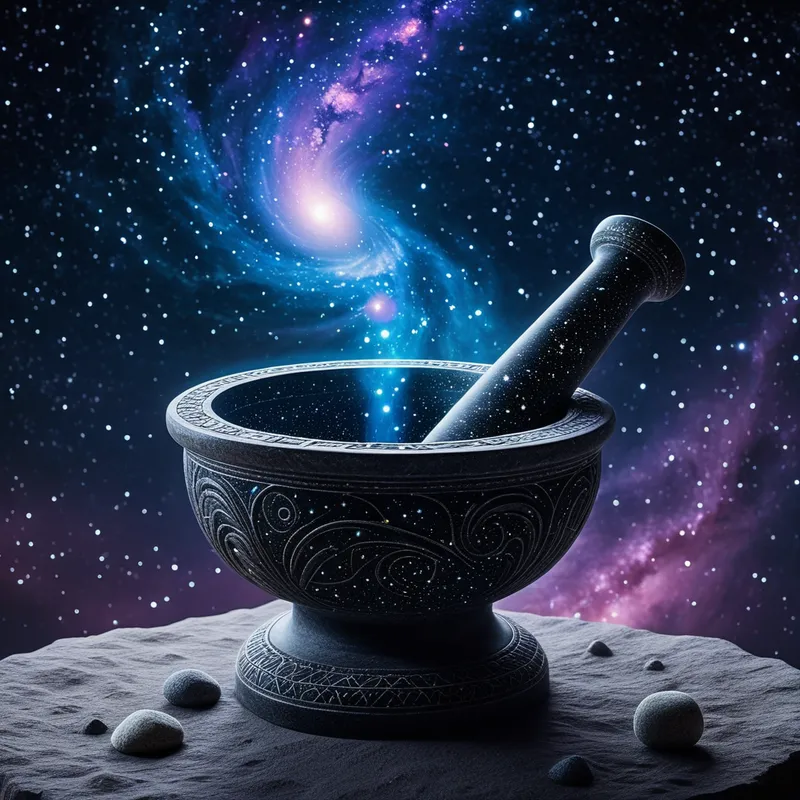
Mortar and Pestle Myth Meaning & Symbolism
A cosmic tale of sacred friction, where the grinding of the Mortar and Pestle births the prima materia from the primordial chaos of the unformed soul.
The Tale of Mortar and Pestle
In the time before time, when the world was a breath held in the dark, there existed only the Unmixed. It was a soup of potential, a churning sea of all-that-could-be, where light and dark, bitter and sweet, stone and star swirled together in a silent, formless cacophony. Nothing was separate, and because nothing was separate, nothing was.
From the heart of this chaos, a longing arose. Not a voice, but a pressure. A need for distinction, for essence, for a thing to be itself. This longing took form as two siblings, born of the same silent desire: the Mortar and the Pestle.
The Mortar was the cup of the world, a bowl carved from the first night, its curves deep and patient, an invitation and a womb. The Pestle was the will of the world, a shaft of the first dawn, straight and unyielding, a question and a spear. They rested in the void, aware of each other, feeling the ache of their incompleteness across the formless expanse.
Then, a movement. A tremor in the Pestle, a answering stillness in the Mortar. Guided by a intelligence older than gods, the Pestle lifted. It was not an attack, but a courtship. It descended, not to destroy, but to meet. And when its substance touched the inner curve of the Mortar, the universe heard its first sound: a deep, resonant CRUNCH that was less a noise and more a shiver of reality.
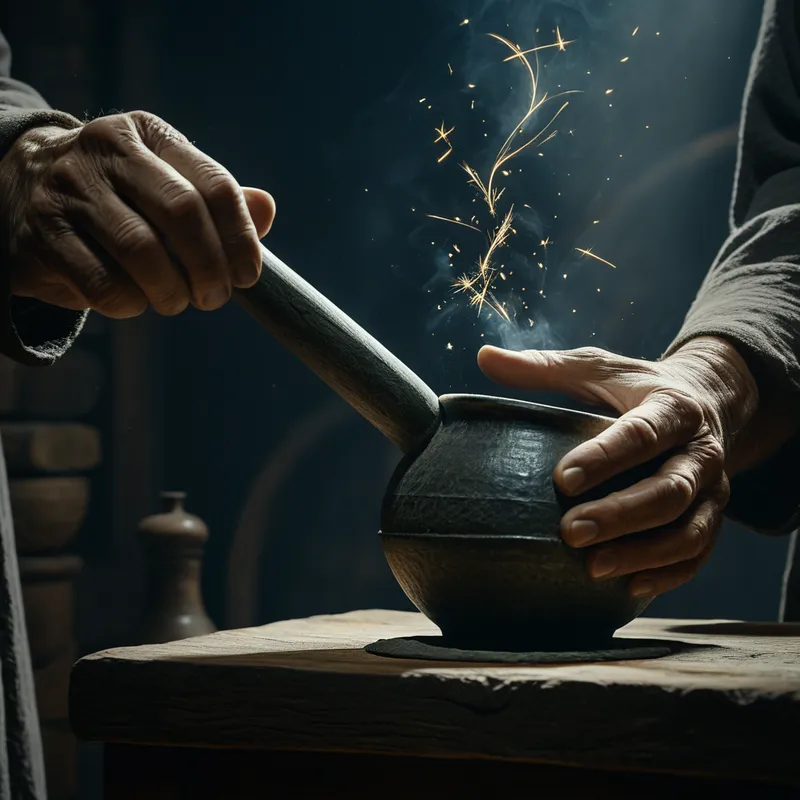
Within the Mortar’s hold, the Unmixed recoiled, then resisted. The Pestle pressed, rotated, ground. Light was scraped from dark. Sweet was peeled from bitter. Specks of future mountains were separated from droplets of future seas. It was not a gentle process. It was a sacred, necessary violence—the friction of creation. Sparks, like newborn stars, flew from the grinding place. A dust, finer than thought, began to rise—the Prima Materia, the First Matter.
The grinding was eternal and a single moment. The Mortar held fast, containing the chaos, accepting the pressure, its stability making the work possible. The Pestle moved with relentless, cyclical purpose, its action defining the substance it worked upon. Together, in their strenuous embrace, they performed the world’s first and only duty: to distinguish, to reduce, to make fine. From the coarse grit of undifferentiated All, they produced the sacred powder from which every sun, every leaf, every beating heart would later be conjured. Their work was the precondition for all else. When the first grain of true matter settled in the bowl, the myth tells us, the siblings rested, not apart, but together—the tool within the vessel, the action cradled by the form. The great grinding had begun, and it would never truly end.
Cultural Origins & Context
This myth finds its home not in the temples of a single people, but in the workshops and codices of the alchemical tradition, a cross-cultural river flowing from Hellenistic Egypt through the Islamic Golden Age and into the medieval and Renaissance West. It was not a story told to children at the hearth, but a philosophical emblem whispered between adepts, illustrated in the cryptic margins of the Emerald Tablet.
Its primary tellers were the alchemists themselves—part proto-chemist, part mystic, part psychologist. They passed it down not as entertainment, but as a direct encoding of their opus, their Great Work. The myth served a dual societal function. Exoterically, it described the literal laboratory process of grinding and mixing substances to begin an experiment. Esoterically, and more importantly, it provided a cosmic model for the transformation of the soul. It legitimized the often messy, violent, and confusing initial stage of inner work by framing it as a divine, cosmogonic necessity. In a world where the Church often viewed such pursuits with suspicion, the myth cloaked radical psychological processes in the respectable garments of ancient cosmic allegory.
Symbolic Architecture
At its core, the myth of Mortar and Pestle is an archetypal map of the fundamental dynamic required to generate consciousness from the unconscious.
The soul is not born whole; it is ground into being from the chaos of its own potential.
The Mortar symbolizes the receptive principle: the psyche’s capacity to hold, to contain, to provide a bounded space for experience. It is the vessel of the Self, the feminine yin, the patient body that receives impressions and impacts. Psychologically, it represents the ego’s necessary function of creating a stable, coherent field—a "container"—within which the chaotic contents of the unconscious can be processed. Without the Mortar, everything spills away into formlessness.
The Pestle symbolizes the active principle: the penetrating force of attention, analysis, and will. It is the discriminating mind, the masculine yang, the thrust of spirit that seeks to know, to separate, to define. It is the force of consciousness itself, which must engage with the undifferentiated material of the psyche to extract meaning and identity.
The grinding is the central symbolic act. It is the friction between conscious and unconscious, between what we know and what we are, between our will and our nature. This friction is often experienced as suffering, conflict, anxiety, or intense introspection—the "dark night of the soul." Yet, the myth sanctifies this friction. It is not a mistake or a punishment; it is the creative act itself.
The Prima Materia is not found; it is made through the courageous friction of self-encounter.
The resulting Prima Materia—the sacred dust—is the symbol of nascent individuality. It is the basic, purified substance of the Self, freed from the clinging mass of unconscious identification and collective baggage. It is the raw material from which a genuine, authentic life can be built.
The Dreamer's Resonance
When this myth stirs in the modern dreamer, it announces a profound somatic and psychological process: the initiation of a grinding phase. To dream of a mortar and pestle, especially if one is actively using it, signals that the psyche has begun the hard, necessary work of breaking down a complex, undifferentiated life situation or a swollen, unconscious complex.
Somatically, this may be felt as a pressure in the chest or solar plexus, a grinding sensation in the joints, or a pervasive tension that seeks resolution through action. Psychologically, the dreamer is likely in a state where conflicting feelings, loyalties, ideas, or identities are churning within them, causing distress. The dream is not a mirror of this chaos, but an image of the solution: the need for conscious (Pestle) engagement with a defined, contained (Mortar) aspect of the self.
A dream of a mortar overflowing with ungrounded, coarse material suggests the ego is overwhelmed, unable to contain the process. A dream of a pestle breaking or being too weak to grind points to a deficit of conscious will or analytical courage. The myth manifests in dreams to assure the dreamer that this difficult, granular work is sacred, creative, and the essential first step toward any real transformation.

Alchemical Translation
For the modern individual seeking individuation—the process of becoming an integrated, whole Self—the myth of Mortar and Pestle models the indispensable first stage of psychic transmutation: calcinatio and solutio through friction.
The journey does not begin with a grand vision or a heroic quest. It begins in the humble, gritty labor of self-confrontation. The "Unmixed" within us is our own personal chaos: our tangled motivations, our unexamined childhood patterns, our swallowed projections, our conflated emotions. We are a mixed mass of potential, but also of confusion.
To start the Work, we must first become the Mortar. We must create a container—through therapy, journaling, meditation, or disciplined reflection—that can hold a specific piece of our chaos. We choose one issue, one recurring pain, one shadow aspect, and we agree to look at it, to hold it steady in the light of our attention.
Then, we must wield the Pestle. This is the active work of analysis, questioning, and feeling through. We grind the issue. We ask: Why does this hurt? Where did this belief come from? What part of this is truly me, and what part is an inheritance I never chose? This grinding is painful. It generates heat (emotion) and dust (insight).
Individuation is not an ascent to a peak, but a descent into the granular truth of what one already is.
The goal of this initial, grinding opus is not a final answer, but the production of your own Prima Materia. It is the fundamental, honest substance of your being in relation to that one issue. It is the "you" that exists after the conflated mass of fear, expectation, and trauma has been broken down. This refined material—this self-knowledge—is the only stable base for all subsequent stages of the Work: the washing, the joining, the fermenting, and the eventual gold.
The myth teaches that the sacred union (conjunctio) is not a peaceful merging, but first a dynamic, forceful engagement. The Self is born not from bliss, but from the sacred, grinding embrace of our own contradictions.
Associated Symbols
Explore related symbols from the CaleaDream lexicon: