Morrigan Myth Meaning & Symbolism
A goddess of fate, war, and sovereignty appears as a crow, offering prophecy and demanding recognition, shaping the destiny of kings and the land itself.
The Tale of Morrigan
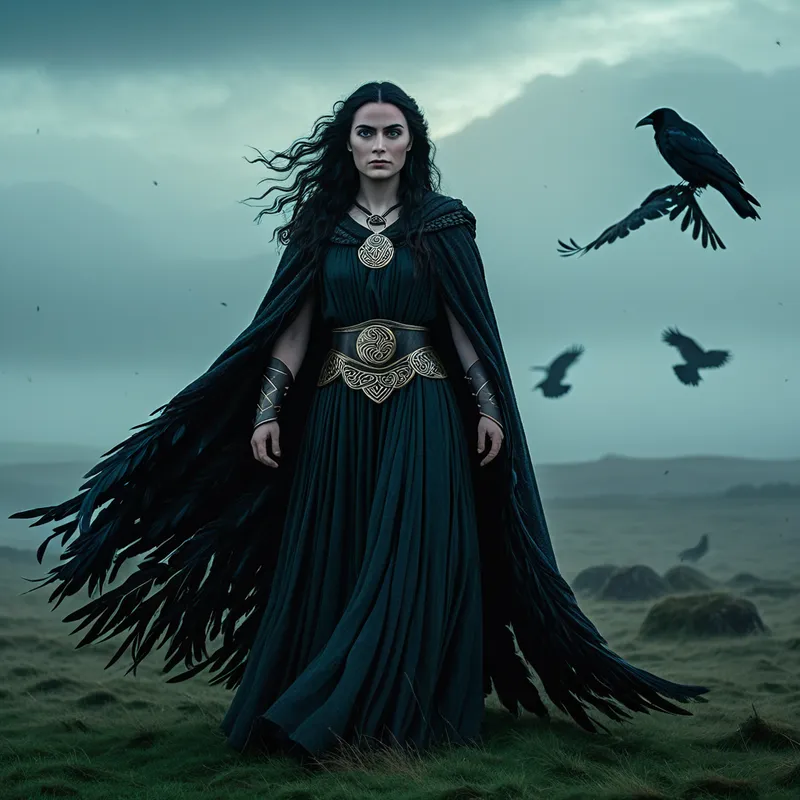
Listen, and hear a tale not of a single being, but of a force. A presence that dwells in the liminal spaces: where river meets land, where day bleeds into night, where life tips into death. She is the bean sí who is also a queen, the washer at the ford who is also the carrion-crow. She is the Morrígan.
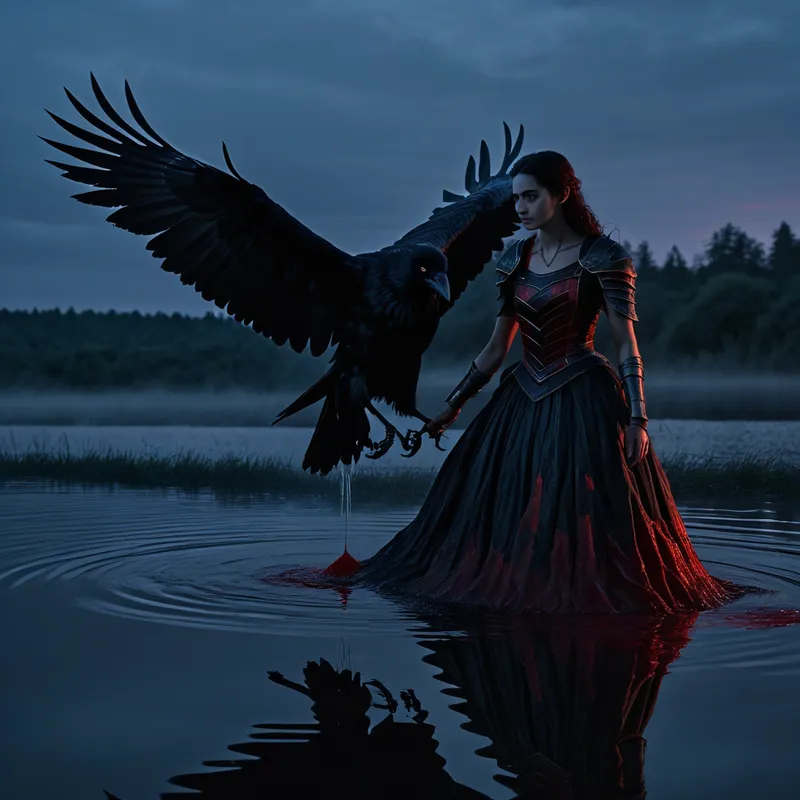
Before the great battle, she comes. The Cú Chulainn, the Hound of Ulster, stands unmatched, his spear-light flashing. He is young, a hero carved from sunlight and rage. By a stream, he sees her. Not as a goddess, but as a woman of impossible beauty, kneeling in the shallows, scrubbing a heap of armor and clothing soaked through with blood and gore. The water runs crimson around her pale hands.
“Who are you, woman,” he calls, “and for whom do you wash these spoils of the slain?”
She does not look up, her voice a melody that chills the bone. “I wash the gear of the one who will fall tomorrow. I wash the gear of Cú Chulainn.”
He laughs, a sharp, defiant sound. He does not know her. He sees only a prophetess of doom, and he rejects the omen. He rejects her. “You speak lies to weaken my heart. I will not fall.”
Then she shifts. The beautiful woman is gone, and in her place, perched upon a bare, twisted branch over the water, is a great crow, its feathers black as a starless midnight. It lets out a single, harsh cry that echoes across the silent landscape. It is a sound of cold fate, of a story already written. She flies towards the camp of his enemies, the army of Queen Medb, where she will shriek and beat her wings above the mustering warriors, stirring their fury.
The battle dawns, chaotic and thunderous. Cú Chulainn fights with the fury of a god, but the Morrígan is there. She appears to him as a heifer, charging him amidst the fray, and he breaks her leg. She comes as an eel, coiling in the ford to trip him, and he crushes her ribs. She comes as a she-wolf, driving cattle to stampede over him, and he blinds her in one eye. Each time, she is wounded. Each time, she retreats.
Exhausted, bleeding from many wounds, Cú Chulainn finally ties himself to a standing stone so he may die on his feet. As his life ebbs, he sees her again. The crow. She alights upon his shoulder, gentle now. She drinks from a wound at his brow. In that final, intimate touch of goddess and dying hero, there is no malice, only completion. She is the fulfiller of prophecies, the consumer of what is fated to fall. She was the washer at the ford, and now she is the keeper of the ford, guiding his spirit across. The land itself seems to sigh, the sovereignty of Ulster passing through this sacred, terrible death.
Cultural Origins & Context
The figure of the Morrígan emerges from the mist-shrouded world of the Insular Celts, specifically from the Irish mythological cycles recorded by Christian monks between the 8th and 12th centuries. These texts, like the Táin Bó Cúailnge, preserve a pagan worldview where the divine is immanent, tied to the land (an tír), and deeply ambiguous.
She was not a goddess worshipped in grand temples, but one encountered at the edges. Her stories were likely told by fili and bards, not as simple tales, but as complex narrative webs that explained the nature of kingship, war, and fate. The Morrígan functioned as a sovereignty goddess; the land’s spirit made manifest. A true king had to engage with her, to earn her favor—or at least, her acknowledgment. Her rejection of Cú Chulainn is not personal vengeance, but a cosmic statement: he, in his solitary, untamed heroism, could not be the sovereign the land required. Her role was to test, to prophesy, and to cleanse the land through the sacred violence of battle, recycling death into new potential.
Symbolic Architecture
The Morrígan is not a person but a process. She is the psychological archetype of the transformative void, the necessary chaos that precedes reordering. Her triplicity—often seen as one being with three aspects (Badb, Macha, and Anand or Morrígan herself)—represents the complete cycle of fate: the prophecy (the shaping of destiny), the confrontation (the battle itself), and the aftermath (the consumption and clearing).
To encounter the Morrígan is to stand at the ford of your own destiny, where the waters of the unconscious run red with the blood of what must die for you to cross.
Her shapeshifting is her core symbol. The beautiful woman is the seductive, terrible truth of our fate, often appearing in a palatable form we initially desire or dismiss. The crow is the raw, unfiltered reality of consequence, of cycles of life feeding on death. The eel, heifer, and wolf are the manifold, twisting ways the unconscious (or fate) will trip, charge, and harry the conscious ego that refuses integration. She is the ultimate enantiodromia, the emergence of the opposite: life in death, power in surrender, sovereignty in acknowledging a force greater than one's own will.
The Dreamer's Resonance
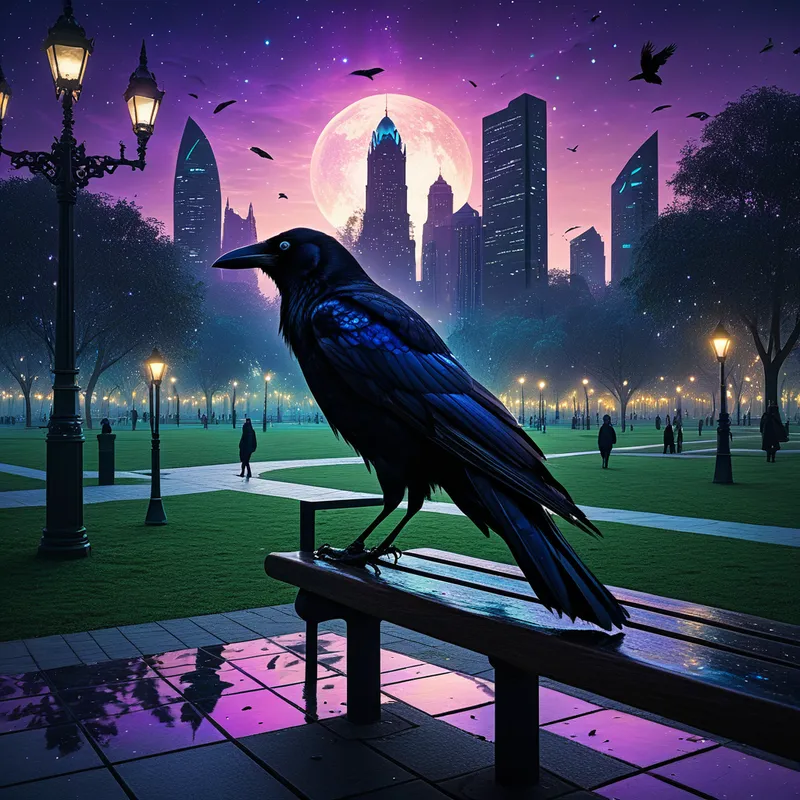
When the pattern of the Morrígan stirs in the modern psyche, it manifests in dreams of profound transition pressured by an inexorable force. One may dream of a commanding, daunting feminine figure offering a cryptic warning. Or of a single, intelligent black bird that seems to observe from every window. Dreams of washing something unclean in a river, or of trying to cross a bridge that is constantly collapsing, echo her myth.
Somatically, this can feel like a gathering pressure, a sense of being "fated" for a difficult change—the end of a career, the collapse of an identity, a necessary confrontation. There is often a deep, instinctual knowing that fights against the conscious mind's desire for stability. The psychological process is the ego's confrontation with the Self's agenda. The Morrígan does not appear to comfort, but to initiate. She forces the dreamer to wash the armor of their old self, to see the blood of their own outmoded ways, and to prepare for a battle that is less about winning and more about being utterly, transformatively real.
Alchemical Translation
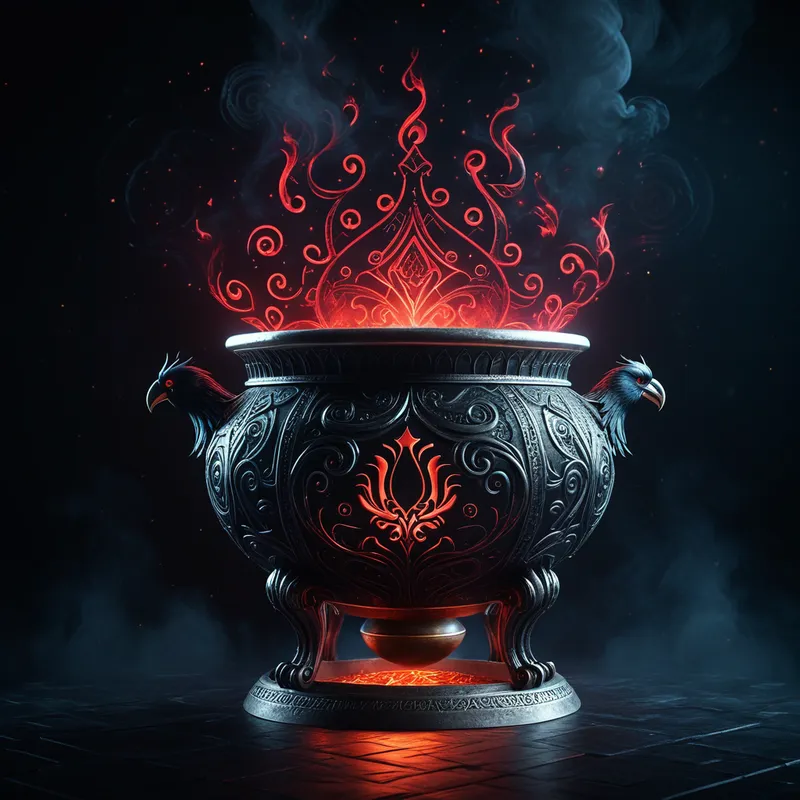
The alchemical journey modeled by the Morrígan is the nigredo. It is the essential blackening, the descent into the murky waters of the ford where everything is stained. For the modern individual, this is the process of confronting one's own "prophecy"—the unconscious pattern or core wound that dictates one's life. Like Cú Chulainn, we often meet this truth in a form we reject (the washer woman), thinking we can outrun or outfight it with our conscious strengths.
The triumph is not in defeating the crow, but in understanding that you are also the stream, the blood, and the crow. Sovereignty is born from that terrifying wholeness.
The alchemical work is to endure the shapeshifting assaults—the eel of slippery self-deception, the heifer of stampeding emotions, the wolf of predatory fears—not to destroy them, but to see them as parts of the whole self. The "death" at the standing stone is the immobilization of the old heroic ego, the part of us that believes it must conquer alone. The Morrígan's final, gentle perch is the moment of acceptance. The psychic transmutation is complete when we integrate the crow's eye view: seeing our life not as a linear conquest, but as a cyclical landscape of battles, endings, and renewals, over which we do not have absolute control, but with which we can be in sacred, sober relationship. We become sovereign not by ruling the land, but by knowing we are of it, subject to its same deep, crow-calling rhythms.
Associated Symbols
Explore related symbols from the CaleaDream lexicon: