Morpheus's Realm Myth Meaning & Symbolism
The myth of Morpheus, the divine shaper of dreams, reveals the soul's nightly journey into a realm of prophecy, truth, and profound self-encounter.
The Tale of Morpheus's Realm
Listen, and let your waking mind drift. Beyond the golden light of the sun, beyond the silver path of the moon, lies a land untouched by time. It is a place of silent rivers and caves of eternal twilight. Here, at the edge of the world where the sun forgets to rise, the earth splits open into a yawning cavern. This is the Cave of Hypnos.
Within, all is hushed. The very air is thick with the scent of earth and the narcotic perfume of countless black poppies that cluster in the gloom. Through the cavern flows the Lethe, its waters whispering secrets of oblivion. And here, upon a couch of ebony draped in deepest indigo, lies Hypnos himself, the Lord of Sleep, still and peaceful.
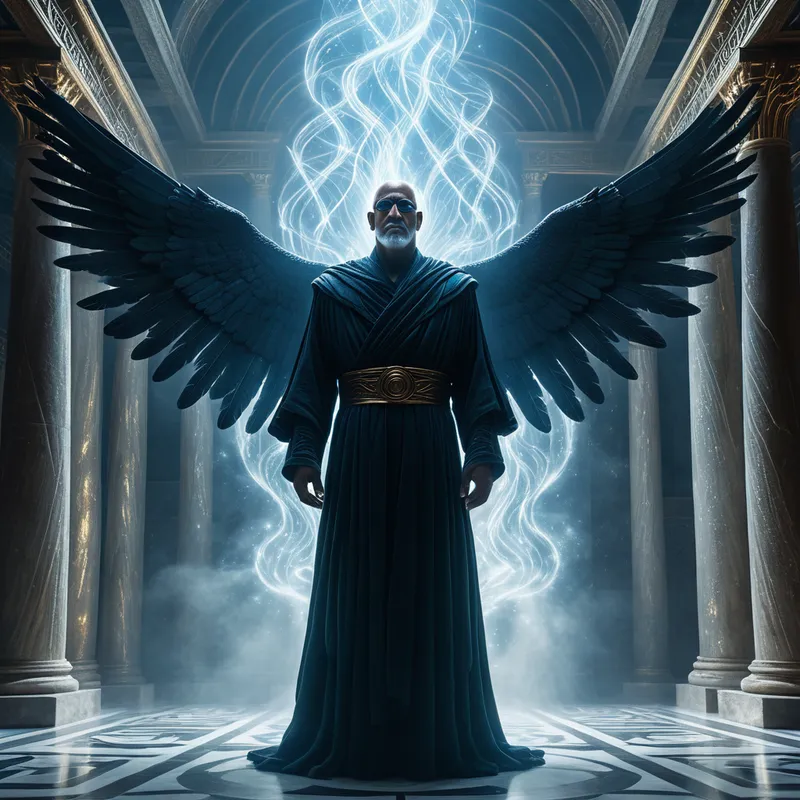
But the true artistry of this realm belongs to his son. From the shadows, a figure emerges, winged and grave. This is Morpheus. His robes are the color of a starless midnight, and in his eyes swirl the stuff of galaxies yet unborn. He is the Shaper, the Moulder. His brothers, Phobetor and Phantasos, craft dreams of creature and thing, but Morpheus’s gift is singular: he takes human form.
When the moon climbs high and mortal eyes grow heavy, Morpheus listens. He hears the silent prayers of the sleeping, the unresolved conflicts of the day, the whispers of the gods. Then, he acts. From the mist that coils by the river Lethe, he gathers the raw essence of dream-stuff. With hands that are both sculptor and weaver, he shapes it. He molds the mist into the exact likeness of a beloved king, a fallen warrior, a distant lover. He gives the form not just face and flesh, but voice, gait, and the very light in its eyes. He weaves into it a message—sometimes a prophecy from Olympus, sometimes a truth too painful for the waking mind to bear.
Silent as a shadow, he then passes through the Gates of Horn and Ivory—the twin portals from which true and false dreams issue forth. He flies on silent wings over the sleeping world, entering the slumbering soul not as an invader, but as a guest. He stands at the foot of the dreamer’s bed, or appears in the midst of their dreamscape, and delivers his fashioned vision. He is the actor in the soul’s most intimate theater, playing a part written by fate or the unconscious itself. When dawn’s first light threatens, he dissolves back into mist, leaving the dreamer to awaken, haunted or enlightened, carrying the echo of his realm into the world of sun and stone.

Cultural Origins & Context
The myth of Morpheus and his realm is not the center of a grand epic, but a vital thread in the rich tapestry of Greek understanding about the invisible world. Our primary source is the Roman poet Ovid in his Metamorphoses, who gave the Oneiroi their distinct personalities and roles. However, the conceptual soil from which this myth grew is purely Greek.
For the Greeks, dreams were not random neurological noise; they were a form of divine communication, a borderland between the human and the divine. The practice of incubation at healing sanctuaries like that of Asclepius formalized this belief. Individuals would sleep in the abaton (the sacred dormitory), hoping for a dream-visit from the god or his serpent, which would diagnose or cure them. In this context, Morpheus is the divine courier and craftsman of these messages.
The myth functioned as a profound psychological and theological model. It explained why we dream of specific, recognizable people. It provided a cosmology for the night, mapping the unknown territory of sleep with rivers, caves, and divine agents. Society’s bards and poets were the primary tellers of such tales, weaving them into larger narratives (like the dream sent to Alcyone in Ovid’s tale) to explore themes of grief, truth, and the permeable boundary between life and death. The myth gave a face and a process to an universal, mysterious experience, grounding it in the familiar hierarchy of the Greek pantheon.
Symbolic Architecture
Morpheus’s realm is not a fantasy; it is a precise map of the human psyche’s nocturnal landscape. Each element is a symbol of a profound inner reality.
The Cave of Hypnos represents the deep, unconscious mind itself—a hidden, foundational place beneath the surface of waking consciousness. The river Lethe, with its waters of forgetfulness, symbolizes the necessary dissolution of the ego and daily identity that must occur for the deeper self to speak. We must “forget” who we are in the day to remember who we are in the essence.
Morpheus himself is the archetype of the psychopomp of the interior—the guide not to the land of the dead, but to the land of the living-but-hidden. His name, “The Shaper,” is the key.
The dream is not a random image, but a shaped message. Morpheus represents the psyche’s innate, intelligent capacity to take the raw, chaotic data of our lives—our fears, desires, memories, and divine sparks—and fashion them into a coherent, symbolic narrative we can see.
His ability to assume the form of any human speaks to the fact that every person in our dreams is ultimately an aspect of ourselves, a part of our own psyche molded into a recognizable shape to deliver a specific message. The Gates of Horn and Ivory symbolize the dream’s dual nature: horn (a permeable, truthful substance) for prophetic or deeply true dreams; ivory (a dense, opaque material) for deceptive or wish-fulfilling fantasies. The myth asks us to discern through which gate our nightly visions arrived.
The Dreamer's Resonance
When a modern individual dreams with the vivid, narrative intensity of a Morphean visitation, they are not merely processing the day’s events. They are undergoing a somatic and psychological process of symbolic integration.
If you dream of a specific, known person acting in a way that is poignant, instructive, or jarringly out of character, you are likely encountering what Jung called a complex—an emotionally charged cluster of ideas and images—wearing that person’s face. Morpheus has shaped that complex into a form you can relate to. The somatic feeling upon waking—the lingering grief, joy, or awe—is the residue of this psychic encounter. It is the body registering a truth that the conscious mind has avoided.
Dreams of receiving a crucial message, of a familiar-yet-altered loved one, or of navigating a dark, labyrinthine landscape (the Cave writ large) are all modern echoes of this myth. The process at work is one of unconscious compensation. The dreaming psyche, through its Morphean intelligence, is presenting a symbolic narrative to balance the one-sidedness of the conscious attitude. It is delivering a truth, often wrapped in the flesh of someone we know, to guide, warn, or heal the waking self.
Alchemical Translation
The myth of Morpheus’s Realm models the individuation process—the alchemical transmutation of the base metal of unconscious content into the gold of conscious insight—with elegant precision.
The first stage, the nigredo, is represented by the journey into the dark Cave and the waters of Lethe. This is the necessary descent into the unconscious, the “forgetting” of the persona and the ego’s certainties. It is the dark night of the soul where all seems formless. Here, in this fertile darkness, the raw prima materia of the psyche swirls.
Morpheus is the agent of the albedo, the whitening. He is the transformative function that gives form to the formless. His shaping hands represent the conscious ego’s developing capacity to engage with the unconscious not as a terrifying chaos, but as a source of symbolic communication. To work with one’s dreams is to become an apprentice to Morpheus—to learn the language of the shapes he sends.
Individuation is the process of inviting Morpheus from the cave of the unconscious to the court of consciousness, to sit as a counselor and shaper of meaning.
The final stage, the rubedo or reddening, is the integration of the dream message into waking life. It is when Alcyone, having seen her drowned husband in a dream crafted by Morpheus, acts upon that truth, leading to their transformation into kingfishers. For the modern individual, this is the moment a dream insight changes a behavior, heals a relationship, or clarifies a life path. The shaped vision from the night realm is translated into conscious action, completing the alchemical cycle. The realm of sleep is thus not an escape from reality, but a vital workshop where the soul’s most essential work of self-creation and truth-seeking is performed, under the watchful, shaping hands of the divine dreamer within.
Associated Symbols
Explore related symbols from the CaleaDream lexicon: