Morozko Myth Meaning & Symbolism
A stepdaughter's encounter with the Frost King reveals that true warmth is not defiance of the cold, but a quality of the soul that winter itself can bless.
The Tale of Morozko
Listen, and hear the tale whispered on the wind that bites from the north, the story that settles with the first deep frost.
In a time when the world was closer to the bone, there lived a widower with a daughter, a girl of gentle spirit and quiet hands. He took a new wife, a woman with a heart as sharp as a splinter of ice, who brought her own daughter, spoiled and sour. The stepmother’s gaze could not abide the light in her stepdaughter’s eyes. “She is a burden,” the woman hissed to the man. “Her presence chills my own child’s prospects. She must go.”
And so, on the cruelest night of the year, when the Baba Yaga herself might shutter her hut, the stepmother commanded the girl. “Go to the deep forest. Sit beneath the tallest fir. Await your cousin, the Frost. Perhaps he will warm you.” It was a death sentence, spoken with a smile.
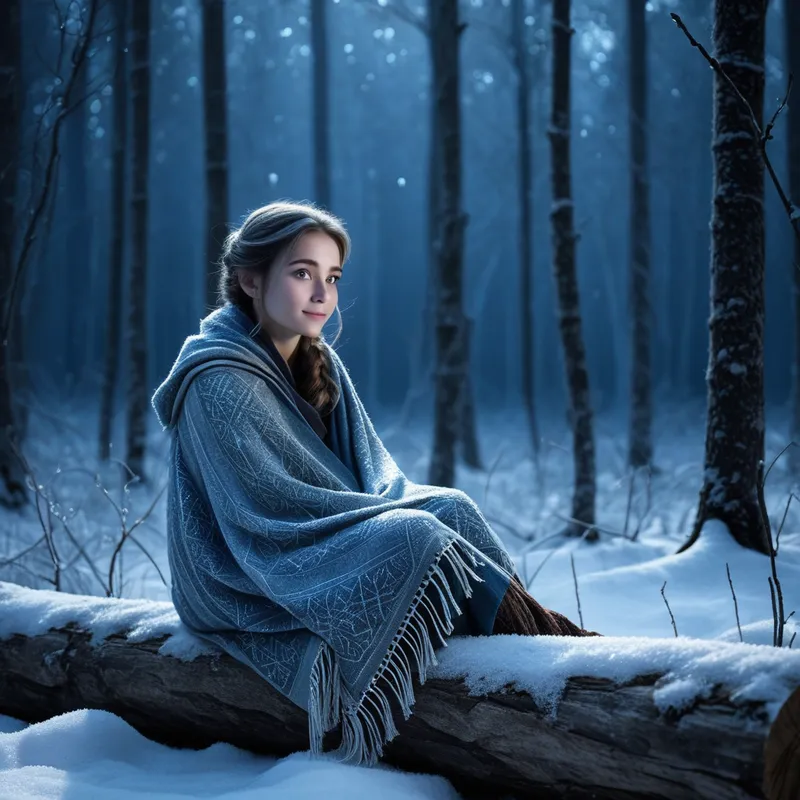
The girl did not weep. She wrapped herself in a thin shawl, a memory of her mother’s touch, and walked into the teeth of the gathering storm. The forest was a cathedral of silence, every branch bowed under a weight of white, every sound swallowed by the snow. She found the great fir, its boughs a dark green sigh against the starless sky, and sat upon a fallen log.
Then He came.
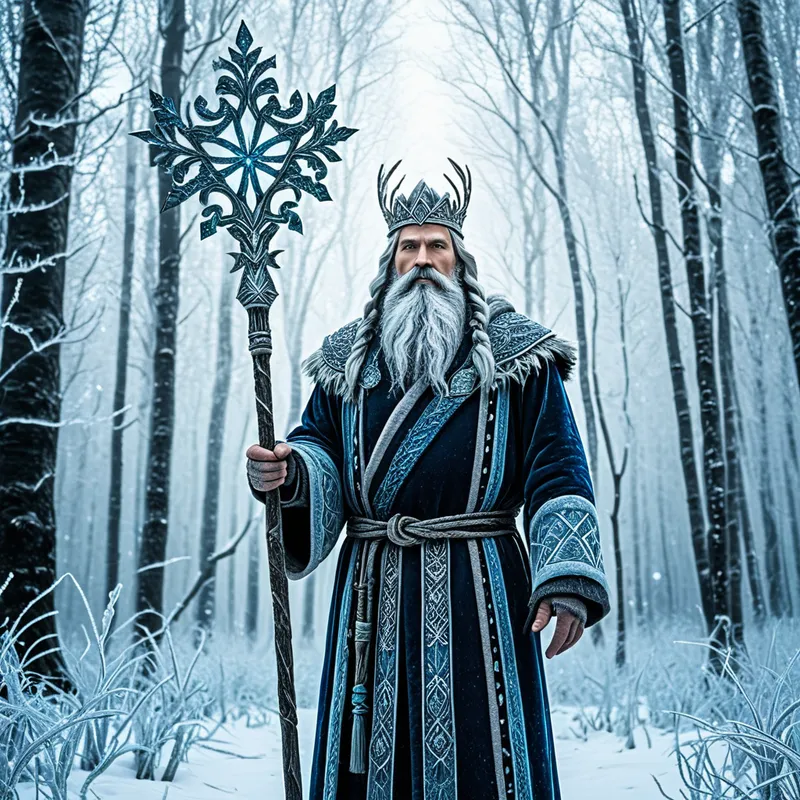
Not with a blizzard’s roar, but with a creeping, crystalline silence. The air itself began to sparkle and crack. He was the heart of winter given form—Morozko, the Frost King. His beard was the hoarfrost that sheathes the world at dawn, his eyes the blue-white glow at the core of a glacier. He circled the log, and his voice was the sound of trees splitting in the deep cold. “Are you warm, maiden?”
The girl, her lips nearly frozen, lifted her head. Her breath plumed like a ghost. “I am warm, Grandfather Frost. Thank you for your kind visit.” Her words were not defiance, but a profound and gentle acknowledgment.
Morozko circled closer. The cold intensified, a force that could snap iron. “And now, maiden? Are you warm?” Through chattering teeth, with a heart that refused to harden, she whispered again, “I am quite warm, Morozko.”
A third time He came, so near his icy breath touched her cheek. The cold was absolute, a purity that burned. “Are. You. Warm?” The girl, nearly insensate, gathered the last ember of her spirit. “I am warm, dear Grandfather. Your winter is… beautiful.”
And in that moment, the Frost King stopped. The punishing cold softened. A strange, gentle warmth began to emanate from the girl herself—not a fire, but a radiance of soul. Morozko, the untouchable, the severe, was moved. He wrapped her in furs of unimaginable softness, heavier than any snow, and laid before her a chest. Within were gowns woven of silver moonlight and jewels that held the light of the North Star. “For your patience,” he rumbled. “For your good heart.”
At dawn, the stepmother, certain of her victory, sent the father to fetch the frozen corpse. He found instead a vision: his daughter, radiant and rich, stepping from the forest in a sleigh drawn by white stags, the chest of treasures beside her. Greed ignited in the stepmother’s heart. “My own daughter,” she commanded, “go now! Sit beneath the fir. Be sweet. Get more!”
The woman’s own daughter went, wrapped in the thickest pelts, grumbling at the cold. When Morozko came, his questions were met with arrogance and demand. “Are you blind, you old frost? I am freezing! Give me my gifts and be quick!” Morozko did not circle thrice. With a single, silent glance, he let the true, unmitigated cold of his being flow. By morning, she was found still and blue, a statue of ice and avarice, a permanent fixture of the winter wood.
Cultural Origins & Context
This tale, in its many regional variations, is a skazka, a story told during the long, dark Zimnie Vechera (Winter Evenings). It was not mere entertainment; it was a survival manual for the soul, told by the light of the hearth while the world outside was claimed by a force both deadly and sacred. The teller was often a grandmother (Babushka), her voice weaving a spell against the very darkness pressing at the windows.
Morozko himself is an ancient figure, predating the tidy pantheons of later centuries. He is not a devil, but a Dukh, a spirit of place and phenomenon—the genius of the frozen land. He is ambivalent, like winter itself: he can kill the unprepared with his breath, yet his frost preserves the harvest, his snow blankets and protects the sleeping earth. The myth served to personify and negotiate humanity’s relationship with this implacable power. It taught respect, not conquest. It framed the winter not as an enemy to be defeated, but as a severe elder, a king whose court one must enter with the proper humility and inner fortitude.
Symbolic Architecture
At its core, the myth of Morozko is an allegory of the ordeal that reveals inherent worth. The forest is not just a physical space, but the dark wood of the soul’s journey. The stepmother represents the corrupting, divisive force of the personal psyche—the complex that devalues the authentic self in favor of a false, entitled persona.
The true test is not to fight the cold, but to discover the unassailable hearth within that makes the cold irrelevant.
Morozko is the ultimate objective judge, the archetypal Senex in his most austere form. His repeated question—“Are you warm?”—is a profound psychological probe. It asks: What is the source of your warmth? Is it external circumstance, entitlement, and comfort? Or is it an unshakeable, internal quality of being? The stepdaughter’s answers are not lies, but revelations. She names her inner reality, her soul’s warmth, in the face of overwhelming outer evidence to the contrary. In doing so, she performs an act of supreme psychological integrity. She meets the frozen, seemingly heartless aspect of reality (the Self in its impersonal, natural-law form) with a heart that does not close. This alignment transforms the encounter from a punishment into a bestowal.
The gifts are not rewards for passivity, but symbols of the psychic qualities she already possessed, now made manifest and functional in the world: robes of moonlight (intuition, reflection), jewels of the North Star (orientation, inner guidance), furs (protection, resilience born of ordeal).
The Dreamer's Resonance
When this myth stirs in the modern dreamer, it often signals an encounter with a “cold” archetypal reality. To dream of being sent into a frozen landscape by a cruel or indifferent figure may reflect a life situation—a job loss, a betrayal, a period of isolation or depression—that feels like an exile into emotional winter. The dream ego feels abandoned, exposed, and sentenced by unconscious forces (the “stepmother” complex).
The critical moment in such a dream is the appearance of the Frost King figure. This could manifest as a terrifying, silent coldness, an imposing icy figure, or simply an overwhelming sense of frigid, impersonal judgment. The dreamer’s response in the dream is diagnostic. Do they rage against the cold, like the stepsister? Do they try to run or build a fire? Or do they, in some small way, find a point of stillness and acceptance within it?
The somatic experience is key: a paradoxical feeling of warmth spreading from the core amidst external freezing, or a sense of profound, peaceful stillness as the cold intensifies. This signals the psyche initiating the mythic pattern—forging the connection between the ego and the nurturing, transformative aspect of the severe archetype. The dream is rehearsing the birth of a new, unshakeable inner foundation.

Alchemical Translation
The process modeled here is the alchemical Nigredo—the descent into the “black cold,” the mortification of the ego’s demands and pretensions. The stepmother’s cruelty is the catalyst that forces the psyche out of the familiar, heated drama of the personal family and into the vast, impersonal crucible of nature and spirit (the forest).
The frost does not create the maiden’s warmth; it reveals it by stripping away everything that is not it.
The ordeal with Morozko is the Albedo, the washing in the icy waters of truth. The ego’s false garments—its complaints, its sense of victimhood, its demands for different treatment—are frozen and shattered. What remains is the irreducible, radiant core of the individual, the “warm heart” that is the true Lapis Philosophorum. This core is not hardened, but paradoxically made more vibrant and capable through its confrontation with absolute cold. It learns that its essence is not dependent on external warmth.
The final stage is the Rubedo. The maiden returns to her world, but transformed. She is clothed in her own authentic power (the moonlit robes), guided by her own inner authority (the star-jewels), and protected by the resilience earned in the ordeal (the furs). She has integrated the “kingly” aspect of the severe, judging Self. The frost has, in the end, been the agent of her crystallization into a more complete and sovereign being.
Associated Symbols
Explore related symbols from the CaleaDream lexicon:
- Forest — The liminal space of the ordeal, representing the deep unconscious where the ego is stripped bare and meets archetypal forces directly.
- Cold — The symbolic state of emotional austerity, harsh truth, and the withdrawal of external warmth that forces an inward turn to discover internal resources.
- Gift — The tangible manifestation of an earned psychic quality, bestowed not as a payment but as a recognition of an inner truth made visible through trial.
- Heart — The central organ of feeling and courage in the myth, representing the unassailable inner warmth that can endure and transform the most severe outer conditions.
- Stepdaughter — The archetypal figure of the undervalued, authentic self who holds an inherent worth unrecognized by the conscious, personal world.
- Stepmother — The personification of the negative mother complex, a psychic force that exiles the true self into the wilderness of the unconscious for the sake of a favored persona.
- Winter — The season of the myth, symbolizing a necessary phase of death, stillness, preservation, and the severe, clarifying wisdom that comes from facing elemental reality.
- Journey — The compulsory movement from the familiar into the unknown wild, representing the psychic process forced upon the individual by unconscious pressures.
- Star — The symbol of inner guidance and constancy, like the North Star jewels, representing the orienting principle that emerges from surviving the disorientation of the ordeal.
- Shadow — The Frost King embodies the cold, severe, potentially deadly aspect of the Shadow, the part of the psyche that seems utterly alien and threatening but holds transformative power.
- Death — Represented by the fate of the stepsister, it symbolizes the psychic death that occurs when the ego meets the archetypal with arrogance, rigidity, and a demand for entitlement.