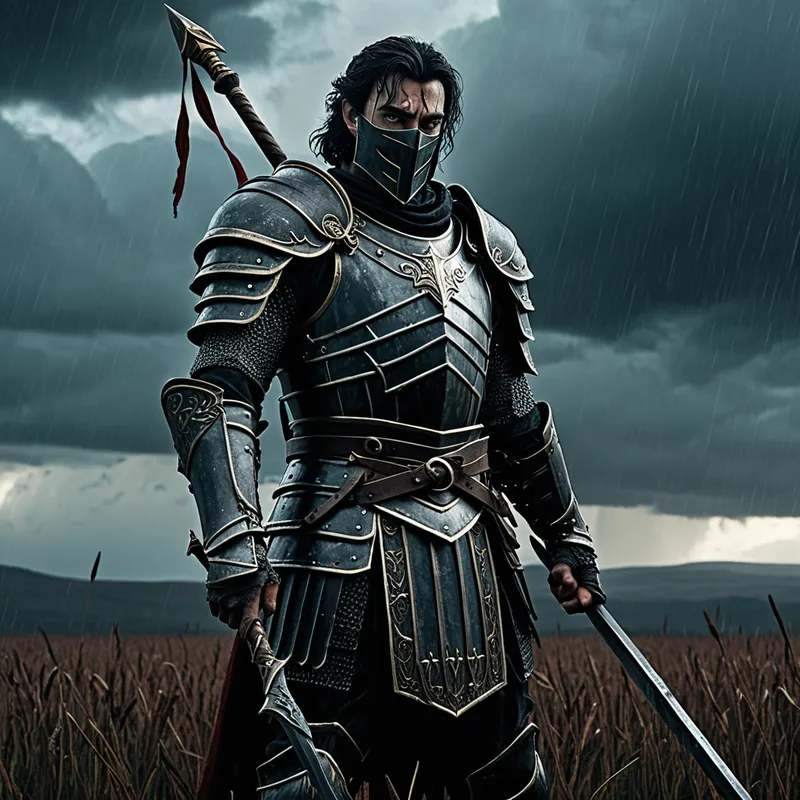
Mordred Myth Meaning & Symbolism
The tragic story of King Arthur's son and nemesis, a figure of prophecy, betrayal, and the inevitable shadow that rises to meet the light.
The Tale of Mordred
Listen, and hear the tale that cracks the foundation of the world. It is not a story that begins with a birth, but with a sin whispered in a castle corridor, a king’s unknowing transgression with his own half-sister, Morgause. From that hidden union, a child was born under a cursed star—a boy named Mordred.
The prophets, those who listen to the whispers of fate in the roots of the earth, spoke of him before he drew breath. They told the High King, Arthur Pendragon, that a child born on May Day would be his doom. Arthur, in the terror of that prophecy, sought to break fate’s wheel. He gathered all noble-born infants born on that day and set them adrift on a ship, a sacrifice to the cold sea to preserve his shining kingdom of Camelot. But the sea is a fickle womb; it spared the one it was meant to claim. Mordred washed ashore, alive, a foundling raised in shadows, his true name a secret etched in poison.
Years flowed like the River Camel. Mordred came to Camelot, a young knight of sharp mind and sharper smile. He did not know the king was his sire, nor the king know this polished youth was the serpent in his garden. Mordred served, and watched, and learned the architecture of his father’s dream. He saw the cracks in the Round Table: the secret love of Lancelot and Guinevere, the pride of the knights, the weariness in Arthur’s eyes. He nurtured these fractures with clever words, a master of the half-truth.
When Arthur sailed to wage war in distant lands, he left his kingdom in the hands of the one he trusted most—his own unrecognized son. It was the key turning in the lock of destiny. Mordred, the regent, seized the throne. He spread the word that Arthur had fallen across the sea. He claimed the crown, and some say, he sought the hand of Guinevere, weaving the final, unthinkable thread of betrayal.
But the king returned. The sea had not taken him. Arthur brought his host back to a white-cliffed shore, to a Britain that now called another “king.” There was no parley, only the grim machinery of fate grinding forward. They met on the wasted plain of Camlann. The mist that morning tasted of iron and old blood. No birds sang.
Father and son faced each other across a field littered with the dying and the dead, the glorious dream of Camelot now just mud and shattered shields. They fought not as king and usurper, but as two ends of the same broken spear. In the final, silent moment, when the armies were still, Arthur drove his spear through Mordred’s body. And Mordred, with the last of his life, brought his own sword down in a great, sweeping blow that shattered his father’s helmet and skull. Light and shadow struck each other down in the same breath. The prophecy was fulfilled, not by a monster, but by a son. The once and future king was borne away to Avalon, and the land plunged into the long, dark night.

Cultural Origins & Context
The figure of Mordred is not a fixed point in Arthurian legend, but a shifting shadow, evolving with the culture that told his story. In the earliest Welsh chronicles, he appears as Medraut, a warrior who fell alongside Arthur at Camlann—a tragic comrade, not a kin-slaying villain. The transformation into Arthur’s nephew, and later his incest-born son, is the work of later medieval scribes, most profoundly Sir Thomas Malory in his Le Morte d’Arthur.
These storytellers were not merely recording history; they were crafting a national mythology for a post-Roman Britain grappling with themes of legacy, sin, and divine judgment. Mordred became the necessary flaw in the perfect king, the embodiment of the tragic Greek hamartia translated to the misty forests of Britain. He served as the narrative mechanism for the fall of a golden age, a cautionary tale about the sins of the father visiting the son, and the fragility of even the most noble ideals when confronted with the chaos of human nature. He was the shadow cast by the brilliant light of Camelot, proving that no kingdom, however just, is immune to the corruption seeded from within.
Symbolic Architecture
Mordred is the archetypal Shadow made flesh. He is not an external evil, but the internal consequence. He represents what the conscious ideal—Arthur’s Logos, his law, his order—has rejected, ignored, or attempted to destroy.
The shadow denied does not disappear; it gathers strength in the dark, waiting to introduce itself at the moment of the ego’s greatest inflation.
He is the living proof of Arthur’s original sin, the hidden child of an unconscious act. Psychologically, he symbolizes the return of the repressed. All that Arthur tried to cast out (the infants on the sea, his own guilt) returns with a name, a face, and a claim to the throne. Mordred is the part of the self that says, “You cannot build a perfect kingdom on a buried secret.” His betrayal is, in a terrible sense, a demand for acknowledgment—a violent confrontation with a truth too long denied.
Furthermore, he embodies the corrupting force of the prophecy itself. By trying to avoid fate through a horrific act (the mass infanticide), Arthur ensures its fulfillment. Mordred is thus also a symbol of the paradoxical, self-fulfilling nature of trauma and defense. The wall built to keep danger out becomes the prison that ensures its victory.
The Dreamer's Resonance
To dream of Mordred is to dream of an internal civil war. It is not a dream of a clear enemy, but of a familiar stranger—a brother, a son, a part of the dreamer’s own psyche that has been disowned but now stands before them, armed and demanding recognition.
Somatically, this may manifest as a tightening in the gut, a sense of dread or inevitability. The dream landscape often mirrors Camlann: a once-familiar place (a childhood home, an office) become a battlefield, a relationship strained to breaking, or a project crumbling from within. The dreamer may find themselves playing both roles—both Arthur, the righteous ruler betrayed, and Mordred, the bitter heir striking back. This is the psyche’s theater, staging the conflict between the persona (the face shown to the world) and the shadow (the denied aspects). The dream signals that a long-avoided truth, a hidden resentment, a buried guilt, or a neglected part of the self is mobilizing. Integration, not further warfare, is the unconscious plea.

Alchemical Translation
The alchemical process modeled by the Mordred myth is the Nigredo, the blackening, the necessary death of the old king and his idealized kingdom. For the modern individual, Camelot represents the constructed self—the perfect persona, the life built on “shoulds,” the identity founded on repressed wounds or family secrets.
Individuation does not proceed by building higher walls around the castle of the self, but by courageously admitting the rightful, if wounded, heir at the gate.
The “Mordred process” begins when this polished self is confronted by its own shadowy offspring: a midlife crisis, a devastating failure, a betrayal that mirrors our own hidden disloyalties to ourselves, or the eruption of a long-buried trauma. This is the psychic Camlann. The battle feels like annihilation.
The alchemical triumph is not in “winning” this battle, but in understanding its inevitability and its purpose. The goal is the transmutation of the relationship. Arthur and Mordred must die so that a more conscious, integrated being—one who acknowledges both king and shadow, light and legacy of sin—can be borne to Avalon for healing. For us, this means allowing the old, rigid identity to die in the confrontation with our truth. We must integrate Mordred: acknowledge our capacity for betrayal, our hidden angers, our inherited flaws. We must grant that wounded, rebellious part a seat at our internal round table, not as ruler, but as acknowledged kin. Only then does the cycle of prophecy and violent return end, and the long work of healing the wounded king within can truly begin.
Associated Symbols
Explore related symbols from the CaleaDream lexicon: