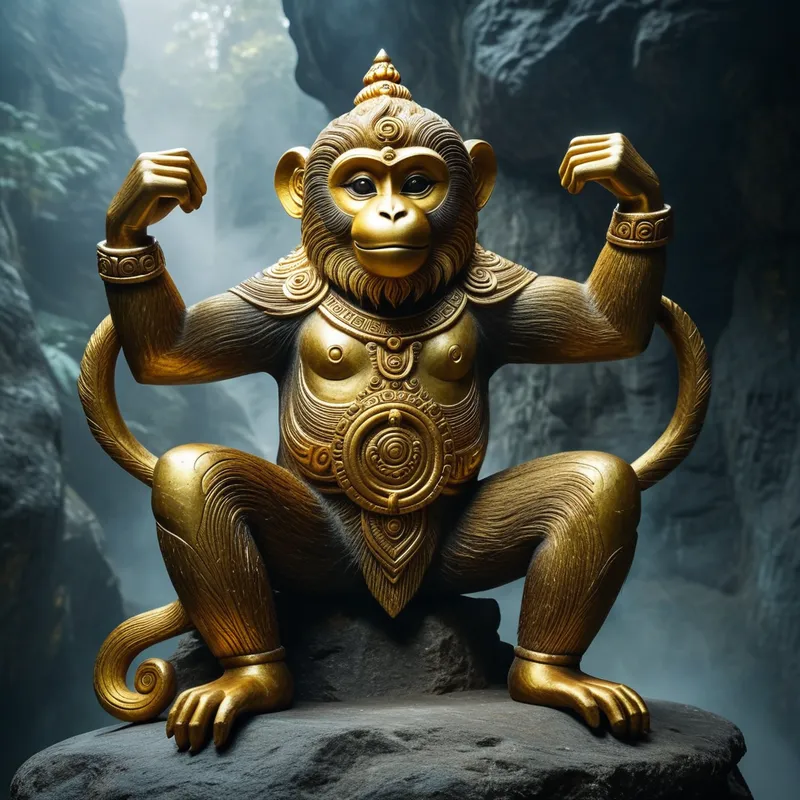
Monkey Mind Myth Meaning & Symbolism
A mythic tale of the restless mind as a wild monkey, leaping through the senses, and the profound stillness that comes from taming its frantic dance.
The Tale of Monkey Mind
Listen, and let the tale settle in your bones. It does not begin with a roar, but with a whisper—the whisper of a single thought in the vast, silent cavern of awareness. In this inner realm, there was no beast more clever, more restless, or more captivating than the Monkey Mind.
Picture it: a creature of luminous fur and lightning limbs, born not of earth but of the very spark of consciousness. Its kingdom was the six gates—the eyes, ears, nose, tongue, body, and the ceaseless thinking mind. And oh, how it loved to reign! From dawn’s first light, it would leap. A flash of color seen became a whole forest of fantasy. A distant sound became a saga of alarm or longing. The memory of a sweet fruit on the tongue would send it swinging through a hundred past pleasures, while a faint ache in the limb would conjure tales of future decay.
Its dance was a frantic, beautiful, exhausting tyranny. It would clutch at a feeling of pride, screeching with triumph, only to be stung by a thought of shame moments later, dropping the prize to flee. It would build elaborate palaces of worry from a single grain of doubt, then abandon them to chase the chimeras of hope. The monkey was never still. It defined itself by its grasping, its fleeing, its perpetual, desperate becoming. The silent watcher of the cave—the innate, spacious awareness—was forgotten, obscured by this dazzling, chaotic performance.
The conflict was not one of battle, but of profound weariness. The monkey itself grew tired. Its leaps became shorter, its chatters more hollow. It had tasted every fruit of experience, yet its hunger was never sated; it had fled every shadow, yet fear was its constant companion. In a moment of exhaustion, between one frantic swing and the next, it caught a glimpse—not of another object to grasp, but of the ground beneath the tree. The vast, unmoving ground of being.
This was the turning. Not a capture, but a profound seeing. The monkey paused. Its frantic energy did not vanish, but it was seen, held in a field of stillness it had never noticed. The practice began—not to chain the monkey, but to offer it a gentle tether of attention. When it leapt to the eye-gate, chasing a form, the awareness softly noted, “seeing.” When it scrambled to the ear, entangled in a melody, the note was “hearing.” Thought after thought, sensation after sensation, the simple, compassionate naming began to untangle the monkey from its own compulsions.
The resolution was not an end, but a homecoming. The monkey’s wild energy remained, but it was no longer the master of the cave. It became a part of the landscape—its vitality recognized, its nature understood. In the profound silence that held even the chattering, the monkey and the watcher were seen as not-two. The restless mind and the still heart found their original, unified ground. The dance continued, but now it was a dance within the stillness, not against it. The myth ends not with a victory, but with a deep, resonant peace, where the monkey’s chatter becomes just another note in the symphony of the real.

Cultural Origins & Context
The metaphor of the Monkey Mind is not a single, codified myth from a specific scripture, but a pervasive and ancient pedagogical image woven throughout the tapestry of Buddhist teachings. Its roots are in the early Pali Canon, where the Buddha often used similes from the natural world to illustrate the untrained mind. It flourished in the commentarial traditions of Theravada Buddhism and found vivid expression in the meditation manuals of later traditions like Mahayana and Vajrayana.
It was passed down not by bards in halls, but by teachers in forest monasteries and on meditation cushions. A master, seeing a student struggle with distraction, might simply say, “Just watch the monkey.” The image was a shared, immediate shorthand for a universal human experience. Its societal function was deeply practical: to de-pathologize mental agitation. By framing distraction not as a personal failing but as the natural, wild state of the untamed mind—as universal as a monkey’s instinct to swing—it removed judgment and offered a clear object for the work of meditation. It democratized the path to peace; everyone, from king to farmer, had a monkey to befriend.
Symbolic Architecture
The myth’s power lies in its flawless symbolic architecture. The monkey is not our enemy, but a part of our psychic ecology. It represents the primordial, associative, and survival-oriented operation of the ego-mind. Its six gates are the entire sensorium, the conduits through which the world floods in and the self projects out.
The monkey does not think; it associates. It does not feel; it reacts. Its kingdom is the perpetual present of stimulus and response, and its tyranny is the illusion that this is all that exists.
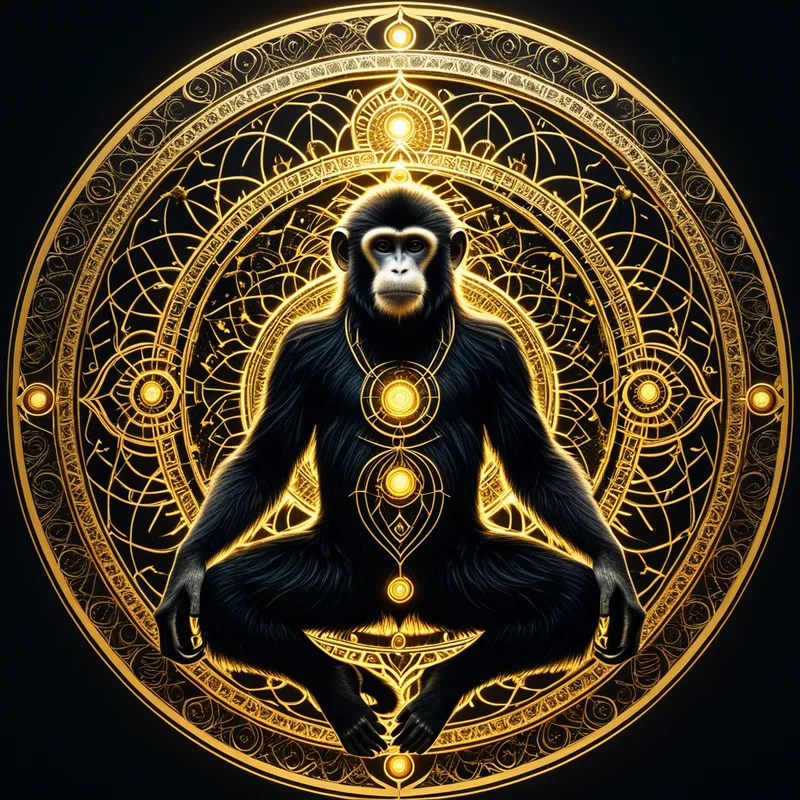
The silent cave of awareness represents the deeper, non-personal consciousness—what Jung might call the Self and Buddhist philosophy calls Tathagatagarbha. The conflict, therefore, is the core human dilemma: the identification of awareness (the true “I”) with the content of awareness (the monkey’s show). The tether of mindful noting is the symbol of Samadhi—the collected, steady mind that can observe without being swept away. The final resolution, the “not-two,” symbolizes the integration of the unconscious, compulsive energies (the monkey) into the conscious, spacious field of the Self. The monkey’s energy is not destroyed; it is transmuted from a source of bondage into a source of creative vitality.
The Dreamer's Resonance
When this myth stirs in the modern dreamer, it rarely appears as a literal monkey. Instead, it manifests as the sensation of the myth. You dream of being in a frantic, overcrowded transit station where every departure board lists conflicting destinations, and you cannot find your gate. You dream of trying to complete a simple task, like reading a book, but the words keep rearranging themselves, or a cacophony of voices from another room drowns out your focus. You dream of being chased not by a monster, but by a swarm of buzzing insects or flickering lights—a diffuse, relentless agitation.
These dreams are somatic maps of psychic fragmentation. The body in the dream is often heavy with exhaustion, mirroring the soul’s fatigue from the ego’s incessant projects. To dream this is to be in the “rising action” of the myth. The dream ego is fully identified with the monkey, lost in its chaotic narrative. The psychological process underway is one of saturation—the unconscious is demonstrating, in visceral imagery, the unsustainable cost of an unexamined, reactive life. It is presenting the problem in its full, felt intensity, preparing the psyche for the possibility of turning, of looking for the ground beneath the station’s chaos.

Alchemical Translation
The myth of the Monkey Mind provides a precise alchemical map for individuation. The first step, nigredo, is the recognition of the chaos—the honest admission of one’s inner fragmentation and suffering. This is the monkey’s weary pause.
The work of mindful observation is the albedo, the whitening. Here, through disciplined attention, we separate the pure, silent witness (the silver of the moon) from the base, reactive contents of consciousness (the lead of the monkey). We practice non-identification: “I am not this thought, this fear, this desire.”
The taming is not a suppression, but a sacred inclusion. The shadow of the monkey—its greed, fear, and vanity—is not cast out but brought into the light of awareness, where it loses its compulsive power.
Finally, the rubedo, the reddening or golden stage, is the integration symbolized by the monkey dancing within the stillness. The vital energy once spent on neurotic loops is now redeemed. The associative, creative power of the monkey-mind becomes available to the conscious personality. The individual no longer has a monkey mind; they have access to the qualities of curiosity, agility, and playfulness, now in service to the whole Self. The myth teaches that enlightenment is not the absence of thought, but the freedom from enslavement to thought. The transmutation is complete when the psyche realizes its fundamental nature is the spacious cave that can contain, with infinite compassion, the entire wild and wonderful dance.
Associated Symbols
Explore related symbols from the CaleaDream lexicon: