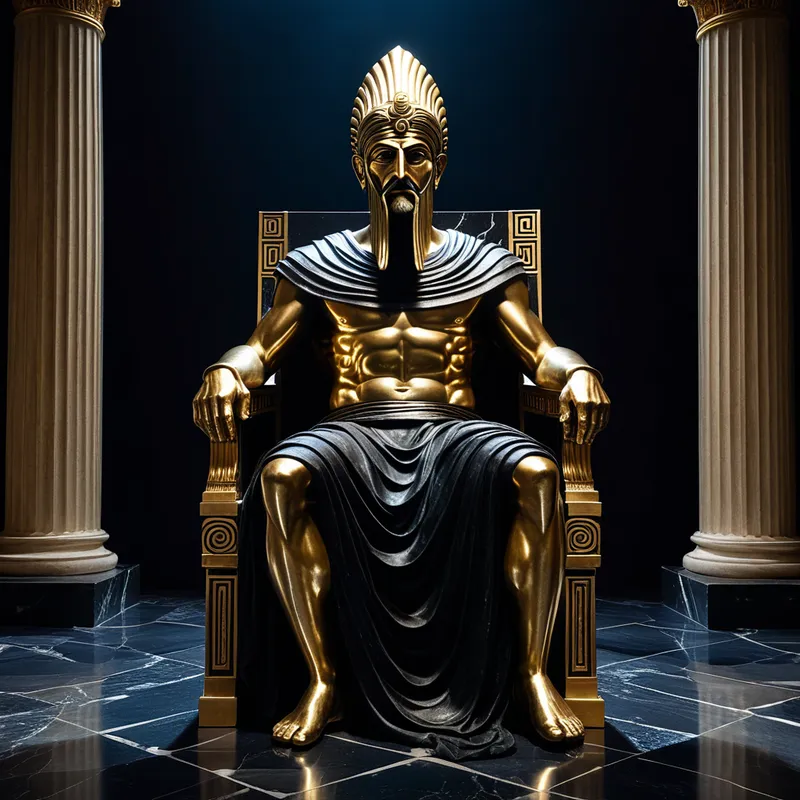
Momus Myth Meaning & Symbolism
The myth of Momus, the divine critic, reveals the necessary yet dangerous role of fault-finding in creation, culture, and the psyche's journey toward wholeness.
The Tale of Momus
In the high, clear air of Mount Olympus, where ambrosia scents the wind and laughter rings like crystal, there dwelt a god unlike his radiant kin. While Zeus wielded thunder and Athena bore the owl’s keen gaze, Momus held a subtler, sharper power. He was the god of mockery, satire, and blame—the divine finger that finds the flaw, the whispered truth that follows every boast.
The hall of the gods was a theater of creation. One day, Hephaestus, his mighty arms gleaming with sweat and soot, presented his masterpiece: a bull of living bronze, its hide a mirror to the sky, its muscles coiled like tectonic promise. The gods marveled. “But,” came a voice, dry as parchment, from the corner where Momus lounged. “You placed the horns too far behind the eyes. How shall it see to gore? A poor design.” A silence fell. Hephaestus’s fire seemed to dim.
Undeterred, Cronus himself, in a rare moment of paternal pride, fashioned the first human. He breathed into it curiosity, strength, and a spark of divine reason. The assembly nodded, seeing themselves reflected in the clay. Momus stirred. “A curious oversight,” he mused. “You built a house but forgot the door. You placed his heart on the outside, naked and vulnerable for all to see. Any sorrow, any rage, is visible. Where is the secret chamber? Where is the lie?”
Then came the grand contest. Poseidon crafted a bull of storm and tide. Hestia, in her quiet wisdom, shaped a house of perfect harmony, where every brick held warmth. And Hermes, the clever one, sculpted a human of dazzling potential. They were brought before the court of Olympus for judgment.
Momus examined each with a critic’s cold eye. He praised Poseidon’s bull for its power, then sighed. “Yet, you placed the horns ahead of the eyes. Now it will see the terror it causes. Is that kindness, or cruelty?” He turned to Hestia’s house. “Beautiful, immutable. And therefore a trap. It cannot move with its owner, a cage of perfection.” Finally, he stood before Hermes’s human. “Ah, the masterpiece. But you, trickster, have forgotten the most essential tool. You did not place a window in his breast, a little door of clear horn, so his neighbors could see his scheming thoughts and guard against his deceit.”
A thunderous quiet gathered. The beautiful creations seemed to shrink under the weight of his unerring gaze. His words were not false. They were inconvenient. They were the splinter in the divine finger, the grain of sand in the celestial oyster. In that moment, the gods did not feel enlightened; they felt exposed. And for exposing the unavoidable flaw in all creation—even their own—Momus, the necessary truth-teller, was cast out from the shining halls, hurled down to walk among mortals, where his voice found a fertile and eternal home.

Cultural Origins & Context
The figure of Momus flows from the deep wellspring of Greek poetic tradition, primarily preserved in the fragments of the lost epic, the Cypria, and later in the works of writers like Aesop and Lucian. He is a minor god, but his role is major. He represents a critical strand in the Greek worldview: the belief that unvarnished examination, even mockery, was a social and spiritual duty.
In the symposium, the theater, and the agora, criticism was a civic art. The comedies of Aristophanes, which mocked politicians and gods alike, operated under Momus’s patronage. He was the divine sanction for parrhesia—frank speech. His myth served as a cautionary tale about the limits of that freedom. To criticize the gods’ work was intellectually honest; to do so in a way that undermined their authority was intolerable. Thus, his exile is not a denial of his truth, but an admission of its disruptive power. Society, even divine society, requires a balance between honest critique and cohesive function. Momus is the part that must be exiled for the whole to feel secure, yet he can never be fully silenced.
Symbolic Architecture
Momus is the archetypal Shadow of creation itself. He is not the critic of bad work, but the critic of all work. He embodies the psychic function that interrupts inflation and hubris. Where the Creator archetype says, “Behold, it is good,” Momus whispers, “But is it complete? Is it true?”
He is the grain of sand in the oyster of the psyche, the necessary irritant around which the pearl of consciousness forms.
His exile from Olympus is profoundly symbolic. It represents the ego’s tendency to banish uncomfortable self-criticism, to relegate the inner critic to the dungeons of the unconscious. We label this voice “negative self-talk” and seek to silence it. Yet, the myth tells us this voice is divine in origin—it is part of the pantheon of the Self. Its judgments, however painful, are often pinpoint accurate. Momus finds the flaw in the bull, the house, and the human not to destroy them, but to point to an unrealized potential, a missing integration. The heart on the outside? A call for discernment between intimacy and vulnerability. The lack of a window to thoughts? A challenge to integrate transparency with wisdom.
His tools—mockery, satire, blame—are the weapons of the disempowered truth. When direct confrontation is impossible, satire becomes the vehicle. Momus thus symbolizes the truth that must disguise itself as jest to be heard at all.

The Dreamer's Resonance
When the pattern of Momus stirs in the modern dreamscape, it often manifests as an experience of relentless, pinpoint criticism. The dreamer may be presenting a project (a “creation”) to a faceless board, only to have a single figure point out a tiny, devastating flaw they secretly knew was there. Or they may be Momus, cruelly dissecting a loved one’s efforts, filled with a mix of righteous clarity and gnawing guilt.
Somatically, this dream process is one of exposure. It is the psyche forcing a confrontation with the gap between intention and execution, between the idealized self and the actual self. The psychological process is the end of naivete. The dream is initiating a phase of rigorous self-assessment. The discomfort is not a sign to retreat, but a sign that a deeper layer of integrity is being demanded. The dream-Momus is not an enemy to be defeated, but a severe, unwelcome ally insisting that the dreamer’s “creation”—be it a relationship, a career, or a self-image—must evolve beyond its current, flawed iteration to become more resilient and authentic.

Alchemical Translation
The alchemical journey modeled by Momus is the transmutation of criticism into discernment. The base metal is the raw, wounded, often projected fault-finding we experience as shame or attack. The goal is the gold of conscious, integrated judgment.
The first stage is Recognitio (Recognition): acknowledging the exiled critic within. We must, like Olympus, first admit that Momus exists and that his voice contains a fragment of divine, if harsh, truth. To simply try to “banish negative thoughts” is to re-enact his exile, guaranteeing his return as a destructive complex.
The second is Separatio (Separation): disentangling the truth of the critique from the poison of its delivery. “The horns are in the wrong place” is a technical observation. “Therefore, you are a failure” is the added venom. The alchemist must separate the valid data from the corrosive narrative.
The ultimate goal is not to create a flawless work, but to create a work—a self—that is conscious of its flaws and has made a meaningful relationship with them.
The final stage is Coniunctio (Conjunction): integrating the critic’s eye into the creator’s hand. This is where Momus is invited back from exile, not to rule, but to counsel. The individual learns to pre-emptively ask Momus’s questions: “Where is the vulnerability I have not protected? Where is the deception I have not acknowledged? What essential element is missing?” This internalized Momus becomes the quality control of the soul, the inner sage who speaks hard truths not to destroy, but to refine.
In this alchemy, the flaw is no longer a source of shame but the very locus of individuation. The crack, as the symbolic image shows, is where the light gets in—and out. It becomes the unique signature of a creation, and a self, that has dared to be examined and has chosen to grow whole, not merely perfect.
Associated Symbols
Explore related symbols from the CaleaDream lexicon: