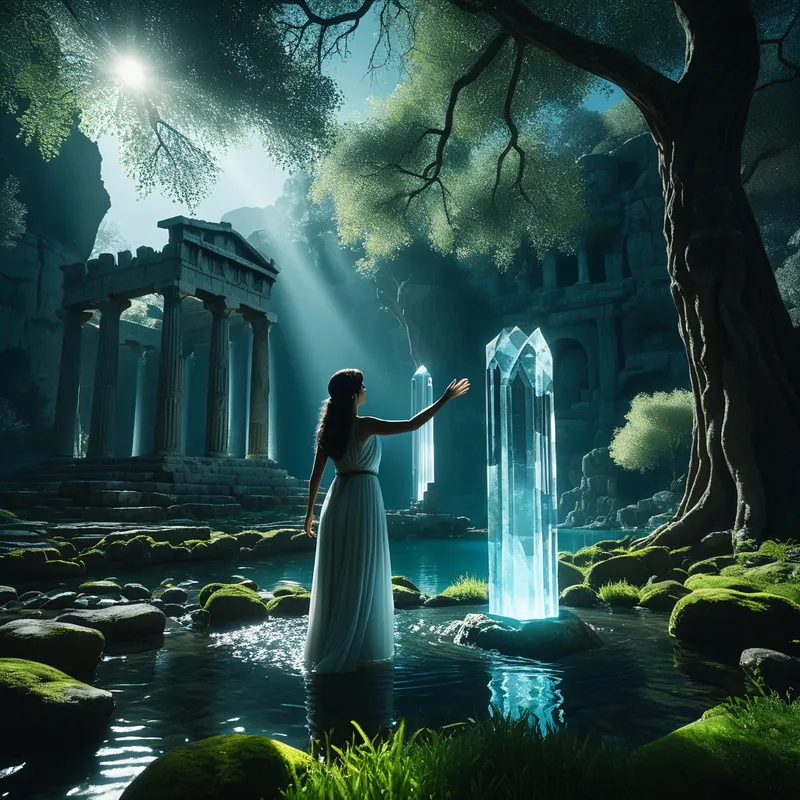
Mnemosyne's Spring Myth Meaning & Symbolism
A sacred spring in the underworld, whose waters grant souls perfect memory before rebirth, revealing the profound link between remembrance and true identity.
The Tale of Mnemosyne's Spring
Before the world knew the names of the Olympians, in the deep, silent places where the roots of the world dig into darkness, there flowed a spring. This was no ordinary water. Its source was not rain or mountain snow, but the very essence of a primordial being: Mnemosyne. Her name was a whisper on the wind of the soul, meaning Remembrance.
In the sunless kingdom of Hades, where the pale shades of the dead drift like mist, two springs bubbled from the rock near the grove of Persephone. The first was known to all: the Lethe. Its dark, cool waters promised oblivion. Every soul that drank from it forgot the pain of life, the sting of loss, the weight of identity. It was a mercy, a gentle erasure before the wheel of rebirth turned again.
But a stone's throw away, hidden in a grove of whispering black poplars, was the second spring. Its waters were not dark, but held a light of their own, like liquid moonlight or the glow of a remembered smile. This was the Spring of Mnemosyne. The air around it hummed with a silent chorus—the echo of every laugh, every oath, every lullaby ever sung. To drink from it was not to forget, but to remember. To remember not just one life, but the pattern of all lives. To recall the soul's journey in its terrible and beautiful entirety.
The choice was stark, whispered by the silent ferryman and the judges of the dead. Most souls, weary and wounded, shuffled toward the Lethe's comforting void. Its waters promised sleep, a clean slate. But a rare few, guided by a spark not even death could extinguish, turned toward the shimmering light of Mnemosyne's gift. They approached not with thirst, but with a sacred dread. To drink was to accept the full burden of self—the triumphs and the shames, the loves and the betrayals—and to carry that unbroken thread of consciousness into what comes next. It was the path of the initiate, the seeker who preferred painful truth to peaceful oblivion. As they knelt and cupped the luminous water, their formless shades seemed to solidify for a moment, lit from within by the fire of a continuous, unbroken I am.

Cultural Origins & Context
This profound myth is not part of the grand epic cycles of Homer, but emerges from the deeper, more mystical streams of Greek religious thought: the Eleusinian Mysteries and the esoteric texts known as the Orphic Gold Tablets. These were not stories for public theaters, but secret maps for the soul, given to initiates who sought a blessed afterlife beyond the common fate of shadowy oblivion.
The tablets, placed on the breasts of the deceased, served as literal guides. They contain explicit instructions for the soul's journey in the underworld, warning against the "cold water pouring from the Lake of Memory" (a reference to Lethe) and directing the soul instead to proclaim, "I am a child of Earth and starry Heaven, but my race is of Heaven alone. I am parched with thirst and I perish. Give me quickly the cold water flowing from the Lake of Memory." This was a coded plea for Mnemosyne's waters. The myth, therefore, functioned as a promise and an imperative: through ritual and right knowledge, one could achieve anamnesis—the unforgetting of one's divine origin—and escape the cycle of endless, forgetful rebirth.
Symbolic Architecture
At its core, the twin springs of Lethe and Mnemosyne represent the fundamental polarity of the human psyche: repression and integration, amnesia and anamnesis.
Lethe is the water of dissociation. It is the psyche's necessary defense against trauma, the gentle fog that allows us to move on, but also the force of cultural conditioning and willful ignorance that keeps us small and repeating.
Mnemosyne is the water of consciousness. It is the painful, glorious act of recollection that makes a life coherent. It is not merely autobiographical memory, but the memory of the Self—the recall of one's innate wholeness, purpose, and connection to the source.
The underworld setting is critical. This choice does not happen in the sunlight of everyday life, but in the nekyia, the night-sea journey into the unconscious. The soul is stripped of its earthly persona. At this nadir point, the essential choice is presented: to dissolve into the collective unconscious (Lethe) or to consciously integrate the contents of the personal and collective unconscious into a new, more durable identity (Mnemosyne). Mnemosyne, as the mother of the Muses, directly links this act of deep remembering to creativity and inspiration. True creation springs from remembered truth.
The Dreamer's Resonance
When this myth stirs in the modern dreamer, it often signals a profound crossroads in the process of individuation. One may dream of being forced to drink from a fountain that causes terrifying loss of self, or of desperately seeking a hidden, pure well in a wasteland. The somatic experience is one of acute thirst—a psychic dehydration.
This is the psyche's signal that a vital nutrient, self-knowledge, is missing. The dreamer may be at a life transition—the end of a relationship, a career shift, a midlife reckoning—where the old identity (the persona) has "died," and the unconscious contents are rising. The Lethe option in dreams manifests as escapist fantasies, numbing behaviors, or a desire to "start over" by utterly erasing the past. The call of Mnemosyne is the harder, more compelling pull: the dream of finding an old diary, reconnecting with a childhood home, or finally understanding a recurring pattern. It is the psyche's insistence that healing and the next stage of growth lie not in forgetting the wound, but in remembering its full story.

Alchemical Translation
The alchemical process mirrored here is solutio—dissolution in the waters of the unconscious—followed by coagulatio—the re-solidification of the self on a higher level. The soul that drinks from Lethe undergoes solutio alone; it dissolves and is recast in the same mold, destined to repeat. The soul that chooses Mnemosyne's spring submits to a solutio that is conscious. It allows its fragmented self to dissolve in the waters of memory, but with the sacred intent of recollection.
This is the alchemy of the soul: to be broken down not into nothingness, but into the essential particles of one's own truth, in order to be reconstituted as a being of knowledge.
For the modern individual, the myth does not advocate for literal belief in reincarnation, but for a psychological practice of mnemosynic living. It is a call to stop drinking from the cultural Lethe of distraction, superficiality, and historical amnesia. It urges us to seek our own spring: through therapy (recalling personal history), active imagination (dialoguing with inner figures), study (recalling cultural and ancestral wisdom), and sincere reflection. By drinking from these waters, we perform the ultimate act of resistance against a fate of forgetful repetition. We claim our narrative, integrate our shadow, and, like the initiates of old, pronounce with newfound solidity: "I am." We become, at last, the authors of our own continuous and remembered becoming.
Associated Symbols
Explore related symbols from the CaleaDream lexicon: