
Miraculous Catch Myth Meaning & Symbolism
Exhausted fishermen, guided by a stranger's word, cast their nets into empty waters and haul in a miraculous, life-altering abundance.
The Tale of Miraculous Catch
The dawn was a thin, grey memory over the Sea of Galilee. The water, once a teeming highway of life, lay flat and silent as a slab of stone. On the shore, the smell of damp nets and cold ashes hung in the air. Simon Peter and his companions moved with the heavy weariness of men whose hope has been wrung out like water from a rag. All night they had labored, their muscles singing a song of strain, casting and hauling, casting and hauling. And each time, the nets came up empty, bearing nothing but the lake’s dark water and their own deepening despair. The boats sat low, not with bounty, but with the leaden weight of failure.
Their work was done. They were washing the nets—a futile cleansing of tools that had captured only shadows—when a figure appeared on the pebbled beach. It was the rabbi from Nazareth, the one whose words carried a strange and unsettling authority. The crowd pressed in on him, hungry for a word, a touch, a sign. To be heard above the murmur, he stepped into the bow of Simon’s boat and asked to be pushed out a little from the land. From that floating pulpit, he spoke. His voice did not boom; it settled on the water and in the hearts of the listeners like a calm.
When he finished, he turned not to the crowd, but to Simon. His eyes held no pity for the fruitless night, only a quiet command that felt like both an impossibility and an inevitability. “Put out into the deep water,” he said, “and let down your nets for a catch.”
Simon’s protest was the protest of every experienced soul defeated by reality. “Master, we have toiled all night and have taken nothing.” Every fiber of his being, every aching muscle, knew the truth of the empty lake. Yet something in the man’s presence, in the simple word “Master,” pierced his resignation. “But at your word,” he said, the phrase a bridge between despair and a terrifying, fragile trust, “I will let down the nets.”
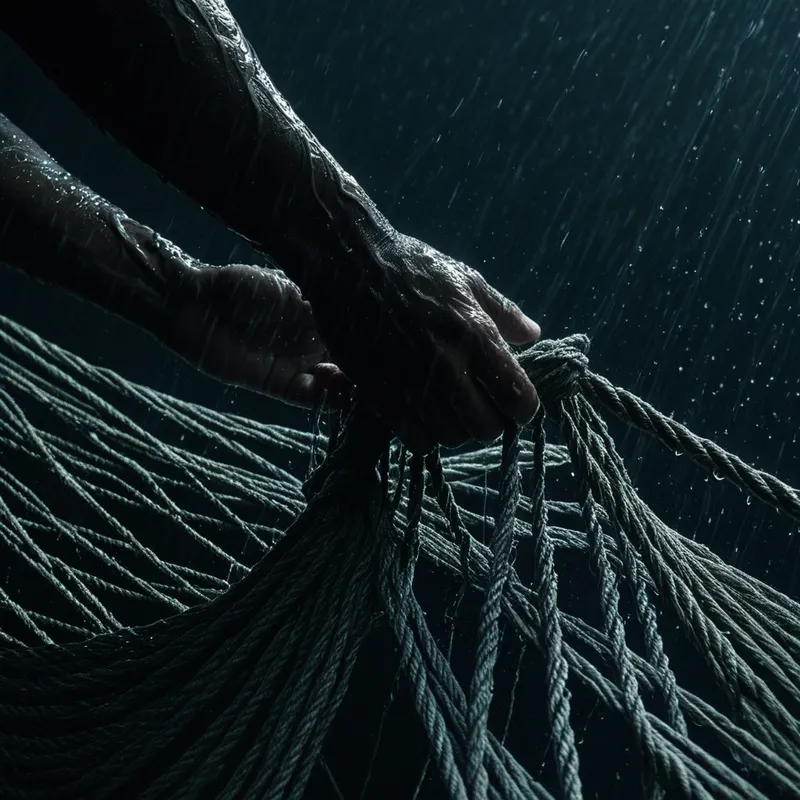
The boat creaked as they rowed back out, the sound mocking their effort. The nets, heavy with water and the memory of emptiness, were cast over the side once more. They sank into the deep, into the realm of the unseen.
Then it happened. Not a slow gathering, but a sudden, violent abundance. The nets seized, jerked, and began to tear. A living, silver torrent thrashed beneath the surface—a chaos of scales and fins where there had been only void. The catch was so vast it threatened to pull them under. A shout went up, a cry of alarm woven with awe. They signaled frantically to their partners in the other boat. Soon both vessels were alongside, heaving and straining, hauling the impossible weight. The boats themselves began to sink, low in the water, swamped by the sheer, miraculous mass of life.
In the center of this storm of abundance, Simon Peter fell to his knees in the sloshing bilge, not in thanks, but in a profound and terrifying recognition. He clutched the rabbi’s knees, his face a mask of awe-struck dread. “Go away from me, Lord,” he gasped, “for I am a sinful man!” The miracle had not just filled his nets; it had illuminated the depths of his own soul, and the contrast was unbearable. But the figure in the boat did not depart. He met the terror with a call that was the true catch of the day: “Do not be afraid. From now on, you will be catching people.” And when they brought the boats to land, they left everything—the staggering bounty, their old lives, the very shore itself—and followed him.
Cultural Origins & Context
This narrative, recorded in the fifth chapter of the Gospel of Luke, is rooted in the tangible world of first-century Galilean peasant life. Fishing on the Sea of Galilee was not a pastoral idyll; it was a grueling, cooperative trade, often conducted at night, subject to the whims of weather and the migration of fish. The story’s power derives from its stark realism—the exhaustion, the empty nets, the practical knowledge of the fishermen. It was a story told by and for communities familiar with such labor and such scarcity.
Within the early Christian movement, this account functioned as a foundational “call story.” It was not merely a tale of a miracle but a paradigm for discipleship. It was told to explain the seemingly irrational act of leaving one’s livelihood to follow an itinerant preacher. The story provided a mythological logic: the encounter with the holy (the numinous) in the midst of ordinary failure re-orders reality itself. It validated the apostles’ authority by rooting it in a transformative, divine mandate that emerged from their own professional defeat. The myth served to model the proper response to divine initiative: initial resistance based on worldly experience, followed by obedience that leads to a revelation so overwhelming it necessitates a complete reorientation of one’s life.
Symbolic Architecture
At its heart, the Miraculous Catch is a supreme allegory for the confrontation between the ego’s calculated efforts and the unpredictable bounty of the Self, the central archetype of wholeness in the psyche.
The ego toils in the shallow, known waters of the night, using the nets of conscious will. It returns again and again to proven methods, yet hauls up only emptiness. This is the crisis of meaning, the burnout of a life lived on the surface of one’s own potential.
The Self, symbolized by the figure of the rabbi, commands a journey “into the deep.” This is an injunction to move beyond the ego’s familiar territory into the unconscious, the realm of the unknown and the feared. The “deep water” is the psychic abyss where shadow and treasure co-mingle.
The obedient act of casting the net on the “word” of the Other represents a surrender of the ego’s hubris. It is the activation of the religious function, the willingness to trust a guidance that comes not from the personal will, but from a transpersonal authority.
The tearing nets and sinking boats signify that the psyche’s bounty, when it comes, is never neat or easily integrated. It is disruptive, overwhelming, and threatens to dismantle the very structures (the “boats”) of the old personality. Simon Peter’s reaction is key: he does not celebrate; he is afraid. The eruption of the numinous induces a “mysterium tremendum et fascinans”—a terrifying and fascinating mystery—that first makes one acutely aware of one’s own inadequacy (“I am a sinful man!”).
The final call, “You will be catching people,” is the alchemical goal: the redeemed energy of the personality, once spent on catching sustenance for the small self, is now redirected toward engaging and transforming the wider world. The fish, ancient symbols of unconscious life, become “people,” representing the integration of unconscious contents into conscious relationship.

The Dreamer's Resonance
When this mythic pattern stirs in the modern dreamer, it often signals a profound turning point in the relationship between conscious effort and unconscious potential. To dream of laboring fruitlessly at a familiar task—be it at a desk, in a workshop, or on a barren shore—speaks to a deep somatic and psychological exhaustion. The ego feels it has done everything correctly, yet life yields no meaning, no “catch.”
The dream may then introduce a guiding figure, a voice, or an intuitive impulse that suggests an illogical, even foolish, new direction (“cast the net on the other side,” “go into the deep”). This is the psyche’s own sage archetype breaking through. The subsequent dream image of a sudden, overwhelming abundance—a room filling with water, a tree heavy with impossible fruit, a sudden influx of people or animals—is not a peaceful reward. It is typically accompanied by anxiety: the net is breaking, the boat is sinking. This is the somatic resonance of the ego being flooded by contents it cannot manage. The dreamer may wake with a sense of awe or dread, a feeling that something too large has been set in motion. The psychological process is one of the unconscious forcibly correcting a one-sided conscious attitude, offering a bounty that the dreamer’s current identity is not yet equipped to receive, demanding a death of the old self.

Alchemical Translation
The myth models the complete arc of psychic transmutation, or individuation. The starting matter is the “lead” of exhausted effort and empirical despair (“we have toiled and taken nothing”). This is the nigredo phase, the dark night of the soul where all known methods fail.
The command to “put out into the deep” is the albedo, the washing pure. It is the cleansing of the old attitude through an act of humility and obedience to a higher, inner directive. The ego must consent to be led beyond its own light, into the darkness where it is not master.
The miraculous catch itself is the citrinitas, the dawning of the golden light. It is the eruption of the Self’s latent potential into consciousness. This is not a gentle infusion but a violent influx of creative, libidinal energy (the teeming fish) that threatens to destroy the old vessels of identity.
Simon’s terrified confession and the reassuring “Do not be afraid” represent the critical moment of mortificatio and sublimatio. The old, sinful self-perception dies in the face of the sacred, and is simultaneously uplifted and given a new purpose. The terror is not dismissed; it is transformed into the ground of a new vocation.
The final stage, the rubedo or reddening, is the act of bringing the boats to land and leaving everything to follow. The integrated personality does not hoard the miraculous bounty for itself. It leaves the astonishing catch on the shore—it does not identify with the miracle as a personal possession. The true product of the alchemy is the transformed human being, whose life energy is now dedicated not to gathering resources for the small ego, but to engaging the world (“catching people”) from a place of connected wholeness. The struggle triumphs not in the acquisition of fish, but in the creation of a fisherman of a wholly new order.
Associated Symbols
Explore related symbols from the CaleaDream lexicon: