
Mimir's Well Myth Meaning & Symbolism
The god Odin sacrifices his eye to drink from the Well of Wisdom, gaining cosmic insight at the cost of a part of himself.
The Tale of Mimir's Well
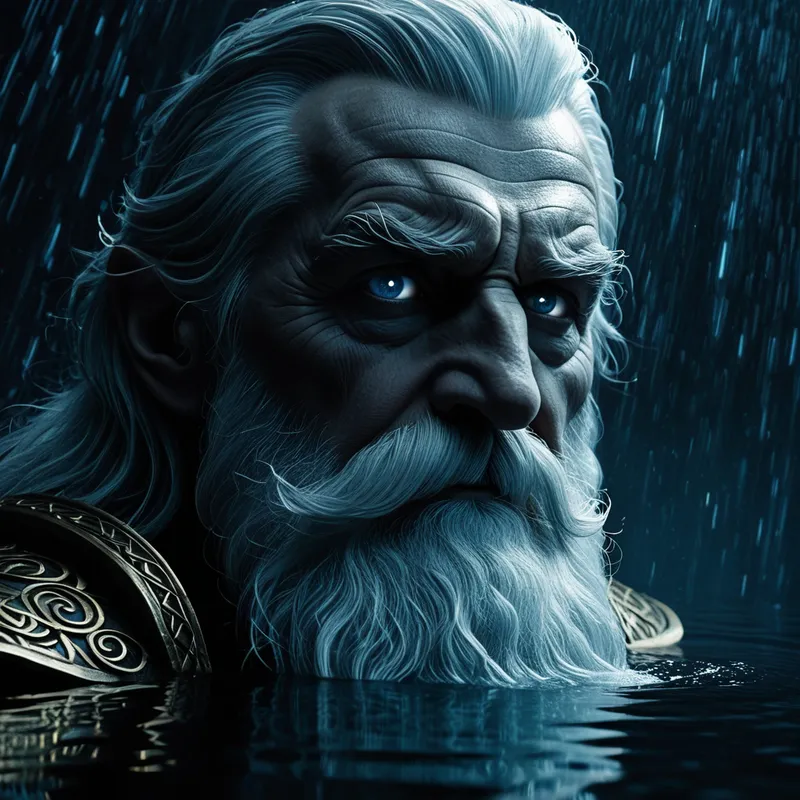
Beneath the groaning roots of the Yggdrasil, where the soil is black with the memory of creation and the air hums with the whispers of things yet to be, lies a place of profound silence. It is a well, but no ordinary spring. Its waters are dark as a moonless midnight, still as death, and deep as time itself. This is Mimir's Well. And beside it, resting upon the cold, damp roots, is a head. Not a skull, but a living head, with eyes that have seen the universe knit itself together and a mind that holds the patterns of all that is, was, and will be. This is Mimir, the guardian.
The silence is broken by a solitary figure. He walks with the weight of worlds upon his shoulders, his cloak the grey of storm clouds, his spear Gungnir a line of certainty in the uncertain gloom. This is Odin, the All-Father, the Raven-God, the seeker. He has traveled the nine worlds, hanged himself on the World Tree, and learned the secrets of the runes. Yet, a gnawing emptiness remains. The wisdom of action, of war and poetry, is not enough. He seeks the wisdom of being, the root-knowledge that flows in the dark water before him.
He stands before the head of Mimir. The ancient eyes open, and their gaze is not hostile, but terribly knowing. "All-Father," the head speaks, its voice like stone grinding deep within the earth. "You seek to drink from my well."
"I do," Odin replies, his own voice hoarse with longing. "I would know the source. I would see the threads of fate not as they are woven, but as they are spun."
Mimir is silent for a long moment. "The water is not forbidden. But it is costly. The price for a draught of this wisdom is non-negotiable. It is a part of you. It is your eye."
A chill, deeper than any frost giant's breath, grips Odin's heart. To surrender an eye is to surrender half the light of the world, to accept a perpetual twilight. It is a maiming, a reduction. He looks into the dark pool. In its impossible depths, he does not see his reflection. He sees galaxies swirling, the great serpent Jörmungandr stirring in the ocean abyss, the final flicker of the sun at Ragnarök. He sees the beautiful, terrible tapestry of all things, interconnected and flowing from this very source.
Without another word, without a cry, Odin the Terrible, the One-Eyed, reaches to his own face. There is a sound, wet and final. He holds the offering, this piece of his own sight, and extends it over the well. He lets it fall. It pierces the dark mirror of the water, sinking into the abyss, a sacrifice swallowed by the deep.
Then, trembling, he kneels. He cups his hands, breaks the surface of the well, and brings the water to his lips. It is cold, tasting of iron and starlight. And as it passes his throat, the world explodes—not in light, but in understanding. The single eye that remains sees not less, but infinitely more. It sees the hidden connections, the silent music of the cosmos, the price of every breath and the destiny in every choice. He rises, no longer just a king of gods, but a knower of roots. He has paid with his sight to gain vision.
Cultural Origins & Context
This profound myth comes to us from the Poetic Edda, primarily in the poem Völuspá (The Prophecy of the Seeress) and referenced in the later Prose Edda. It was not a story for children, but a core cosmological narrative recited by skalds and seers. In the harsh, pragmatic world of the Norse, wisdom was not a gentle virtue but a vital, hard-won tool for survival and leadership. Odin’s relentless pursuit of it, even through self-mutilation, framed the ultimate cultural value: that true knowledge requires immense personal cost.
The myth functioned as a foundational explanation for Odin’s epithet "the One-Eyed" and established the divine rationale for his unparalleled, often terrifying, wisdom. It positioned wisdom not as an innate gift, but as a transaction with the primordial depths of existence itself, guarded by a being, Mimir, whose name is thought to mean "The Rememberer." This story was a pillar in the Norse worldview, illustrating that to navigate a cosmos destined for destruction (Ragnarök), one needed the deepest, most painful kind of insight.
Symbolic Architecture
At its heart, the myth of Mimir’s Well is an archetypal map of the psyche’s journey from knowledge to wisdom. The Well represents the unconscious itself—the deep, dark, reflective pool where all memories, potentials, and primordial patterns reside. Mimir is the personification of the objective, non-ego consciousness that guards this realm; he is the Self, the inner sage who knows the cost of truth.
Odin’s sacrifice is the critical fulcrum.
To gain the wisdom of the whole, one must sacrifice the perspective of the part. The ego must willingly relinquish a fundamental way of seeing the world to be granted a vision of the world as it truly is.
The physical eye symbolizes the ego’s primary orientation—its focused, daylight consciousness, its preference for one side of reality (light over dark, known over unknown, self over other). Plucking it out is the ultimate act of kenosis—an emptying of the ego’s claim to total authority. The wisdom gained is not more information, but a shift in the very mode of perception: from binary sight to holistic vision. Odin does not become blind; he gains the "inner eye," the capacity for insight, intuition, and seeing the interconnectedness of all things. His missing eye is a permanent wound, a reminder that wisdom is not a possession but a relationship with the depths, forever marked by the price of admission.

The Dreamer's Resonance
When this myth stirs in the modern psyche, it often manifests in dreams of profound cost and revelation. A dreamer might dream of willingly removing a tooth, cutting off a finger, or, more abstractly, surrendering a prized diploma, a wedding ring, or a key. The somatic feeling is one of intense, visceral sacrifice, coupled with a strange, calm certainty. There is pain, but it is clean pain, purposeful pain.
Psychologically, this dream pattern signals a critical juncture in the process of individuation. The dream-ego is being called to relinquish an outdated but cherished identity structure—a way of seeing oneself (the "I" as a successful professional, a perpetual caretaker, a victim of circumstance) that has become a limitation. The "well" in the dream may appear as a mirror, a computer screen displaying infinite data, or a quiet forest pool. Drinking from it after the sacrifice often brings a wave of silent, boundless understanding, not as a thought, but as a felt sense of unity and truth. The dreamer is undergoing the ordeal of trading a partial, ego-bound truth for a more complete, soul-bound reality.

Alchemical Translation
The alchemical process mirrored in Odin’s ordeal is the nigredo—the blackening, the dissolution of the old form. The ego’s certainties are plunged into the aqua permanens, the permanent water of the unconscious. The prized "eye," our conscious standpoint, must be dissolved so that a new, more integrated consciousness can be coagulated.
For the modern individual, this is the model of psychic transmutation that occurs when we voluntarily confront a foundational shadow. It is the businessman who sacrifices his obsession with external validation to discover his intrinsic worth. It is the artist who abandons a safe, popular style to find her authentic, vulnerable voice. It is anyone who dares to question a core belief they inherited, trading the comfort of a handed-down map for the daunting responsibility of charting their own territory.
The Well’s wisdom is not comfort; it is coherence. It does not promise happiness, but meaning. It offers the pattern that makes sense of the pain.
The myth teaches that individuation—becoming who one truly is—is not an accumulation of skills or traits, but a successive series of such sacrifices. Each time we offer up a piece of our conditioned self-image to the depths, we drink a little deeper from the well of the Self. We become, like Odin, a paradox: both wounded and whole, limited in one dimension to become vast in another. We learn to see in the dark, guided not by the light of what we wish were true, but by the vision of what is.
Associated Symbols
Explore related symbols from the CaleaDream lexicon:
- Ear
- Dentist
- Information
- Truth
- Subconscious
- Knowledge
- Glistening Waterfall
- Translucent Dream
- Nostalgic Reverie
- Aquamarine Stone
- Beryl Nugget
- Aquamarine Orb
- Cadmium Shadow
- Baleen
- Echoing Harmonica
- Library of Shadows
- Rainy Reading Nook
- Imaginary Critics
- Literary Feast
- Sleepy Coffee Mug
- Magic 8 Ball
- Bouncy Ball
- Modern Art Museum
- Whispered Secrets
- Frosted Glass
- Information Overload
- Sound Drift
- Damping
- Cough
- Forgetting
- Cooling
- Pickled
- Crisp