
Midgard Myth Meaning & Symbolism
The world of humanity, forged from the giant Ymir's body, encircled by the serpent Jörmungandr, a fragile order amidst primal chaos.
The Tale of Midgard
Listen, and hear the tale of the world’s making, not from nothing, but from the body of a god.
In the time before time, there was only the yawning gap, Ginnungagap, flanked by the realm of fire and the realm of ice. Where their breaths met, a rime formed, and from that melting frost was born Ymir, the great giant. From his sweat came more giants, and from the ice came a cow, whose milk fed him. As she licked the salty ice, she freed another form: Buri, whose son begat three brothers—Odin, Vili, and Ve.
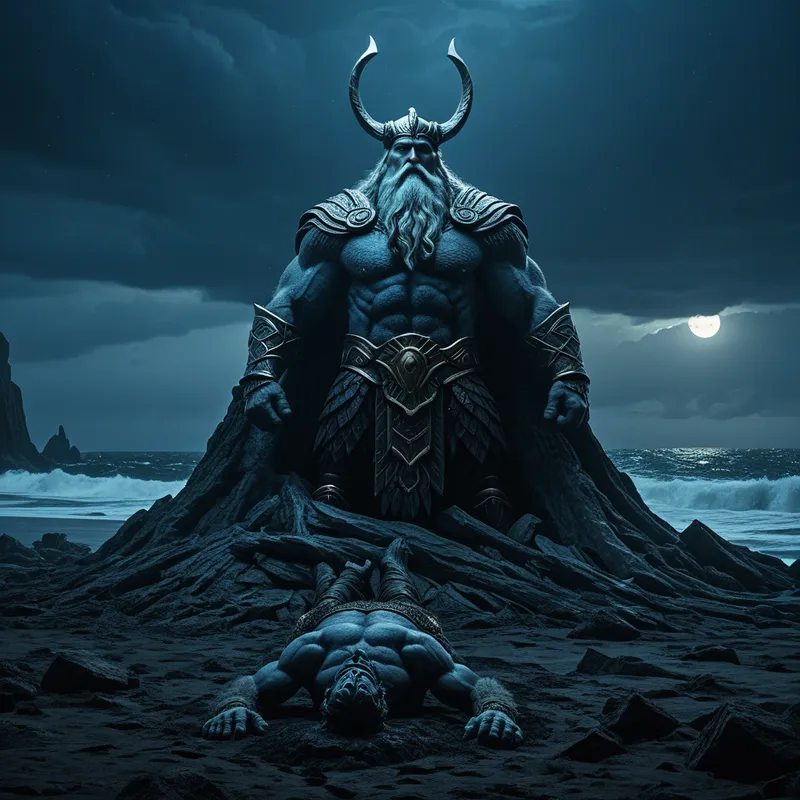
These brothers looked upon the chaotic, giant-ridden void and knew a world could be born. But creation, they saw, required a terrible sacrifice. They turned on the slumbering Ymir. The battle was cataclysmic, a storm of blood and fury. When the giant fell, his lifeblood gushed forth in such a torrent that it drowned all the frost giants but one. From that colossal corpse, the brothers began their craft.
They dragged Ymir’s body into the center of the great void. His flesh they molded into the rich, dark earth. His unspilled blood they poured out to become all the seas and lakes, a salty moat around the land. His bones they raised into towering mountains and jagged cliffs. His teeth and shattered jaw became the stones and scree. From his skull, they fashioned the dome of the sky, setting a dwarf at each of its four corners to hold it aloft. They snatched sparks and embers from the realm of fire and set them in the sky to be the sun, the moon, and the stars.
And in the very center of this new earth, they built a stronghold. They raised a wall from Ymir’s eyebrows, a mighty barrier to encircle a safe enclosure. They called this place Midgard, the Middle Yard. Here, they would place their children-to-be. Walking along a shore, Odin and his brothers found two logs, an ash and an elm. They breathed into them spirit and life, gave them sharp wit and warm blood, and clothed them. The man they called Ask, and the woman, Embla. To them, they gave Midgard as their home.
But the world outside the wall remained. The surviving giants dwelled in Jötunheimr, a land of raw power and ancient grudge. And in the deep ocean that surrounded Midgard, Odin cast a most fearsome child: the great serpent Jörmungandr. The beast grew so vast that it encircled all the world, grasping its own tail in its mouth, a living, scaled boundary between the ordered yard of humanity and the abyssal chaos of the deep. Midgard stood complete—a crafted sanctuary, a precious, defended spark of order, born from a body and ringed by a serpent, awaiting the dawn of its days and the twilight of its gods.
Cultural Origins & Context
The myth of Midgard’s creation is preserved primarily in the Prose Edda of Snorri Sturluson and the older, poetic fragments of the Poetic Edda. For the Norse peoples—farmers, sailors, and warriors living in a world of harsh climates, unforgiving seas, and territorial conflicts—this was not mere fantasy. It was a sacred geography. The myth was likely told by skalds (poets) and elders, not as a simple story of the past, but as an ongoing explanation of present reality.
Its societal function was profound. It answered the fundamental human questions: Why is the world the way it is? Why is there sea and land? Why are there dangers beyond our fields? It established humanity’s place within a vast, animate cosmos, ruled by gods, threatened by giants, and connected by the great tree Yggdrasil. Midgard was the innangard—the inner, lawful, cultivated space of the family, the farm, and the community. Everything beyond its conceptual wall was utangard—the outer, wild, chaotic, and dangerous. This myth provided the psychic and social template for all Norse life, justifying the need for strong walls, vigilant watchmen, and sacred order against the ever-present, encircling chaos.
Symbolic Architecture
Midgard is the archetypal human condition, rendered in mythic form. It is not a given paradise, but a constructed sanctuary. Its creation from the dismembered body of a primordial being speaks to a foundational psychological truth: our world of meaning, culture, and consciousness is built upon the sacrifice and integration of a more primal, undifferentiated state of being.
The self is not found, but forged from the raw material of the unconscious.
Ymir represents the primal, instinctual, and chaotic totality of the unconscious psyche. The gods—Odin, Vili, Ve—symbolize the emerging forces of consciousness (thought, will, and sacred numinosity) that must confront, slay, and creatively dismember this chaos to build a habitable inner world. The wall of eyebrows is the threshold of perception itself, the barrier that defines what is "me" and "not-me," what is safe and known versus what is foreign and threatening.
Most potent is the symbol of Jörmungandr, the World Serpent. It is not merely a monster outside the walls; it is the wall, a living, dynamic boundary. It represents the necessary tension that defines existence. It is the limit that gives form, the embodiment of the "other," the threat that makes the sanctuary sacred. It is the psychological shadow, not as an internal enemy to be destroyed, but as the encircling reality that gives our conscious identity its shape and its purpose.
The Dreamer's Resonance
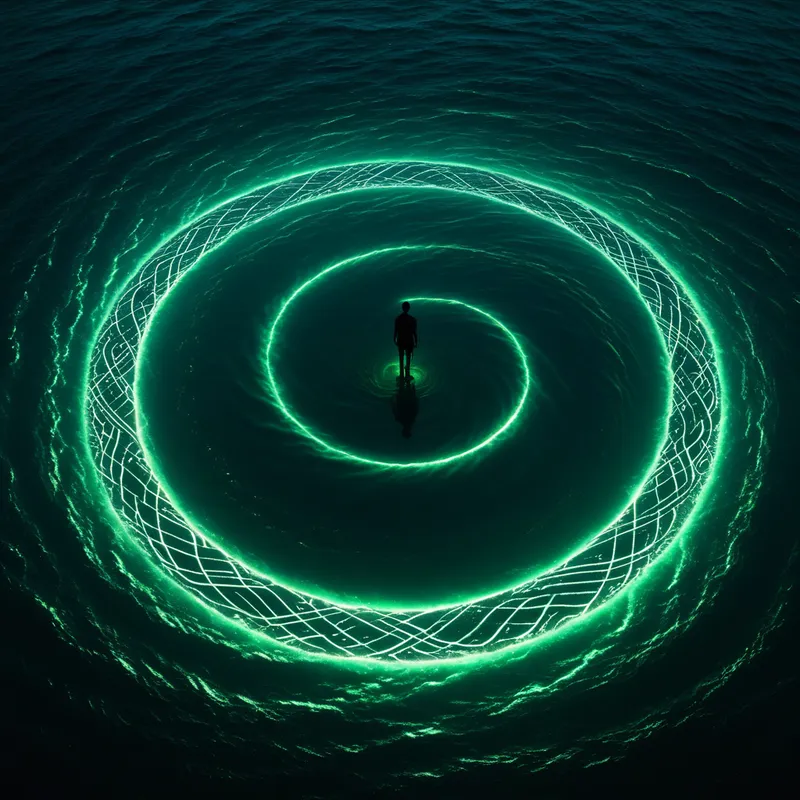
When the motif of Midgard surfaces in modern dreams, it often manifests as a profound somatic experience of boundedness and encirclement. The dreamer may find themselves in a safe, well-defined space—a walled garden, a lighted room in a vast darkness, a small boat on a calm spot of sea. The comfort of this space is palpable, but so is the acute awareness of what lies just beyond its perimeter.
The psychological process at work is one of ego consolidation in the face of the unconscious. The dream-ego is establishing or re-establishing its territory. The encircling presence—whether a dark forest, a deep ocean, or a silent, watching multitude—represents the contents of the personal or collective unconscious that feel too vast, too powerful, or too alien to be integrated. The dream is not necessarily a call to battle, but a mapping of the current psychic landscape. It asks: Where are my boundaries? What have I built my sense of self upon? What immense, perhaps serpentine, realities have I placed "out there" to preserve my inner order? The anxiety or awe in the dream is the somatic signature of the ego touching its own limits.
Alchemical Translation
The myth of Midgard models the alchemical opus of individuation—the process of creating a coherent, resilient self from the prima materia of the unconscious. The first, violent stage is the separatio and mortificatio: the confrontation with the Ymir-like mass of undifferentiated drives, complexes, and inherited patterns (the personal and familial giants). This "slaying" is the painful but necessary act of analysis, of breaking down compulsive behaviors and identifying autonomous complexes.
The second stage is the creatio: the conscious, god-like act of using that raw material. The flesh of old wounds becomes the soil for new growth (earth). The flood of released emotion is channeled into the sea of the soul, given bounds (the shore). The hard structures of defense (bones) are reshaped into the supporting architecture of one's values (mountains). The skull of old, rigid thinking is lifted to become the vault of a new perspective (the sky).
The goal is not to escape the serpent, but to recognize it as the shape of your own wholeness.
Finally, the circumambulatio: the integration symbolized by Jörmungandr. The individuating individual does not destroy their shadow or their connection to the primal chaos. Instead, they come to know its contours. They learn that the serpent that seems to threaten their sanctuary is, in fact, the boundary that defines it. The ultimate alchemical translation is the realization that the protected self (Midgard) and the encircling other (Jörmungandr) are two aspects of a single, vast system—the Self. To know the limits of your crafted world is to begin to comprehend the true scale of your being. The wall is not a prison, but the rim of a vessel, and the vessel is what makes the life within possible.
Associated Symbols
Explore related symbols from the CaleaDream lexicon: