Middle Passage Myth Meaning & Symbolism
A mythic remembrance of the oceanic crossing, where ancestors endured a cosmic rupture to forge a new consciousness from the depths of despair.
The Tale of Middle Passage
Listen. This is not a story that begins with "once upon a time." It begins in the middle of a scream that became a silence, in the space between a heartbeat and the next one that never came. It begins with the world turning inside out.
The sun, Nyame, watched from his golden throne as the earth cracked. The green, singing forests of the ancestors grew quiet. The rivers that carried the voices of the Orishas were forced to swallow their own songs. Then came the breaking of the circle. Strong hands, that knew the weight of yam and the curve of a child's back, were bound by cold iron that knew nothing. Feet that had danced the stories of the world into the dust were marched towards a horizon that had forgotten its name: the sea.
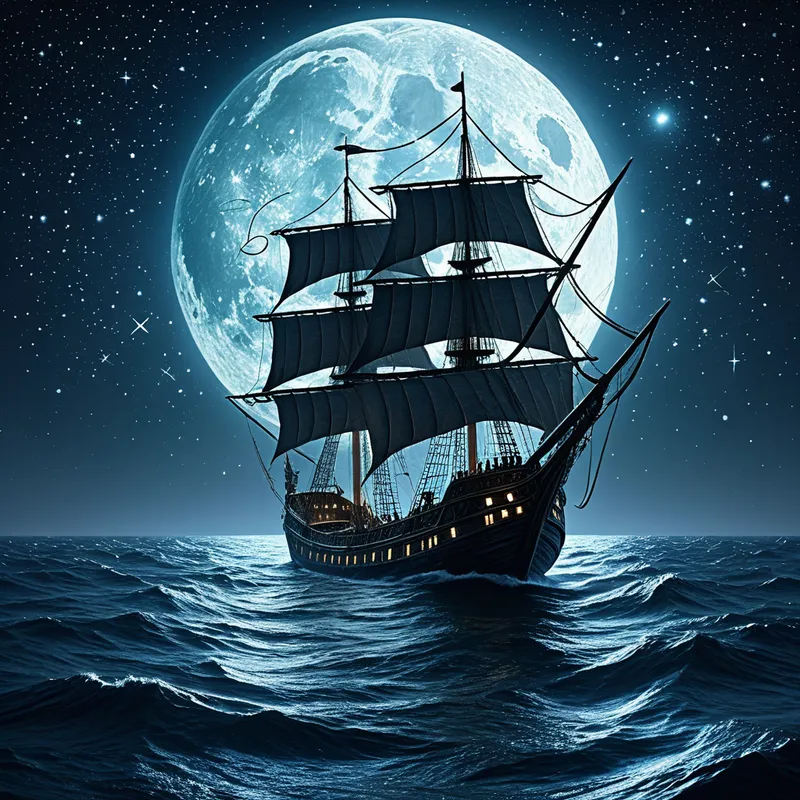
And the sea, it was not the welcoming womb of Yemoja. It became a vast, gray maw, a liquid desert. Upon it floated great wooden beasts, their bellies hollow with a new kind of darkness. This was the Middle Passage, the breathing coffin, the world-between-worlds. Here, time dissolved. The rhythm of the moon was replaced by the creak of timber and the choke of salt air. The air grew thick with the ghosts of names—names discarded overboard, names whispered into the palm of a neighbor, names swallowed to become a secret seed in the gut.
In that darkness, a profound alchemy began. The body was shackled, but the spirit… the spirit undertook a desperate journey. Some say the wise ones, the priests and priestesses, called upon the Egungun and the Orishas. They performed the rituals in the silence of their minds, pouring libations with tears, tracing sacred symbols in the sweat on the floor. They made a covenant with the deep. They spoke to the ocean not as a prison, but as a reluctant midwife.
Many souls could not bear the rupture and chose to return home. They shaped their breath into wings and flew back across the water, following the path of the moon, to rejoin the company of ancestors. Their bodies were given to the deep, and the fish became their messengers.
But for those who remained, a transformation was forged in that crucible of suffering. The memories of the land—the smell of hot soil, the pattern of a woven cloth, the cadence of a proverb—these did not die. They were broken apart like sacred kola nuts, and from the pieces, a new consciousness was assembled. It was a consciousness born of duality: holding the memory of a whole self while staring into the face of a world that denied it. In the hold, the first notes of a new spiritual grammar were hummed—a sorrow song that contained a map, a prayer that doubled as a plan, a lullaby that was also a battle hymn.
The resolution was not an arrival on a golden shore. It was the first, staggering step onto a strange, hard land, carrying within them the entire ocean. They had crossed. They were now the people of the passage, the children of the breach, the architects of a soul forged in the abyss. The myth ends where history begins: with a breath taken in a new, hostile air, a breath that carried the weight and the wisdom of the deep.
Cultural Origins & Context
The myth of the Middle Passage is not housed in a single, sacred text. It is an emergent mythology, born from the collective trauma and triumph of the African Diaspora, primarily in the Americas and the Caribbean. Its origins are in the unspoken, the suppressed, and the resiliently remembered. It was passed down not through official bards, but through the coded language of spirituals, the polyrhythms of drumming that remembered the heartbeat of the land, the call-and-response of work songs, and the embodied memory in dance.
Its primary storytellers were the enslaved Africans themselves and their descendants. The myth functioned as a crucial psychic survival mechanism. In a system designed to annihilate history, culture, and personhood, this narrative act of remembrance became a radical act of creation. It provided a cosmological framework to explain the inexplicable rupture, to honor those who were lost, and to assert that the journey, however horrific, was not the end of their story. It transformed a historical crime against humanity into a spiritual trial of a people, allowing them to situate their suffering within a larger, meaningful arc of endurance and eventual transcendence. It is the foundational bedrock upon which diasporic religions like Vodou, Candomblé, and Santería built their syncretic bridges, often envisioning the ocean as the realm of powerful spirits who witnessed and received the ancestors.
Symbolic Architecture
The Middle Passage is the ultimate symbol of the Cosmic Rupture. It represents the violent severing from source—from land, lineage, language, and a coherent cosmology. Psychologically, it maps the experience of profound alienation, the ego's brutal separation from the nourishing waters of the unconscious (the familiar homeland) and its imprisonment by a tyrannical, impersonal structure (the slave ship, the system).
The ship's hold is the crucible of the soul, where all former identities are dissolved so that a more resilient, conscious one may be precipitated.
The ocean is dual-natured: it is the devouring mother (Tehom, the abyss) and the preserving, amniotic fluid of transformation. To be swallowed by it is to face the ultimate dissolution of the self. The choice of the ancestors to "fly home" or to endure symbolizes the psyche's options when faced with unbearable trauma: fragmentation (psychosis, spiritual death) or a harrowing, piece-by-piece reconstruction.
The central, triumphant symbol is the forging of a Dual Consciousness. This is the psyche's genius adaptation—the ability to hold two seemingly irreconcilable realities at once: memory and presence, trauma and hope, subjugation and an unbreakable inner freedom. This is not a pathology, but a profound evolutionary step in soul-making.
The Dreamer's Resonance
When this mythic pattern stirs in the modern dreamer, it signals a profound encounter with the personal or collective shadow. It is not a dream of simple travel, but of passage under duress.
Dreams of being trapped in the hold of a ship, of drowning in a vast, dark sea, or of being severed from one's family and cast adrift point to a psychological process of rupture. The dreamer may be undergoing a life event that feels annihilating—the end of a foundational relationship, the loss of a cultural or familial anchor, a diagnosis, or a moral injury that shatters their worldview. The somatic feeling is one of compression, weight, and breathlessness, a literalized anxiety.
Conversely, dreams of finding breath underwater, of communicating with luminous beings in the deep, or of discovering a secret, inner compass while adrift indicate the psyche is engaged in the myth's alchemical work. The dream ego is learning to navigate the "ocean" of the unconscious without its familiar landmarks, beginning to forge that dual consciousness. It is a sign of the psyche's innate resilience, its deep memory that even in the most crushing confines, the work of reassembly and meaning-making is possible.

Alchemical Translation
For the individual, the myth of the Middle Passage models the most painful, necessary, and transformative stage of individuation: the Nigredo. This is the "dark night of the soul," where the comfortable structures of the personality (the "homeland") are violently dismantled by life circumstances or by the demands of the Self. One is shackled in the hold of depression, anxiety, or meaninglessness.
The alchemical instruction here is not to escape the darkness, but to do the work within it. It is to perform the silent rituals of self-remembrance. To gather the fragments of one's shattered identity—the values, memories, and truths that the "slave ship" of crisis tried to throw overboard—and protect them as sacred seeds.
The triumph is not in avoiding the passage, but in undergoing it consciously, and emerging with the salt of the deep integrated into one's bones.
The process culminates in the creation of an inner Dual Consciousness. The integrated individual is one who can acknowledge the reality of their wounding (the historical fact of the passage) without being defined solely by it. They can hold their brokenness and their wholeness in the same glance. They become a bridge between worlds—between the unconscious and consciousness, between victimhood and agency, between the pain of the past and the possibility of the future. They carry the ocean within them, not as a flood to drown them, but as a well of depth, resilience, and a wisdom forged in the abyss. They have, in the deepest sense, crossed over.
Associated Symbols
Explore related symbols from the CaleaDream lexicon: