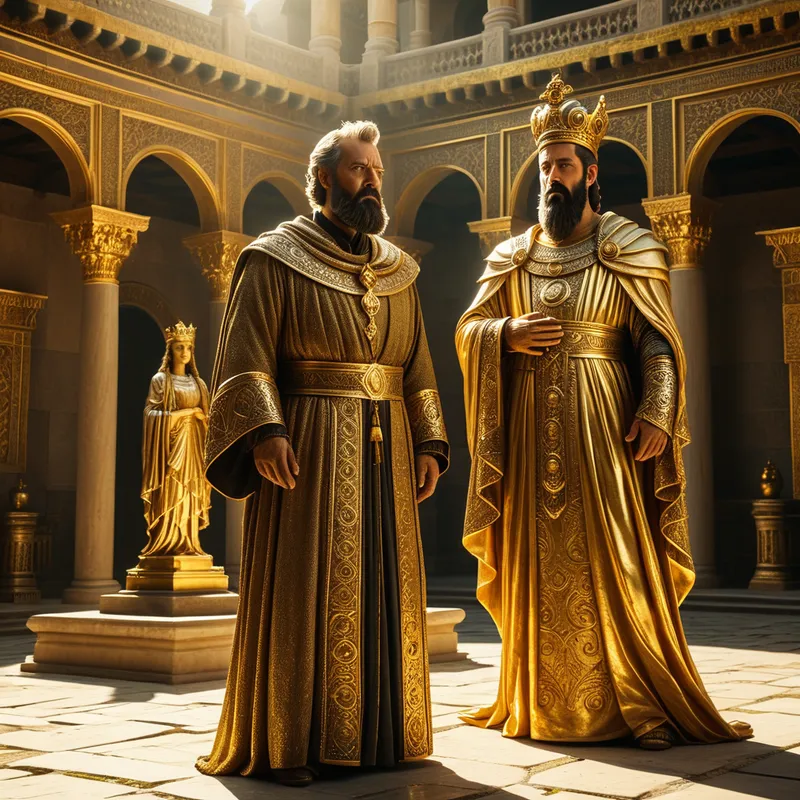
Midas' Golden Touch Myth Meaning & Symbolism
A king granted a wish turns everything he touches to gold, learning that true wealth lies not in metal, but in the warmth of life itself.
The Tale of Midas’ Golden Touch
Hear now the tale of [Midas](/myths/midas “Myth from Global/Universal culture.”/), king of Phrygia, a man whose name became a byword for fortune and folly. His story begins not in a throne room, but in a wild, vine-tangled grove. The old satyr [Silenus](/myths/silenus “Myth from Greek culture.”/), tutor to the god Dionysus, had stumbled from his revels, lost and wine-sodden. [Midas](/myths/midas “Myth from Global/Universal culture.”/) found him, treated him with royal hospitality for ten days and nights, and returned him gently to his divine charge.
In gratitude, Dionysus, his eyes sparkling with vine-dark mirth, appeared before the king. “Ask of me any boon, Midas,” the god proclaimed, his voice like the murmur of a deep, intoxicating river. “Name your heart’s desire, and it shall be yours.”
Midas did not hesitate. He did not ask for wisdom, or long life, or victory in battle. His mind, already heavy with the weight of his crown’s gold, saw only one glittering path. “Grant,” he said, his voice thick with longing, “that everything I touch be turned to gold.”
A shadow, fleeting and profound, passed over Dionysus’s face. But a god’s word is binding. “So be it,” he intoned, and a strange, cold warmth flooded Midas’s veins.
At first, it was a miracle. He brushed a low-hanging oak branch—it chimed and solidified into a lattice of priceless filigree. He scooped a stone from [the earth](/myths/the-earth “Myth from Hindu culture.”/)—it became a nugget of purest ore in his palm. Laughing, he ran through his palace, transforming tables, chairs, and pillars into a dazzling, silent museum of gold. He was the master of alchemy, the creator of wealth from mere matter.
But then came the hunger. He called for a feast, a celebration of his power. He reached for a plump fig—it hardened into a golden weight. He raised a cup of wine to his lips—the liquid thickened into a molten, undrinkable stream that coated his throat. Panic, cold and sharp, pierced his euphoria. His beloved daughter, hearing his cries of distress, rushed to embrace him. As her arms wrapped around his neck, her comforting words ceased mid-breath. Her warm, living form stiffened in his grasp, her eyes wide with a final, uncomprehending love, now frozen in a mask of perfect, heartbreaking gold.
The king’s triumphant laughter turned to a wail of utter despair. He clutched his golden child, feeling not wealth, but the ultimate poverty. He had been granted the touch of death disguised as fortune. The palace, once filled with life, was now a mausoleum of silent, shining metal. His wish had built a prison of absolute, sterile value, and he was its solitary, starving warden.

Cultural Origins & Context
The myth of Midas is not a story of Zeus or Athena, but belongs to the rich periphery of Greek storytelling, where mortal kings interact with the less orderly, more visceral gods like Dionysus. It is primarily preserved in the Latin poet Ovid’s [Metamorphoses](/myths/metamorphoses “Myth from Greek culture.”/), a compendium of transformation myths that served as a vital source for later European culture. Before Ovid, the tale was part of the oral tradition, a cautionary fable told in [the symposium](/myths/the-symposium “Myth from Greek culture.”/) and the marketplace.
Its societal function was multifaceted. For the mercantile Greeks, it was a stark warning about the nature of pleonexia—the insatiable desire for more. It questioned the very definition of olbos (prosperity/happiness). True wealth, the story whispers, is not in inert metal but in the flowing, perishable stuff of life: food, drink, and human connection. The myth also explores the complex relationship between mortals and gods. Dionysus’s gift is a classic “monkey’s paw” scenario, revealing that divine gifts are often riddles that test the recipient’s soul. Midas, like many heroes in these peripheral tales, is not a great warrior but an everyman whose fatal flaw is blindingly common: unchecked desire.
Symbolic Architecture
At its core, the myth is a profound [allegory](/symbols/allegory “Symbol: A narrative device where characters, events, or settings represent abstract ideas or moral qualities, conveying deeper meanings through symbolic storytelling.”/) of misplaced valuation and the [petrification](/symbols/petrification “Symbol: A state of being turned to stone, representing paralysis, permanence, or transformation in the face of overwhelming fear, trauma, or awe.”/) of [life](/symbols/life “Symbol: The symbol of ‘Life’ represents a journey of growth, interconnectedness, and existential meaning, encompassing both the joys and challenges that define human experience.”/) by literalism. The “golden touch” is not a power, but a perceptual disorder.
The wish that turns all to gold is the ego’s fantasy of absolute control, the desire to fix the fluid, living process of the world into a single, static, and “valuable” state.
Gold symbolizes the ultimate object of desire—pure, incorruptible, and universally valued. But when this symbolic value is made literal, it becomes a [curse](/symbols/curse “Symbol: A supernatural invocation of harm or misfortune, often representing deep-seated fears, guilt, or perceived external malevolence.”/). [Food](/symbols/food “Symbol: Food in dreams often symbolizes nourishment, both physical and emotional, representing the fulfillment of basic needs as well as deeper desires for connection or growth.”/), [wine](/symbols/wine “Symbol: Wine often symbolizes celebration, indulgence, and the deepening of personal connections, but it can also represent excess and escape.”/), and the [daughter](/symbols/daughter “Symbol: In dreams, a daughter symbolizes innocence, potential, and the nurturing aspects of oneself or one’s relationships.”/) represent the chthonic and relational [wealth](/symbols/wealth “Symbol: Wealth in dreams often represents abundance, security, or inner resources, but can also symbolize burdens, anxieties, or moral/spiritual values.”/) of [the world](/myths/the-world “Myth from Tarot culture.”/): nourishment, [ecstasy](/symbols/ecstasy “Symbol: A state of overwhelming joy, rapture, or intense emotional/spiritual transcendence, often involving a loss of self-awareness.”/), and love. These are processes, not objects. They require exchange, [digestion](/symbols/digestion “Symbol: Represents processing, assimilation, and elimination of experiences, emotions, or information. Often symbolizes how we handle life’s challenges and absorb what nourishes us.”/), and [vulnerability](/symbols/vulnerability “Symbol: A state of emotional or physical exposure, often involving risk of harm, that reveals authentic self beneath protective layers.”/). To turn them to gold is to interrupt their life-giving flow, transforming sustenance into sculpture.
Psychologically, Midas represents the part of the [psyche](/myths/psyche “Myth from Greek culture.”/) that seeks to concretize the intangible. He is the ruler who mistakes the map (gold, [status](/symbols/status “Symbol: Represents one’s social position, rank, or standing within a group, often tied to achievement, power, or recognition.”/), control) for the territory (life, experience, [relationship](/symbols/relationship “Symbol: A representation of connections we have with others in our lives, often reflecting our emotional state.”/)). His touch is [the ego](/myths/the-ego “Myth from Jungian culture.”/)‘s appropriating grasp, which, when driven by unconscious greed, kills the very [thing](/myths/thing “Myth from Norse culture.”/) it seeks to possess. The daughter, turned to a [statue](/symbols/statue “Symbol: A statue typically represents permanence, ideals, or entities that are revered.”/), is the ultimate [symbol](/symbols/symbol “Symbol: A symbol can represent an idea, concept, or belief, serving as a powerful tool for communication and understanding.”/) of this: love, when grasped as a possession, becomes a dead effigy.

The Dreamer’s Resonance
When this myth stirs in the modern dreamscape, it rarely appears as a classical king in a toga. Instead, the dreamer may experience a chilling version of the “[Midas touch](/myths/midas-touch “Myth from Greek culture.”/)” in contemporary settings. One might dream of a promotion that turns colleagues into competitive automatons, or of acquiring a perfect house that becomes a cold, echoing shell. The somatic feeling is often one of creeping dread or claustrophobic [triumph](/myths/triumph “Myth from Roman culture.”/)—a victory that feels like a defeat.
This dream pattern signals a profound psychological process: the realization that a deeply held desire or a strategy for security is actually isolating and life-denying. The dream ego is experiencing the “golden” consequences of a psychic attitude that seeks to control, monetize, or perfect aspects of life that must remain fluid and imperfect. The transformation of a loved one into a statue or a machine in a dream is a direct cry from the soul, indicating that an animating relationship is in danger of being turned into a dead structure—a role, an obligation, a trophy. The dream is the moment of Midas’s horror, the body’s and psyche’s rebellion against a self-imposed curse of sterile success.

Alchemical Translation
The path of Midas models a brutal but essential alchemical sequence for individuation: the desire for [the Philosopher’s Stone](/myths/the-philosophers-stone “Myth from Alchemical culture.”/), the ensuing [nigredo](/myths/nigredo “Myth from Alchemical culture.”/) (blackening), and the plea for solve (dissolution).
Midas begins in the alchemical stage of citrinitas (yellowing), obsessed with the solar metal, gold. He believes he has found the secret of transmutation, the shortcut to perfection. But his operation is flawed, performed with a greedy, literal mind. The result is not enlightenment, but a descent into the nigredo—the black despair of realizing his “gold” is spiritual death. His golden palace becomes his dark prison.
His salvation lies not in gaining another power, but in surrendering the one he has. He must petition the god, the symbolic representation of the unconscious Self, for release. The journey to [the river](/myths/the-river “Myth from Buddhist culture.”/) Pactolus is the journey to the waters of the unconscious, to the flowing, cleansing principle that opposes rigid, metallic fixation.
The washing away of the golden touch is the alchemical solve: the dissolution of a rigid, ego-bound complex in the fluid wisdom of the deeper Self.
For the modern individual, the “alchemical translation” is the process of recognizing where we have turned our living relationships, our creative joys, or our inner lives into “gold”—into projects, metrics, or image-management exercises. The redemption comes not through acquiring more, but through a humbling immersion in what is simple, fluid, and real: feeling over form, process over product, connection over control. We must wash our “Midas hands” in the river of our own tears—the acknowledgment of our folly—to restore our capacity to touch the world without destroying it, to hold what we love without turning it to stone. The myth ends not with Midas becoming wise, but with him becoming human again, his fingers finally able to feel the earth, and his heart, once heavy with gold, now light with the memory of loss and the grace of a second chance.
Associated Symbols
Explore related symbols from the CaleaDream lexicon: