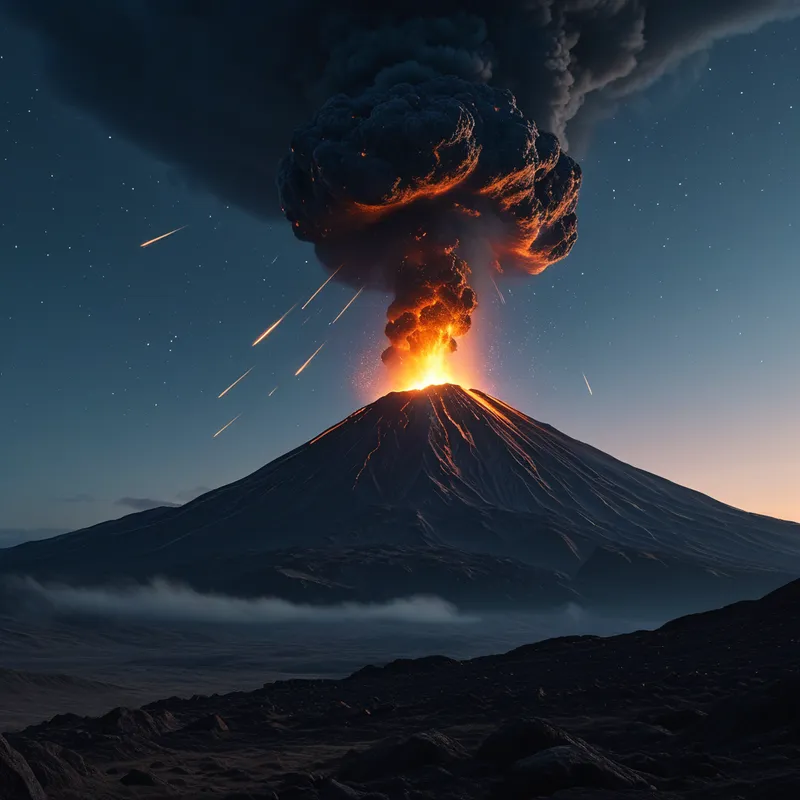
Meteor Craters Myth Meaning & Symbolism
A celestial stone falls, shattering the world. From the wound, a new, sacred order is born, teaching that the deepest scars hold the seeds of creation.
The Tale of Meteor Craters
Listen. Before the fields were named, before the rivers learned their courses, the sky was a silent, watchful dome. The people lived in the rhythm of sun and soil. Then came the night of the broken covenant.
It began not with sound, but with light—a second, furious sun tearing a bleeding path across the heavens. The air itself began to scream, a shriek that came from the bones of the world. The gods, it was said, were quarreling. Perhaps a star-god had grown arrogant, or the Sky-Holder had loosened their grip. The brilliant, terrifying seed fell.
When it struck, the word “strike” is too small. The earth did not receive it; it was violated by it. The ground, which had borne them all, convulsed like a living thing in agony. A wave of force, visible as a shimmer of heat and dust, raced outward, flattening forests and silencing every creature. Then, the sound—a roar that was not a roar but the world’s own voice cracking. For days, a shroud of ash and death fell, blotting out the sun, turning day into a dim, choking twilight. The people huddled, believing the order of creation had been unmade.
When the dust settled, they ventured forth, led by the bravest or the most despairing. They found it: a wound in the world. A vast, circular pit, its edges raw and upturned, steam hissing from its depths. The familiar land was gone. In its place was a bowl of shattered rock, fused into strange, glassy forms, and at its heart, a black, pitted stone—cold now, but humming with a memory of fire. It was not a part of this world. It was a numen from the void.
The first to approach called it a curse. But as the seasons turned, a miracle unfolded. Rain collected in the crater’s bowl, forming a perfect, circular lake of startling blue. Lush, unknown plants sprouted from the mineral-rich soil at its rim. Animals, drawn to the water, flourished. The scar, the brutal, chaotic wound, had become a womb. The people understood. The sky had not attacked them; it had gifted them. The violent marriage of heaven and earth had birthed a new, sacred center. They built their altars on the rim, offered prayers to the fallen star, and told their children of the day the world was remade by a fist from the sky.

Cultural Origins & Context
The myth of the meteor crater is a global motif, one of humanity’s most profound and widespread geological memories. From the Kaali field in Estonia to the Kandimalal in Australia, and from the Coon Butte in North America to tales in the Americas and Asia, cultures worldwide have preserved the memory of these cataclysmic events. These stories were not told by astronomers but by survivors—elders, shamans, and storytellers who witnessed, or inherited the memory of, an event that defied all explanation within their cosmology.
The myth served a crucial societal function: it domesticated the terrifying. By weaving the event into a narrative of divine intention—whether punishment, gift, or cosmic battle—it restored order to a traumatized psyche. The crater became a temenos, a sacred precinct. It explained why this particular lake was so round, why these stones were so strange, and why the game was so plentiful here. It transformed a site of absolute chaos into the axis of a new world, providing a literal and spiritual center for the community to reorganize around.
Symbolic Architecture
At its core, the meteor crater myth is a master symbol of traumatic transformation. The meteor itself represents the psychic trauma—sudden, violent, alien, and arriving from a realm (the unconscious, fate, the external world) outside the individual's control. It is the phone call in the night, the diagnosis, the betrayal, the sudden loss that obliterates the familiar landscape of the self.
The crater is the psyche’s scar tissue—the depression formed around the unintegrated, foreign core of pain.
The initial phase—the impact, the fire, the darkness—symbolizes the shock and disintegration of the ego. The old “I” cannot comprehend or withstand the force. The subsequent period of ash and twilight represents the depression, numbness, and disorientation that follows trauma. The crucial alchemy, however, lies in the crater’s transformation into a fertile, sacred basin. This symbolizes the psyche’s innate, often unconscious, drive to make meaning out of suffering. The foreign, painful object (the meteorite) is not removed; it is ritualized. It becomes the omphalos, the navel of a new self. The wound becomes a vessel that holds the waters of the unconscious, giving birth to new life, new insights, and a new, more resilient order.

The Dreamer's Resonance
When this mythic pattern surfaces in modern dreams, it often signals a profound encounter with the Self or a core trauma. Dreaming of a meteor streaking toward you speaks of an impending or recent psychic collision—a realization, a memory, or an external event that feels destined and devastating. Dreaming of standing at the edge of a vast crater signifies confronting the aftermath of such an impact. The dreamer is surveying the damage to their inner landscape.
The somatic feeling here is one of profound disorientation mixed with awe. There is the hollow feeling of the “crater” in the chest or gut, the sense of being scooped out. Yet, there is also the cool, clear water at the bottom—a symbol of emotion that has settled into a deep, reflective pool. To dream of finding strange, beautiful crystals or thriving plants in the crater is a powerful indicator of the unconscious already working to heal and create meaning from the wound. The dream is modeling the process of moving from victim of the impact to custodian of the sacred site.

Alchemical Translation
For the modern individual, the myth maps the alchemical process of individuation through the opus contra naturam—the work against nature, which here means against the ego’s desire for continuity and comfort. The meteor’s descent is the nigredo, the blackening: the utter dissolution of the old personality structure.
The alchemical fire is not lit in the hearth; it falls from heaven, incinerating the known to make space for the true.
The ego’s task is not to avoid the impact, but to endure the mortificatio—the symbolic death—and then to consciously participate in the sanctification of the wound. This is the albedo, the whitening. One must go to the crater’s edge, touch the alien meteorite of one’s pain, and acknowledge it as a part of one’s history. One must build an inner altar there. This means refusing to see one’s deepest wounds merely as sources of shame or weakness, but recognizing them as the violent, divine intrusions that shaped the unique topography of the soul.
The final stage, the rubedo or reddening, is the full flowering of life from the crater. It is the creative work, the relationships, the wisdom, and the compassion that could only have grown from that specific, fertilized scar-tissue. The individual becomes the crater-lake: a being whose deepest, most wounded part holds the clearest reflection of the sky, and whose shores are lush with a life that is resilient precisely because it knows the cost of its ground.
Associated Symbols
Explore related symbols from the CaleaDream lexicon: