Metatron in Kabbalah Myth Meaning & Symbolism
The myth of a human, Enoch, who ascended through divine wisdom to become Metatron, the celestial scribe and mediator of the divine will.
The Tale of Metatron in Kabbalah
Listen, and let the veil thin. Before the foundations of the world were set, the Ein Sof breathed, and from that breath, realms of light cascaded into being. But our tale does not begin there, in the pure divine. It begins in the dust, with the scent of earth after rain, and the labored breath of a man walking with God.
His name was Enoch. He was a man of the soil, yet his eyes were fixed on the spaces between the stars. While others built cities of stone, he built a soul of seeking. For three hundred and sixty-five years, he walked a path no other had fully tread, until the boundary between the human and the holy grew thin as parchment. Then, the call came—not in thunder, but in a terrible, beautiful silence that unstitched the world.
Angels of fire, their wings the sound of crashing waters, descended. They did not greet him; they unmade him. They stripped from Enoch the garment of flesh, the cloak of mortality, and washed him in rivers of blazing light. They anointed him with the oil of the supernal realms, and his very bones became letters of a sacred alphabet. His human heart was replaced by a wheel of turning fire, and upon his brow, a crown was set, inscribed with the letters that seal creation.
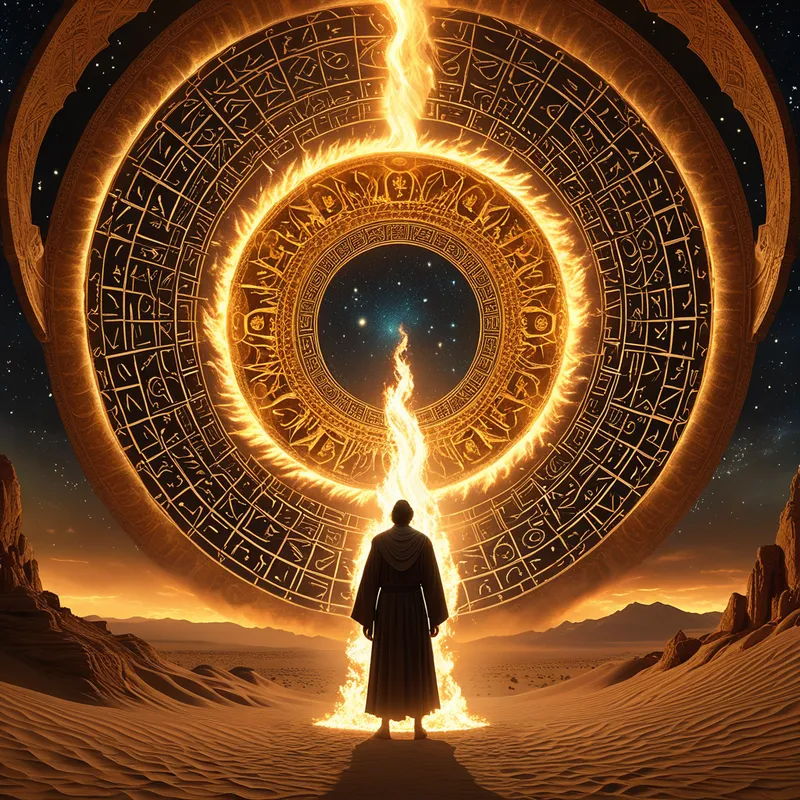
He was led, or rather, he flowed, through the Heikhalot, palaces of crystalline sound and frozen flame. At each gate, guardians of terrifying aspect challenged him, but the letters shining from his form were keys that turned the locks of heaven itself. He passed beyond the curtain of the firmament, beyond the place where even angels dare not look.
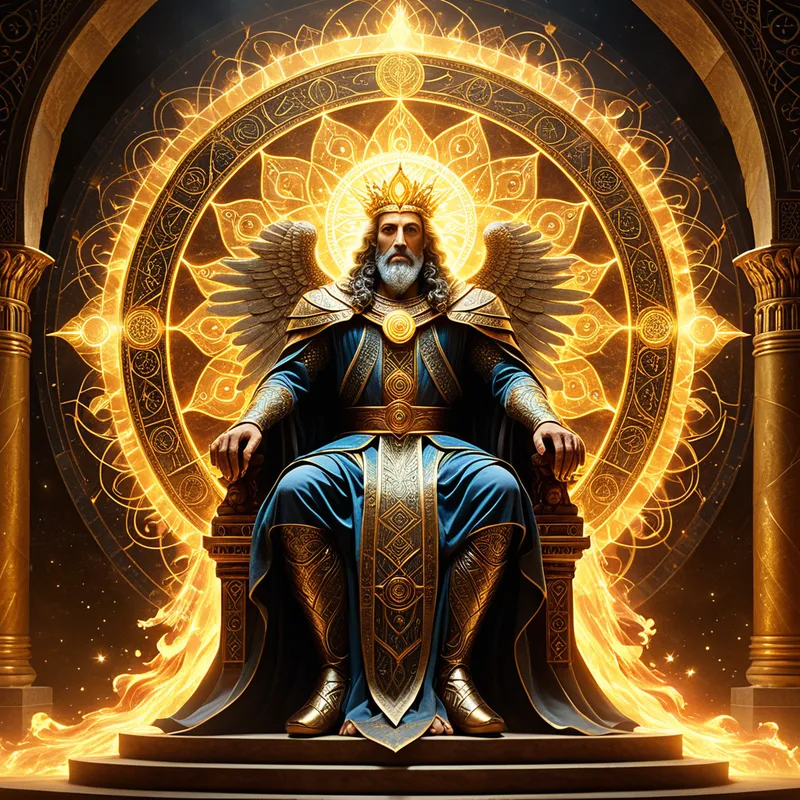
And in the highest chamber, before the shimmering, unbearable presence of the Divine Throne, the transformation was sealed. The man Enoch was no more. In his place stood a being of colossal stature, a prince among the celestial hosts. Seventy-two wings of spectral light sprang from his back, and three hundred and sixty-five thousand eyes gazed out from his essence. He was given a throne—a mirror of the Divine Throne—and a name that holds the architecture of reality: Metatron, Sar ha-Panim, the Prince of the Divine Presence.
His duty? To be the scribe. With a stylus of lightning, he inscribes the deeds of Israel into the Sefer ha-Chayim, the Book of Life. He is the voice that translates the ineffable will of the Ein Sof into a language the angels can bear. He is the bridge, the mediator, the living proof that the dust can dream of the throne, and in dreaming, become part of its foundation.
Cultural Origins & Context
The myth of Metatron is not found in the canonical Hebrew Bible but flourishes in the rich, hidden soil of Kabbalah and Heikhalot literature, composed between the 3rd and 8th centuries CE. These were esoteric teachings, passed in whispers from master to initiated disciple, for "it is not permitted to reveal the secrets of the Merkabah to anyone unless he is wise and understands on his own."
The myth served multiple profound functions. For the mystics who risked these visionary ascents, Metatron was both a goal and a guide—a map showing that a human soul could traverse the terrifying beauty of the divine realms and achieve ultimate communion. Societally, in times of exile and powerlessness, the myth asserted a breathtaking spiritual potency: the ultimate authority in heaven was not a distant god, but a transformed human, advocating for humanity from within the very heart of divinity.
Symbolic Architecture
Metatron is the ultimate symbol of the human potential for radical ontological transformation. He represents the apotheosis of consciousness, where the seeker of wisdom (Enoch) becomes the embodiment and administrator of that wisdom (Metatron).
The journey from name to Name is the alchemy of the soul. To become Metatron is to have one's personal identity dissolved and reconstituted as a function of the cosmic order—a conscious organ of the divine body.
The stripping by the angels symbolizes the necessary deconstruction of the earthly ego, the "garment of flesh" that limits perception. The crown and the throne signify not merely reward, but the assumption of immense responsibility and cosmic function. Metatron is not a passive deity; he is the active principle of mediation, the logos or word that translates absolute unity into the plurality of creation. He is the psyche that has integrated the totality of its experience into a coherent, serving whole.
The Dreamer's Resonance
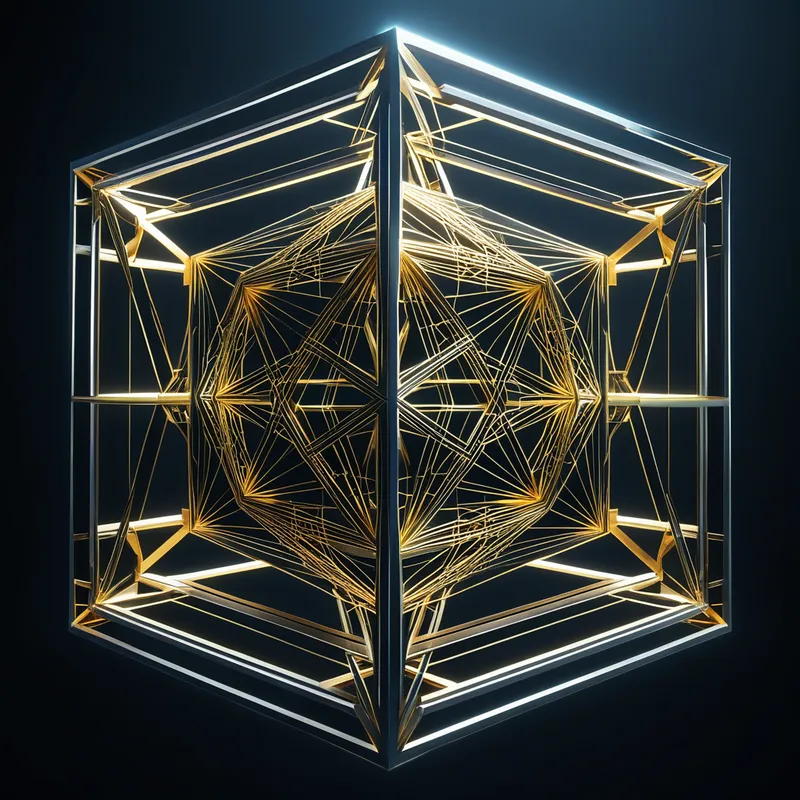
When this myth stirs in the modern unconscious, it often manifests in dreams of overwhelming systems, sacred geometry, or terrifying promotions. You may dream of being given a key to a vast, incomprehensible machine you are now expected to operate. You may see your own body transforming into light or data, or find yourself in a colossal library where you are both the reader and the text being written.
Somatically, this can feel like a cracking open of the crown of the head, a pressure of "knowing too much," or a profound sense of dislocation from ordinary life. Psychologically, this is the process of the ego confronting the Self—the total, transpersonal psyche. The dreamer is undergoing a rite of passage where their old identity is being dismantled to make way for a consciousness that can hold greater complexity, responsibility, and connection to the transpersonal. It is often accompanied by both awe and profound terror—the "fear and trembling" of standing before the divine.

Alchemical Translation
The myth of Metatron is a precise map of the Jungian process of individuation—the journey toward psychic wholeness. The figure of Enoch represents the conscious personality that commits wholly to the inner journey ("walking with God"). The angelic stripping is the nigredo, the dark night of the soul, where the comforting illusions of the persona are ruthlessly torn away.
The ascent through the palaces is the arduous work of confronting unconscious complexes (the angelic guardians) and integrating shadow material. Receiving the crown and throne is the albedo and rubedo—the emergence of the Self as the new, guiding center of the personality. But crucially, this is not a journey for self-aggrandizement.
The individuated Self, like Metatron, is not an end in itself. It is a vessel for service, a means of mediating between the primal, unconscious depths (the Ein Sof) and the needs of the living world. The triumph is not in ruling, but in scribing; in translating inner truth into outer coherence.
For the modern individual, this translates to the struggle to find one's authentic vocation—not just a job, but a function that aligns personal gifts with a transpersonal need. It is the process of becoming a conscious conduit, where one's life becomes an act of mediation between spirit and matter, idea and action, the self and the other.
Associated Symbols
Explore related symbols from the CaleaDream lexicon:
- Crown — The crown placed upon Metatron's brow symbolizes the assumption of ultimate spiritual authority and the completion of the individuation process, where the Self is recognized as the sovereign center.
- Throne — Represents a stable, centered seat of consciousness from which one administers the inner world and mediates between different levels of reality, mirroring the divine order.
- Light — The transformative, purifying, and illuminating fire that unmakes Enoch and constitutes Metatron's being, symbolizing enlightened consciousness and divine knowledge.
- Key — The sacred letters that act as keys to the heavenly palaces, representing the esoteric knowledge or inner realizations that unlock deeper stages of psychological and spiritual development.
- Bridge — Metatron himself is the living bridge between the human and the divine, the finite and the infinite, symbolizing the ego-Self axis and the function of mediation.
- Book — The Sefer ha-Chayim that Metatron inscribes represents the record of the soul's journey, the totality of one's experiences and deeds being integrated into a coherent narrative of meaning.
- Fire — The element of radical transformation and purification, through which the mortal is burned away to reveal the angelic, symbolizing the often painful process of psychological metamorphosis.
- Order — Metatron is the administrator of the celestial order, symbolizing the psyche's drive to create coherence, structure, and meaning from the chaos of unconscious contents.
- Scribe — The core function of Metatron, representing the conscious act of recording, witnessing, and giving form to the flow of inner and outer experience.
- Journey — The entire narrative, from Enoch's walk to the heavenly ascent, maps the archetypal journey of the soul from identification with the personal to participation in the transpersonal.
- Temple — The celestial palaces (Heikhalot) are the interior sacred architecture of the psyche through which one must travel to reach the inner sanctum of the Self.
- Vision — The myth is born from and leads to visionary experience, representing the capacity of consciousness to perceive realities beyond the literal and to be reshaped by that perception.