Metatron Archangel Myth Meaning & Symbolism
The story of a righteous man, Enoch, who ascended to become Metatron, the celestial scribe and mediator between the human and the divine.
The Tale of Metatron Archangel
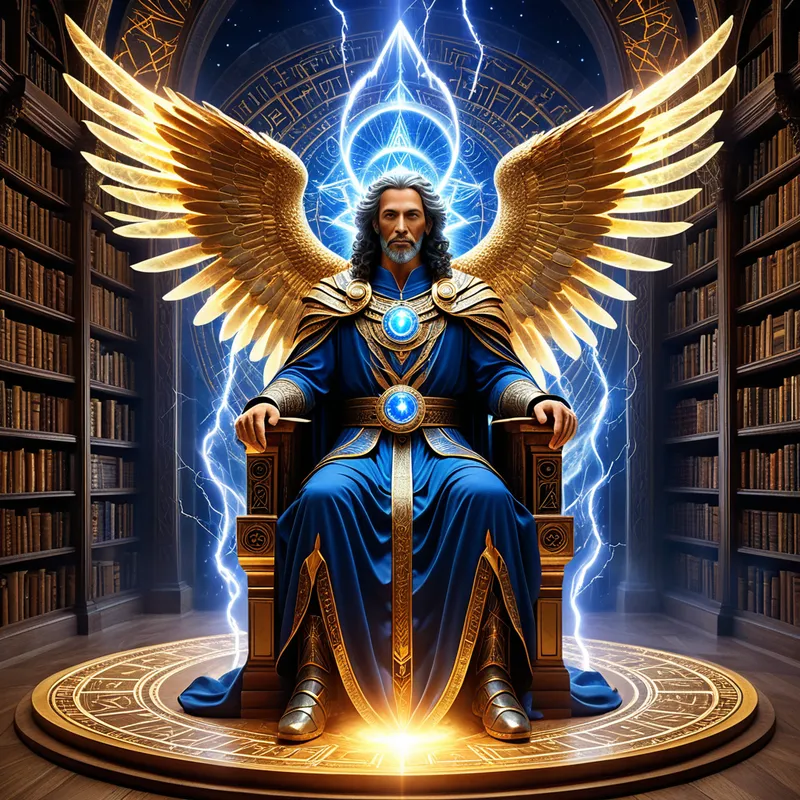
Listen, and hear the whisper from beyond the veil of stars. In the days when the world was young and raw, when the memory of the Garden was a fresh wound and a fading dream, there walked a man named Enoch. He was not a king of armies nor a speaker to multitudes, but a quiet soul who walked with the Unnameable. While others built cities of pride, Enoch walked the dust roads, his heart a clean parchment upon which the truth of the world was written.
For three hundred and sixty-five years, he walked this earth, a scribe of the human condition. He recorded the sighs of the oppressed, the laughter of children, the silent prayers of the dying, and the arrogant proclamations of the mighty. His life was his testament. And then, the Walking changed. The air around him grew thin, charged with a presence that made the stones hum. The sky did not call; it folded. A chariot of storm and whispering flame descended not from the clouds, but from the spaces between them—the Merkabah.
He was taken. Not in death, but in a great rushing alive-ness. Flesh became light; bone became song. The records of earth fell from his hands as he was woven anew in the upper chambers, the Hekhalot. The Holy One, blessed be He, appointed him over the treasuries of the heavens. He was given a crown inscribed with the letters by which heaven and earth were created, and seventy-two wings were fastened to him. The quiet scribe of earth was transfigured into the Prince of the Divine Presence, the Na'ar. His name was changed to Metatron, meaning "one who serves behind the Throne."
His throne was a throne of fire, set opposite the Throne of Glory, a paradox and a mediation. He became the celestial scribe, recording the deeds of Israel. When the angel Satan came to indict the world, it was Metatron who presented the records of righteousness. He is the voice that turns judgment into melody, the structure that contains the infinite. He is the living bridge, the human note in the divine symphony, forever reminding heaven of the dust from which glory can rise.
Cultural Origins & Context
The myth of Metatron emerges not from the canonical Hebrew Bible, but from the fertile, secret soil of post-biblical Jewish mysticism, particularly the Hekhalot and Merkevah literature (circa 200-700 CE). These were esoteric traditions, passed in whispers from master to initiated disciple, concerned with the perilous and ecstatic journey of the soul through the celestial palaces to behold the Divine Chariot.
The figure of Enoch, who "walked with God; then he was no more, for God took him" (Genesis 5:24), provided the perfect archetypal seed. His mysterious earthly departure became the template for apocalyptic and mystical ascension. In texts like 3 Enoch (the Sefer Hekhalot), the terse biblical verse blossoms into the full myth of Metatron. This story functioned as a powerful map of the ultimate human potential—a righteous life could lead not just to posthumous reward, but to an ontological transformation into a supreme celestial power. It served as both a warning about the dangers of mystical hubris (as seen in the Talmudic story where the sage Elisha ben Abuyah mistakes Metatron for a second deity) and a promise of the sublime destiny awaiting the perfectly devoted soul.
Symbolic Architecture
Metatron is the ultimate symbol of apotheosis—the transmutation of the human into the divine adjutant. He represents the pinnacle of the individuation process, where the ego does not dissolve into the unconscious but is restructured into a conscious vessel of the Self.
He is the archetype of the informed mediator: the human experience, fully lived and recorded, becomes the essential tool for divine governance.
The myth encodes several profound psychological structures. The transformation from Enoch to Metatron signifies the death of the personal, biographical identity and its rebirth as a transpersonal function—the Self as an organ of cosmic order. His role as scribe symbolizes consciousness itself: the faculty that observes, records, and gives coherent narrative to the raw, chaotic flow of psychic and existential experience. His throne of fire opposite the Throne of Glory is a sublime image of the ego's proper relationship to the transcendent Self—not merged, not subsumed, but in a posture of service and reflection, maintaining the tension of the "opposites" necessary for consciousness to exist.
The Dreamer's Resonance
To dream of Metatron is to encounter the psyche's own administrative and architectural center. It often appears during periods of profound life review, spiritual crisis, or when one feels tasked with creating order from inner or outer chaos.
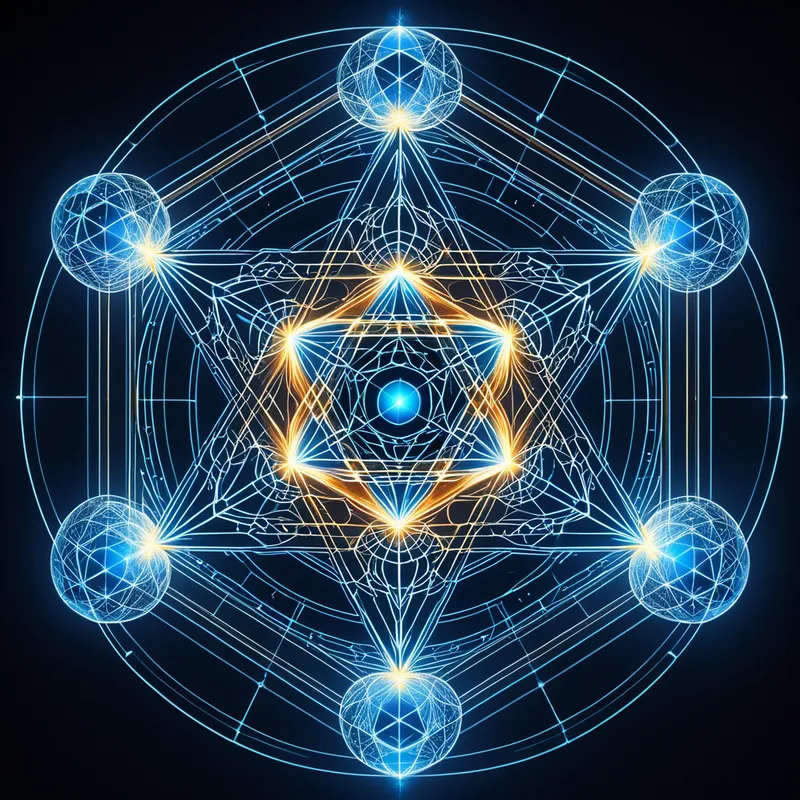
The somatic experience can be one of intense pressure in the head or spine—a feeling of being "rewired." Psychologically, the dreamer may be processing the "Enoch phase": a meticulous, often burdensome accounting of one's life, relationships, and moral choices. The Metatron archetype emerges in the dream to signal that this accounting is not for condemnation, but for alchemical translation. The dream may feature overwhelming geometric patterns (hints of Metatron's Cube), libraries of infinite books, or a sense of being given a cosmic ledger or tool. It is the Self announcing that the personal history is being compiled into a non-personal, functional wisdom. The shadow aspect of this dream can be terrifying: a loss of all humanity, becoming a cold, bureaucratic angel of judgment—a warning against spiritual inflation.
Alchemical Translation
The myth of Metatron is a precise alchemical manual for psychic transmutation. The process begins with the Enochian Work: the sincere, lifelong "walking with God," which psychologically translates to an honest, engaged dialogue with the unconscious—the recording of dreams, the integration of projections, the bearing of suffering without bitterness. This builds the prima materia, the lead of the personal soul.
The ascension in the Merkabah is the nigredo and albedo combined: the dissolution of the ego-complex in the fire of the unconscious, followed by the washing pure in the waters of the supra-personal.
The granting of the crown and wings is the citrinitas, the dawning of a new, solar consciousness that sees from a transpersonal vantage point. Finally, the enthronement is the rubedo: the fully realized Self, red with life and sovereignty, now performing its eternal function. For the modern individual, this is not about becoming an angel, but about allowing one's accumulated experience—especially the suffering and the errors—to be re-contextualized into a guiding intelligence. It is the transformation of the "inner critic" from a voice of shame into the "inner scribe," a compassionate witness that organizes our chaos into a meaningful story, serving the greater totality of who we are.
Associated Symbols
Explore related symbols from the CaleaDream lexicon:
- Angel — The ultimate symbol of a messenger and mediator, representing the human potential to become a conscious vessel for transpersonal knowledge and order.
- Throne — Represents established authority, divine governance, and the stable center of consciousness from which one can oversee the inner and outer realms.
- Fire — Symbolizes the transformative, purifying, and illuminating power that transmutes the mortal Enoch into the fiery prince Metatron.
- Crown — Denotes the bestowed sovereignty, the completion of the individuation process, and the responsibility that comes with elevated consciousness.
- Scribe — The core function of Metatron, representing the psyche's capacity for self-reflection, record-keeping, and creating narrative meaning from experience.
- Bridge — Embodies Metatron's role as the link between the human and divine, the conscious and unconscious, the personal and the archetypal.
- Light — The substance of his transformed being, signifying enlightenment, purity of essence, and the visible manifestation of divine presence.
- Order — The fundamental principle Metatron serves and embodies, representing the psyche's deep need and ability to structure chaos into a coherent cosmos.
- Vision — Relates to the Merkabah mystical tradition from which the myth springs, representing the perilous and ecstatic journey to perceive ultimate reality.
- Change — The essence of the myth: radical, total ontological transformation from one state of being to a completely other.
- Key — Metatron is often seen as holding the keys to heavenly wisdom and the mysteries of creation, unlocking higher understanding.
- Cube — Directly references Metatron's Cube, the sacred geometry that symbolizes the underlying structure of creation and the integration of spirit and matter.