Mesoamerican Ballgame Myth Meaning & Symbolism
A sacred cosmic contest where life, death, and the sun's journey are played out in a ritual ballgame of sacrifice and regeneration.
The Tale of the Ballgame
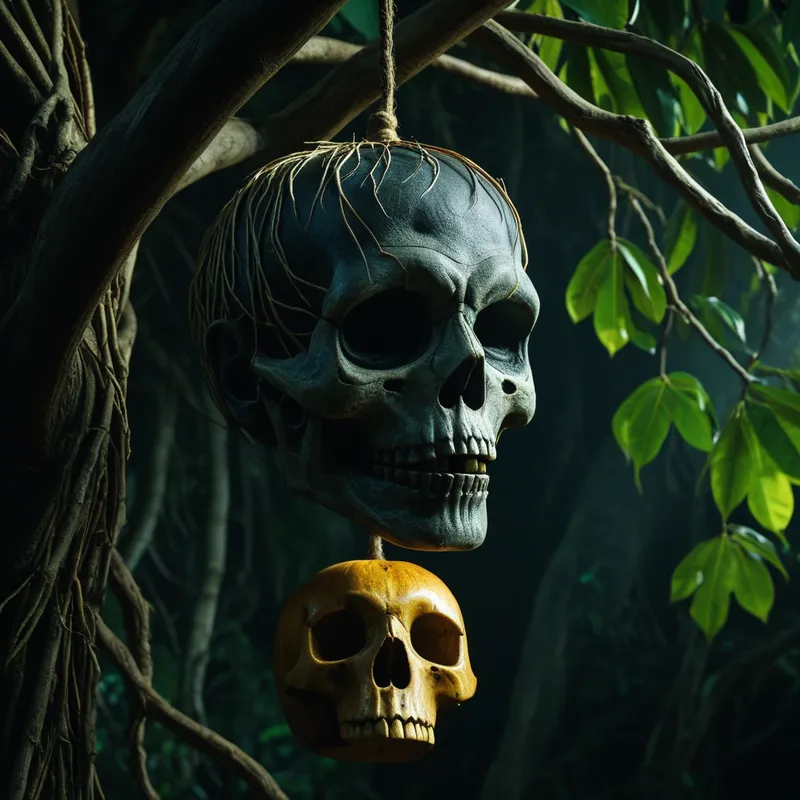
Listen. The story does not begin on the green earth, but in the cold, silent halls of the underworld, the Place of Fright, Xibalba. Here, the first players were not heroes, but failures. Hear the names: One Hunahpu and Seven Hunahpu, lords of the dawning world, great ballplayers whose thunderous play disturbed the lords of death. Summoned to Xibalba for their insolence, they were tricked, humiliated, and sacrificed. Their heads were placed in a barren tree, which then bore fruit—a grim warning and a silent promise.
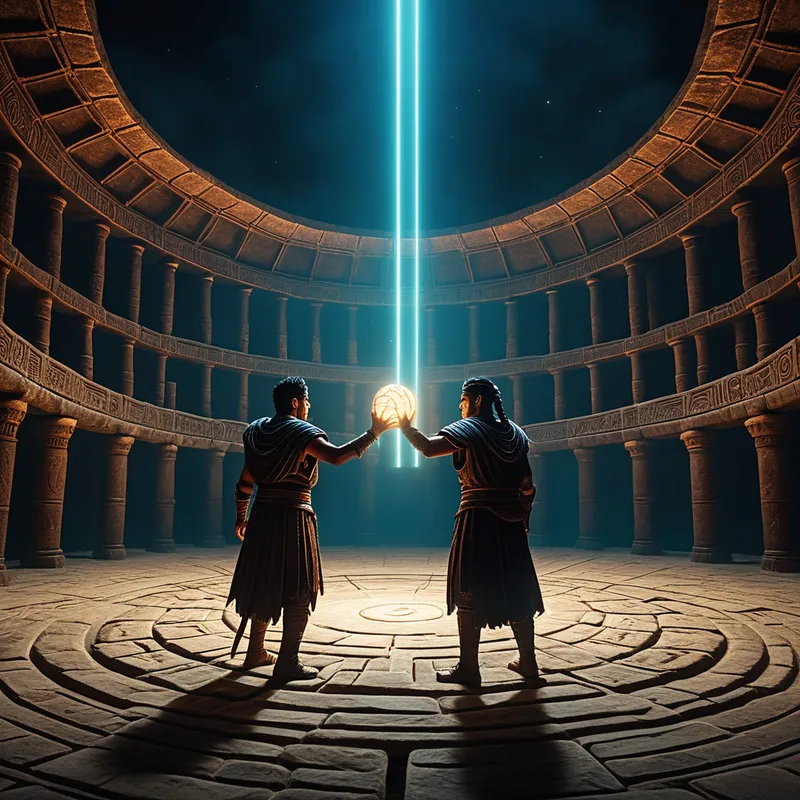
From this sacrifice, life stirred. The skull of One Hunahpu spat into the hand of a daughter of Xibalba, and she conceived. Thus were born the true players, the destined ones: Hunahpu and Xbalanque. They grew under the earth, knowing their legacy was written in the hollow thump of the rubber ball. When they too were summoned to Xibalba, they did not come as victims, but as challengers. They entered the great ballcourt of the dead, a cavernous space smelling of damp stone and old blood.
The game was not sport; it was war by other means. The heavy ball, forged from the sacred sap of the rubber tree, was a celestial body, a skull, a heart. The Lords of Death—One Death and Seven Death, Scab Stripper and Blood Gatherer—cheated at every turn. They offered bladed gloves, stone balls, vertigo and fire. But the Twins were cunning. They consulted the creatures of the underworld, they sacrificed a borrowed animal heart to deceive the lords, and they played with a grace that was defiance itself.
The final match was the axis of all things. The Twins allowed themselves to be defeated, to be ground into bone and ash. But this was their ultimate gambit. From the ashes, reborn as miraculous fish-men, they returned as dancers and magicians, performing wonders for the death lords. They sacrificed a dog and brought it back to life. They burned a house and restored it. Enthralled, the lords demanded the ultimate trick: “Sacrifice us, and bring us back!”
And so, the Twins did. But for One Death and Seven Death, there was no return. The lords of Xibalba were undone by their own hunger for the spectacle of resurrection. The Twins did not merely win a game; they broke the tyranny of the static underworld. They retrieved the buried remains of their father, One Hunahpu, and ascended not to rule the dead, but to become the sun and the moon. Their play in the dark court below set the celestial bodies in motion above, establishing the eternal cycle of day and night, life and death, sacrifice and renewal.
Cultural Origins & Context
This narrative, the heart of the Popol Vuh, was not mere entertainment. It was the sacred charter for a ritual that permeated Mesoamerican life for nearly three millennia. The ballgame, known as ōllamaliztli in Nahuatl, was played from the Olmec heartlands to the Aztec capital. The myth provided its divine precedent and profound meaning.
The story was likely preserved and performed by elite scribes and priests, the keepers of the sacred calendars. Its societal function was multifaceted. On one level, it was a foundational cosmology, explaining the origins of the sun, moon, and maize. On another, it legitimized the power of kings, who re-enacted the Hero Twins’ victory over chaos in monumental stone ballcourts flanking their palaces. The game was a political spectacle, a ritual of war and diplomacy, and a divinatory act where the bouncing of the ball echoed the fate of the community. Most critically, it was a profound religious ceremony, intimately tied to concepts of fertility, sacrifice, and sustaining the cosmic order. To play the game was to participate directly in the mythic drama of death and regeneration.
Symbolic Architecture
The ballcourt is the axis mundi made manifest—a liminal trench between worlds. The game itself is a dynamic model of the cosmos.
The ball is the sun, plunging into the underworld at dusk and being reborn at dawn. It is also the human head, the seat of consciousness and the prize of sacrifice.
The vertical stone rings are not merely goals; they are portals, the gaping maw of the earth monster or the celestial gate. Scoring a goal was a ritual re-enactment of the sun passing through the zenith or the soul passing through the threshold of death—an event so momentous it often concluded with the sacrifice of a player, whose blood would fertilize the earth as the sun’s light fertilizes the day.
Psychologically, the myth maps the ego’s confrontation with the unconscious. The arrogant father figures (One and Seven Hunahpu) represent an undeveloped consciousness, easily tricked and destroyed by the shadowy contents of the psyche (Xibalba). The Hero Twins symbolize the nascent, resilient Self. They descend into the chaos, not to conquer by force, but to engage it through cunning, patience, and acceptance of necessary sacrifice. Their strategy is one of integration, not annihilation.
The Dreamer's Resonance
When this myth stirs in the modern dreamer, it often manifests as a sense of being in a high-stakes, rule-bound contest where the rules are unclear or constantly shifting. The dreamer may be in a vast, enclosed court or arena, tasked with keeping a heavy, animate ball in motion. There is immense somatic pressure—the weight of the ball, the strain of the hips and elbows (the primary tools of the ancient game).
This dream pattern signals a critical phase of psychological initiation. The “ball” is a core complex, a dense knot of energy (a relationship, a career struggle, a creative block) that must be put into play and navigated, not avoided. The “shifting rules” and “cheating opponents” represent the irrational, shadowy aspects of the psyche or external circumstances that seem unfairly arrayed against consciousness. The dreamer is being called to the court—to stop being a spectator to their own inner conflict and to engage it ritually, with the full awareness that the process may require the “death” of an old attitude or identity.
Alchemical Translation
The alchemy of the ballgame myth is the transmutation of passive suffering into active, sacred struggle. It models individuation not as a linear ascent, but as a cyclical game of descent, dissolution, and return.
The first, failed sacrifice of the fathers is the nigredo—the necessary blackening, the crushing of naive ego. The Twins’ journey is the albedo—the whitening, the purification through cunning and alliance with instinct (the animals of Xibalba).
The crucial stage is the Twins’ voluntary death and transformation into fish-men—the citrinitas. They do not resist dissolution; they consciously choose it, moving from solid form to fluid potential. This is the psychic capacity to let a rigid identity be ground down so a more authentic Self can emerge. Their final tricks and the defeat of the death lords represent the rubedo—the reddening, the creation of the philosophical gold. The reborn sun and moon are symbols of a consciousness that has integrated the dark, chthonic powers of the underworld. It is no longer at the mercy of inner demons but has learned their language and turned their own energy against stagnation.
For the modern individual, the myth instructs: Your deepest conflicts are the ballcourt. The heavy, seemingly oppressive burden you carry is the sacred ball. Do not seek to exit the game. Instead, learn its sacred, brutal rules. Engage the shadowy opponents within not with brute force, but with strategic wisdom, theatricality, and the willingness to be transformed by the process. The goal is not to “win” in a conventional sense, but to keep the cosmic game in play, to ensure that through your engaged struggle, the sun of consciousness continues to rise, and the fertile cycle of death and rebirth turns within your own soul.
Associated Symbols
Explore related symbols from the CaleaDream lexicon: