Mesa Villages Myth Meaning & Symbolism
A sacred Hopi narrative of emergence, migration, and covenant, guiding the people to their destined mesa homes through spiritual signs and ancestral wisdom.
The Tale of Mesa Villages
Listen. The world was not always as it is. In the beginning, there was the Sipapuni, the navel of the world, a place of deep, moist earth and whispering spirits. The people emerged into this, the Fourth World, guided by the wisdom of Spider Grandmother. She spoke not with a voice of thunder, but with the soft click of stone on stone, weaving the first instructions into the fabric of their being.
“You must journey,” her wisdom hummed. “You must find the Center Place. It is not given. It is earned through walking, through watching, through remembering the covenant.”
And so the great migrations began. They were not a single people, but many clans, each carrying a sacred tablet, a piece of the covenant, a fragment of the map written in spirit. They walked under a sun that baked the red earth into cracked pottery and under moons that cast long, searching shadows. They crossed deserts that sang with wind, mountains that held the breath of storms, and rivers that ran with memories of rain.
Confusion came, as it must. Paths diverged. Some forgot the songs. Others were seduced by easier lands, by greener valleys that promised rest without responsibility. They built villages that crumbled, for they were not the Center Place. Strife grew between the people. The world felt unbalanced, a potter’s wheel spinning without the guiding hand.
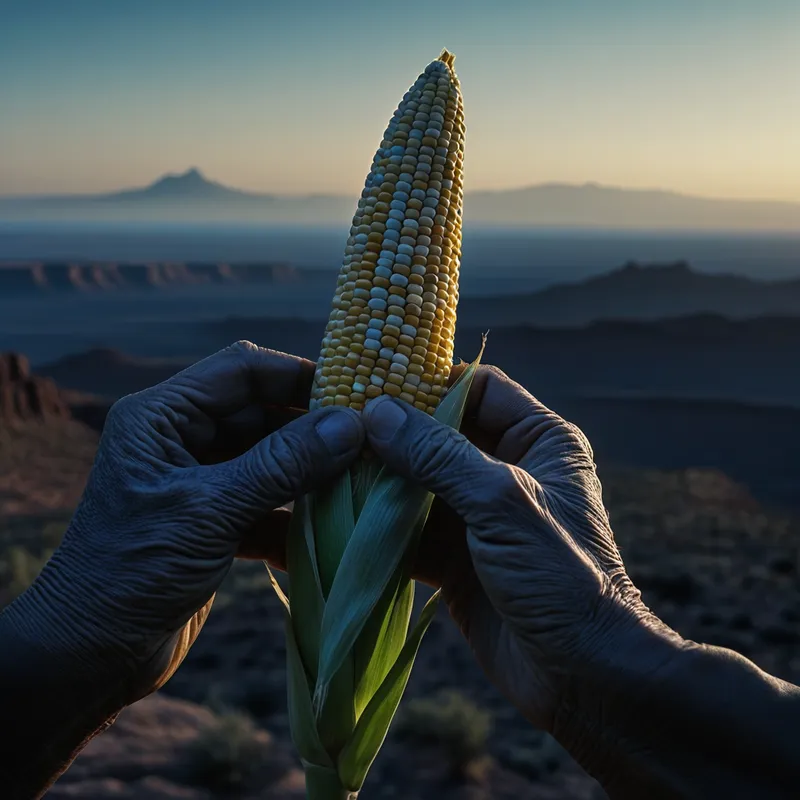
Then, the signs. Not in grand pronouncements, but in the subtle language of the land itself. A Masau'u, a small, swift-moving cloud, would appear on the horizon, pausing over a certain high, arid plateau. A Kikmongwi, a village chief, would dream of a specific rock formation that held the shape of a bear or a sprouting bean. Most sacred of all was the corn. In trial gardens, planted with prayer and ash, the true sign would show: the corn must not merely grow, but thrive—its roots drinking deep from unseen waters, its ears filling with kernels of every color, a perfect, resilient life in a seemingly barren place.
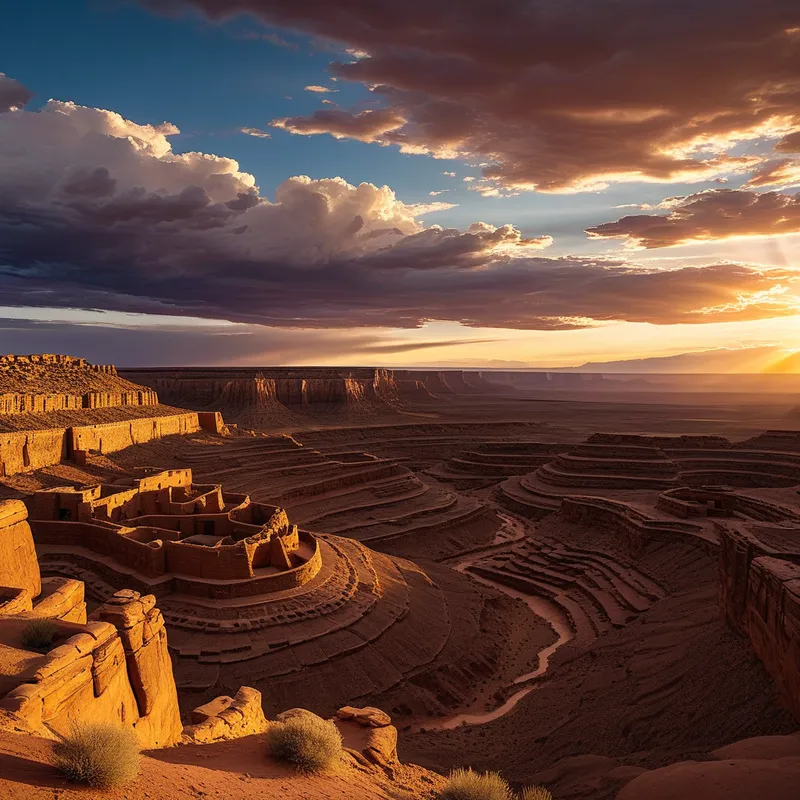
One by one, the faithful clans, those who had guarded their tablets and kept the ceremonies pure, were led. They climbed steep, defensible rock faces—not to hide, but to see and be seen by the sky. Here, on the first, second, and third mesas, they found their homes: Walpi, Shungopavi, Oraibi. They built not with the ambition of empires, but with the patience of erosion, their stone and adobe dwellings becoming one with the cliff itself.
From these high places, they could see the entirety of their world: the vast sweep of the desert, the path of the sun, the approach of the clouds. They had not found a land of milk and honey, but a land of challenge and revelation—the true Center Place, where the covenant between heaven, earth, and people could be maintained, where life, in all its difficult beauty, was in perfect balance.
Cultural Origins & Context
This is not a myth of a distant, forgotten past, but a living narrative that structures Hopi reality. The story of the Mesa Villages is the foundational history, conveyed through an oral tradition of immense precision—in kiva ceremonies, in the teachings of clan elders, and in the daily rituals of farming. It is a map of identity, explaining why the Hopi live where they do, on high, arid plateaus, by divine design rather than mere circumstance.
The myth functions as a social and spiritual charter. It validates the authority of the clan system, as each clan has its own migration story that contributes to the whole. It explains the sacred responsibility of the Hopi as stewards of the Fourth World, charged with performing the necessary ceremonies—the Niman Kachina Home Dance, the Powamu Bean Dance—to maintain balance for all beings. The mesa tops are not just homes; they are spiritual citadels, the vantage points from which this sacred duty is performed. The myth is told not to entertain, but to remind, to bind the community to its purpose and to the austere, glorious land it was destined to inhabit.
Symbolic Architecture
At its heart, the myth is a profound blueprint for the individuation process—the soul’s journey to its own Center Place. The Sipapuni represents the unconscious, the moist, dark womb of potential from which conscious life emerges. The migration is the long, often confusing development of the ego, seeking its rightful place in the psychic geography.
The true Center Place is never where life is easiest, but where it is most meaningful. It is found at the intersection of deepest challenge and highest responsibility.
The clans and their sacred tablets symbolize the fragmented aspects of the Self—talents, instincts, ancestral patterns—that must be gathered and integrated on the journey. The mesas themselves are powerful symbols of the conscious mind elevated, a fortified place of awareness risen above the flat, undifferentiated plains of unconsciousness. From this height, one can see the patterns of one’s own life, anticipate storms (emotional upheavals), and welcome the nourishing rains (insights). The thriving corn in barren earth is the ultimate symbol of the Self realized: a life of profound meaning and resilience cultivated not in spite of, but because of, the specific, unique conditions of one’s own being.
The Dreamer's Resonance
When this mythic pattern stirs in the modern dreamer, it often manifests as dreams of searching for a specific, elusive home; of climbing arduous but meaningful paths; or of trying to read cryptic signs in the landscape. One might dream of holding a broken piece of pottery or a map with faded ink, representing the fragmented covenant with one’s own deeper purpose.
Somatically, this can feel like a deep, restless tug in the solar plexus—a “homing” instinct for a place the conscious mind cannot name. Psychologically, it marks a transition from a life lived by default (the “easier valleys”) to a life sought by design. The dreamer is in the migration phase, where old identities and settlements (jobs, relationships, self-concepts) are found wanting and crumble, because they are not aligned with the soul’s true Center Place. The anxiety and confusion of the dream are the growing pains of the psyche reorienting itself toward its destined north star.

Alchemical Translation
The alchemy modeled here is the transmutation of wandering into pilgrimage, and of hardship into covenant. The prima materia is the raw, unformed longing for purpose. The long, arduous migration is the nigredo, the blackening—a period of dissolution, confusion, and burning away of false paths and easy answers.
The signs—the cloud, the dream, the thriving corn—represent moments of albedo, whitening, where the illuminating spirit (the Masau'u) provides flashes of insight. These are not full revelations, but hints that require faith and interpretation, forcing the ego into a collaborative relationship with the unconscious.
The covenant is not a contract for comfort, but a vow to participate consciously in the difficult miracle of your own existence.
Finally, establishing the mesa village is the rubedo, the reddening, the culmination. It is the conscious establishment of the Self in its rightful, defensible position. The individual no longer seeks wholeness externally, but creates the conditions for it internally and then lives from that fortified center. Life’s challenges—the arid climate, the exposed position—are no longer curses, but the very conditions that make the covenant meaningful and the corn of the soul grow deep roots. The myth teaches that individuation is not about arriving at a static paradise, but about building your village on the sacred, challenging mesa that is uniquely yours, from which you can tend to your world with clear-eyed responsibility and hard-won grace.
Associated Symbols
Explore related symbols from the CaleaDream lexicon: