Merlin's Prophecies Myth Meaning & Symbolism
The tale of the wizard Merlin, whose prophetic visions of Britain's fate reveal the profound tension between destiny and human choice.
The Tale of Merlin's Prophecies
Listen, and I will tell you of a time when the world was woven from breath and shadow, when the future was not a path but a song, half-heard in the wind. It begins not with a king, but with a child born of no mortal father, a spirit of the ancient woods and the deep earth given flesh. They named him Merlin.
From his first cry, he heard the whispers of the stones and the secrets of the streams. He grew in the wild places, a man with one foot in the world of men and the other in the realm of the Otherworld. His power was not of the sword, but of sight. He saw the threads of what would be, shimmering like spider-silk in the dawn light, a vast and terrible tapestry.
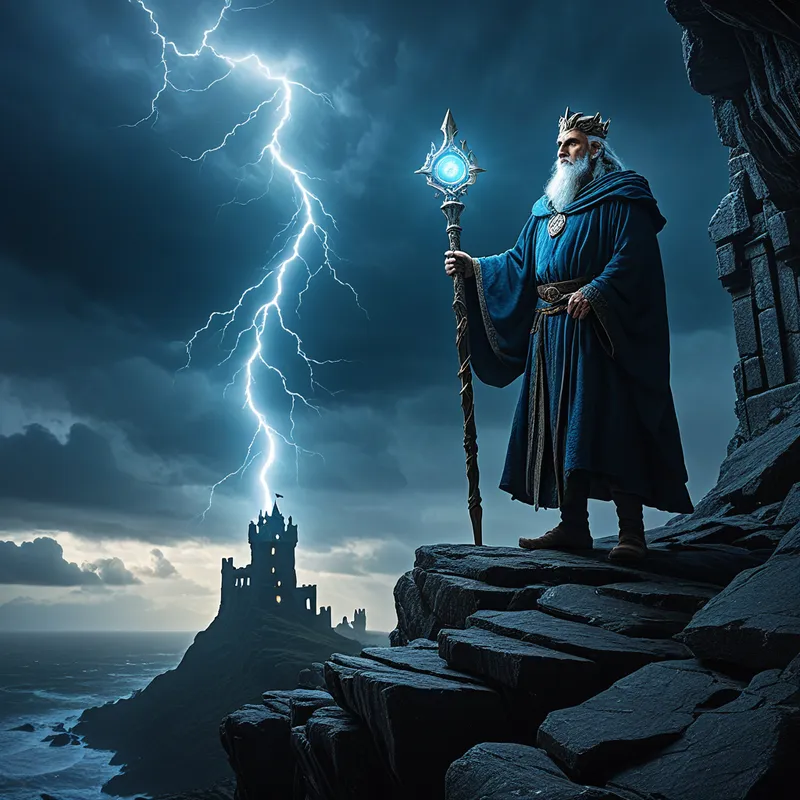
The tale is told of a day when the sky turned the color of a bruise, and the new king, Uther Pendragon, desperate for victory, sought the prophet. He found Merlin not in a hall, but in a grove of ancient oaks, his back against the bark of the oldest tree, his eyes closed as if in sleep. But he was not sleeping. He was watching. "I see a red dragon and a white dragon," Merlin murmured, his voice like roots shifting deep underground. "They wake beneath the fortress of the land. They fight. And their battle will shake the towers of kings." The air grew cold. The leaves stilled. In the space between heartbeats, Uther saw it too—the coiling, fiery beasts locked in eternal struggle beneath the soil of Britain itself.
This was but the first thread. Merlin’s prophecies flowed like a river from a hidden spring. He spoke of a stone from which a sword would be drawn, a sword that was not a sword but a covenant. He saw the coming of the Once and Future King, a boy who would be pulled from the mist of a lake, armed by the Lady of its waters. He foretold the shining city of Camelot, its banners bright, and its fall, its halls echoing with the silence of betrayal. He sang of a great battle on a desolate plain, where loyalties would shatter like ice and a kingdom would bleed into the earth.
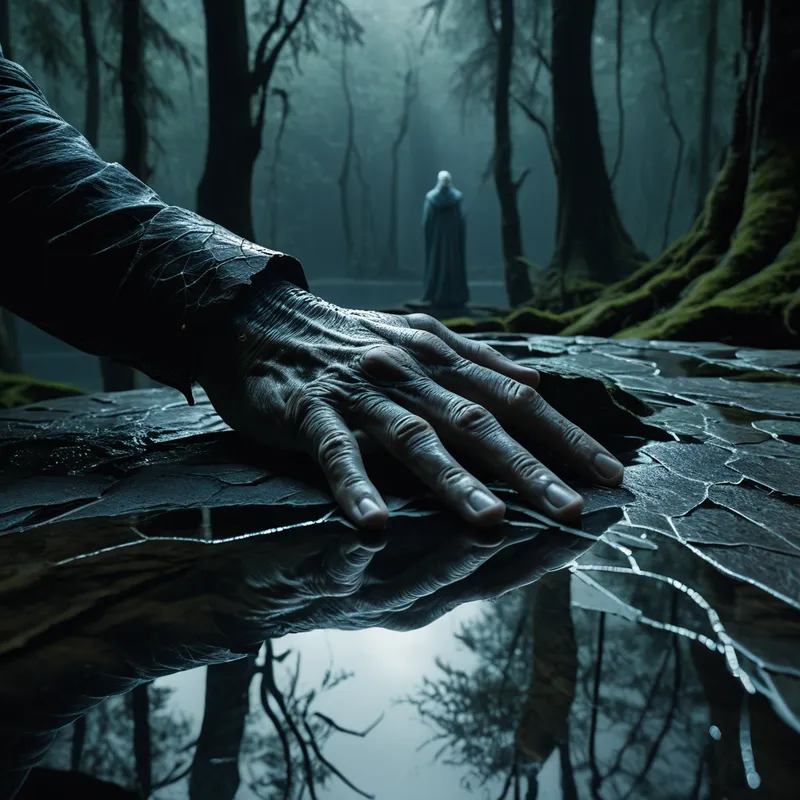
Yet the most haunting prophecy was of his own end. He saw it in the still surface of a forest pool—not a death in battle, but a living death. He foresaw a enchantment, woven by cunning and desire, that would bind him not in chains of iron, but in a prison of air and hawthorn, a tower without walls, where he would remain, seeing all yet touching nothing, until the world’s need was greatest. He spoke this fate not with fear, but with the weary acceptance of one who has read the last page of his own story. And so the prophet, who shaped the destiny of a nation, walked knowingly toward the snare set by his own heart, his final visions echoing in the empty air as the living stones closed around him.
Cultural Origins & Context
The figure of Merlin and his prophecies are a profound fusion of Celtic myth, early medieval history, and political prophecy. His earliest literary incarnation is in the works of Geoffrey of Monmouth in the 12th century, particularly in Historia Regum Britanniae and the separate Prophetiae Merlini. Geoffrey drew upon older Welsh traditions concerning a wild, prophetic figure named Myrddin Wyllt, a bard driven mad by the horrors of battle who lived in the Caledonian Forest, uttering cryptic verses about the future.
These prophecies served a crucial societal function far beyond entertainment. In a time of Norman conquest and political upheaval, "Merlin's Prophecies" were often used as political tools. They offered a sense of deep, mystical continuity for the Britons, a promise that despite current subjugation, a glorious destiny—often linked to a returning national hero—was woven into the very fabric of the land. The prophecies were not mere predictions; they were a form of cultural memory and hope, recited by bards and scribes to affirm a people’s identity and their sacred connection to the territory of Britain itself.
Symbolic Architecture
At its core, the myth of Merlin’s Prophecies is not about fortune-telling, but about the architecture of consciousness itself. Merlin represents the archetypal union of human and natural wisdom, the Wild Man who is also the ultimate Sage. His prophecies symbolize the unconscious mind—a vast, timeless realm where all possibilities, past and future, exist simultaneously.
The prophecy is not a script to be followed, but a deep pattern to be recognized. It is the psyche speaking to itself in the language of symbols.
The two dragons—red and white—battling beneath the land are a master symbol. They represent the primal, opposing forces within a nation or an individual: sovereignty versus chaos, passion versus purity, the conscious will versus the unconscious shadow. Their eternal struggle signifies that wholeness is not a static peace, but a dynamic, ongoing tension. Merlin’s vision of them does not stop their fight; it brings it to light, making the inner conflict conscious and therefore manageable.
His ultimate fate, imprisonment by his own enchantment, is the most profound symbol of all. It represents the peril of the sage who becomes trapped by the very knowledge he serves. The prison of air is the prison of pure intellect, of seeing so much that one becomes disconnected from lived experience, from vulnerability, and from the redeeming power of human folly and love.
The Dreamer's Resonance
When this myth stirs in the modern dreamer, it often manifests as a profound encounter with the pattern-making function of the psyche. You may dream of finding a book with your name on it, filled with events that have not yet happened but feel eerily familiar. You may dream of a wise but isolated figure (often on a cliff, in a tower, or deep in a forest) who shows you a map of your own life, with branching paths glowing and fading.
Somatically, this can feel like a pressure in the third eye or a tingling at the crown of the head—a sense of "knowing" that is not cognitive. Psychologically, you are likely at a crossroads where your life’s deeper pattern, your personal "prophecy" or calling, is pressing against your conscious choices. The dream is the psyche’s attempt to show you the larger tapestry, to warn of inner conflicts (the dragons) you have buried, or to confront you with a feeling of being "trapped by your own knowledge"—perhaps by overthinking, analysis paralysis, or a role as the perpetual guide for others that has left you isolated.

Alchemical Translation
The alchemical journey modeled by Merlin’s myth is the transmutation of blind fate into conscious destiny. The prima materia is the raw, prophetic vision—the chaotic, overwhelming sight of all possible futures. The process begins with nigredo, the descent into the dark forest or the battle beneath the tower, where the opposing dragons of the psyche are first acknowledged. This is the confrontation with one’s own deepest conflicts and inherited patterns.
The wizard’s true magic is not in foreseeing the future, but in suffering it consciously, thereby changing its essential meaning from a sentence to a dialogue.
The albedo is represented by the clarity of the vision itself—the still pool, the voice from the oak. It is the stage of reflection and insight, where pattern emerges from chaos. But the crucial, often missed, stage is the rubedo, the reddening. This is not achieved in Merlin’s triumphant moments, but in his imprisonment. His passive suffering within the enchantment is the final, fiery crucible. Here, mere knowledge (sapientia) is forced to integrate with the human condition of limitation and desire. The sage must be humbled.
For the modern individual, the alchemical goal is not to become an all-seeing prophet, but to integrate the prophetic function. It is to learn to listen to the inner Merlin—the deep, pattern-recognizing intuition—without being enslaved by it. It means to use foresight not to control life, but to engage with it more fully, to make choices that are resonant with one’s soul’s pattern while accepting the mystery and the inevitable "enchantments" (limitations, failures, heartbreaks) that are part of the human journey. The ultimate transmutation is when fate, once a external force, becomes an internal compass, and the living tomb of foreknowledge becomes the fertile ground for wisdom.
Associated Symbols
Explore related symbols from the CaleaDream lexicon: