
Merlin's Cave Myth Meaning & Symbolism
The story of the wizard Merlin's self-imprisonment in a cave of air and stone, a myth of prophecy, enchantment, and the price of ultimate knowledge.
The Tale of Merlin's Cave
Hear now a tale not of a king’s glory, but of a wizard’s grief. It begins not with a sword drawn from stone, but with a soul entombed in air.
In the deep, green fastness of the Welsh forests, where the mist clings to the mountains like a memory, there lived a man who was more than a man. He was Merlin, son of no mortal father, whose mind could walk the paths of tomorrow and whose words could bend the bones of the earth. He served kings, built castles with a song, and guided the once and future king, Arthur, with a wisdom as deep and cold as a winter well.
Yet, for all his power, Merlin’s heart was a vulnerable thing. He fell, not to a spell, but to a glance—the glance of a maiden named Viviane, or Nimue. She came to him as a student, her eyes holding the dark mystery of the forest pools he so loved. Enchanted, he taught her all he knew: the secrets of the beasts, the language of the stars, the charms that bind and unbind reality itself. He loved her with the desperate passion of an immortal who has finally found a mortal anchor.
But the final secret, the one she desired most, was the secret of confinement. “Master,” she whispered, her voice like wind through reeds, “how might one be sheltered from all the world? How might one make a tower without stone, a prison without bars?”
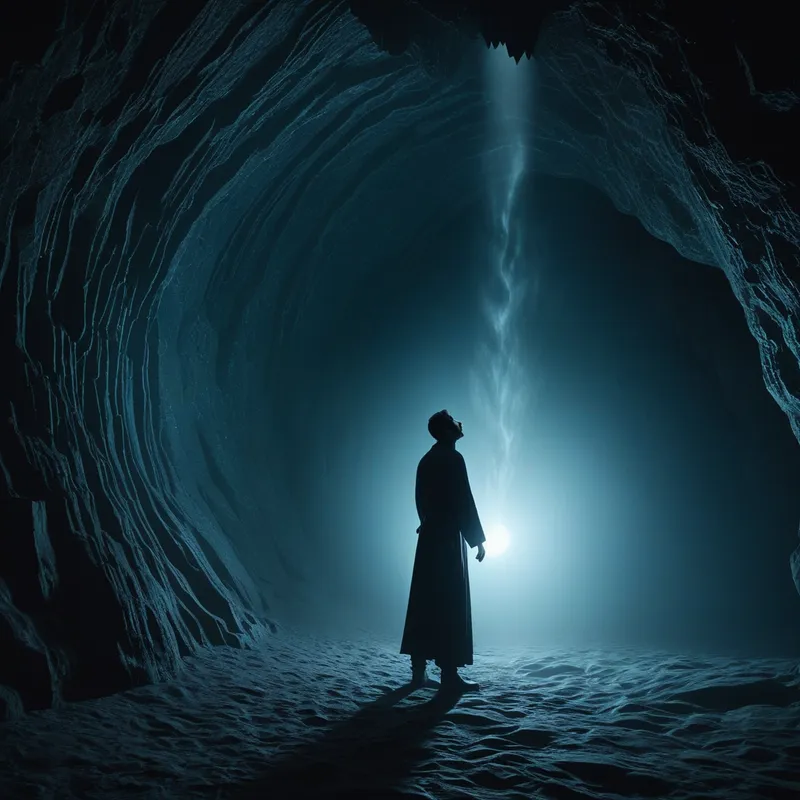
Blinded by devotion, the great prophet did not see the snare. He showed her. With words of power that tasted of iron and twilight, he taught her how to weave the very air into walls, to spin enchantments that could make a cave a tomb and a tomb a sanctuary. They traveled to a hidden place, a natural cave of glittering rock deep in the woods. There, at her pleading, he demonstrated the charm.
He raised his hands. The air thickened, shimmering like heat haze, weaving itself into a perfect, invisible sphere within the cave’s mouth. “See,” he said, his voice full of pride and love. “Nothing may enter. Nothing may leave. It is a world unto itself.”
It was then that Viviane’s eyes lost their softness, hardening into the flint of purpose. She spoke the words he had given her, but with a subtle twist, a final syllable of command he had not taught. The shimmering air-wall snapped shut—with Merlin inside.
He turned, confusion becoming horror. He pressed his hands against nothingness, a barrier as solid as diamond. “Viviane!” he cried. But she only looked at him, a sorrow in her gaze that was already receding into the distance. “You see too much, my teacher,” she said, her voice fading as she stepped back into the world. “You have seen the doom of the king, the ruin of the realm, the long winter of Logres. It is a mercy to be spared the sight of it. Sleep now. Dream your prophecies. They will haunt only these stones.”
And she was gone. The great wizard, who had shaped the destiny of a nation, was left in a silence so profound it was a sound unto itself. The cave became his crystal ball. There, they say, he remains—not dead, but dreaming. His voice sometimes echoes in the wind, a mad, prophetic babble. His form is sometimes seen, a shadow against the rock, forever pressing against the prison of his own making, watching the tides of fate he can no longer steer, entombed not by betrayal alone, but by the unbearable weight of his own foresight.
Cultural Origins & Context
The tale of Merlin’s imprisonment is a late and poignant addition to the Arthurian cycle, finding its most famous expression in Sir Thomas Malory’s 15th-century Le Morte d’Arthur, though its roots dig deeper into Welsh folklore. Earlier Welsh texts like the Vita Merlini portray a wild, woodland prophet driven mad by the horrors of battle, who retreats to the forest. The motif of his enchantment and confinement, particularly by a female figure, seems to have evolved from this, merging the native Celtic archetype of the prophetic, mad sage with the medieval romance trope of the powerful man undone by love.
This myth was not a story of courtly heroism but a darker, more reflective folktale, likely passed down in regions like Carmarthenshire in Wales, where locales are still named for him. Its societal function was complex. On one level, it served as an etiological myth, explaining strange sounds or sights in certain wild places as the last remnants of the wizard’s power. On a deeper level, it provided a necessary conclusion for a figure whose omniscience threatened the narrative. In a Christianized world, the pagan, semi-demonic source of Merlin’s power had to be neutralized. His imprisonment by his own pupil, using his own arts, is a profound literary and cultural solution: it contains the wild, amoral magic of the old world within a “cave” of story, allowing the legend of Arthur to proceed toward its tragic, human conclusion.
Symbolic Architecture
The cave is the central symbol, and it is profoundly ambivalent. It is simultaneously a womb and a tomb, a sanctuary and a prison. It represents the ultimate retreat of consciousness into itself.
The cave is the psyche’s bedrock, where the light of ego meets the shadow of the unconscious and is swallowed whole.
Merlin himself symbolizes the intellect and prophetic consciousness pushed to its absolute limit. He is the archetypal sage, but his knowledge becomes a curse. His imprisonment by Viviane, often called the Lady of the Lake, is rich with meaning. She represents the unconscious itself—the deep, feminine, intuitive waters from which Excalibur was drawn and to which it must return. Merlin, the master of conscious will and intellectual magic, is ultimately mastered by the very realm he sought to command. His love for her is the ego’s fatal attraction to the mysteries of the unconscious, a desire for union that results not in integration, but in engulfment.
The “cave of air” is the masterstroke of the symbol. He is not bound by iron, but by spirit; not by another’s will, but by the perfected form of his own knowledge. This is the prison of a paradigm, the gilded cage of a worldview so complete it admits no new data. He is trapped in a self-referential loop of prophecy, seeing all futures but participating in none.
The Dreamer's Resonance
When this myth stirs in the modern unconscious, it often manifests in dreams of paradoxical confinement. One may dream of being trapped in a glass room, a house with no doors, or an office where the walls are made of shifting, intangible data. The somatic feeling is one of profound frustration and eerie stillness—the body is not bound, yet movement is impossible.
Psychologically, this signals a state where the conscious mind has become imprisoned by its own constructs. The dreamer may be trapped by a rigid identity (“I am the wise one,” “I am the one in control”), a system of belief, or an intellectual understanding of their own life that has become a predictive, joyless script. Like Merlin, they see the pattern, they foresee the outcome of their habits and relationships, but feel powerless to change the trajectory. The dream is a reflection of a psyche that has achieved a certain wisdom but at the cost of aliveness, requiring a descent into a more chaotic, feeling-based state (the Viviane principle) to be freed—even if that freedom initially looks like madness or dissolution.

Alchemical Translation
The alchemical process mirrored here is not the creation of gold, but the solvè et coagulà—dissolve and coagulate. Merlin’s fate represents the peril and necessity of the solvè, the dissolution.
The conscious mind must be willingly entombed in the cave of the unconscious for the old king (the ruling conscious attitude) to die and for the new to be conceived.
Merlin’s imprisonment is the ultimate dissolution of the heroic, directing ego. He does not fight his fate; in many versions, he almost accedes to it, as if knowing it is the next necessary stage. His conscious, prophetic mind is submerged so that the Arthurian world—a symbol of the individual’s cultural and personal achievements—can run its destined course toward the necessary failure and wounding (the Battle of Camlann).
For the modern individual, this myth models the terrifying but crucial stage of individuation where one must allow one’s hard-won identity, one’s “known mind,” to be enclosed and rendered passive. It is the period of depression, of creative block, of midlife crisis, where everything you know how to do no longer works. You are in the cave, watching your own life unfold like a prophecy you cannot alter. The purpose of this imprisonment is not punishment, but incubation. The old wisdom must ferment in the dark. The Viviane who trapped you is not an external betrayer, but an emergent part of your own soul—the deep, intuitive self that knows you must stop doing in order to finally become something new. The liberation from this cave does not come from breaking the airy walls, but from the walls themselves eventually being absorbed, when the distinction between the prophet and his vision finally dissolves, and the dreamer becomes the dream.
Associated Symbols
Explore related symbols from the CaleaDream lexicon: