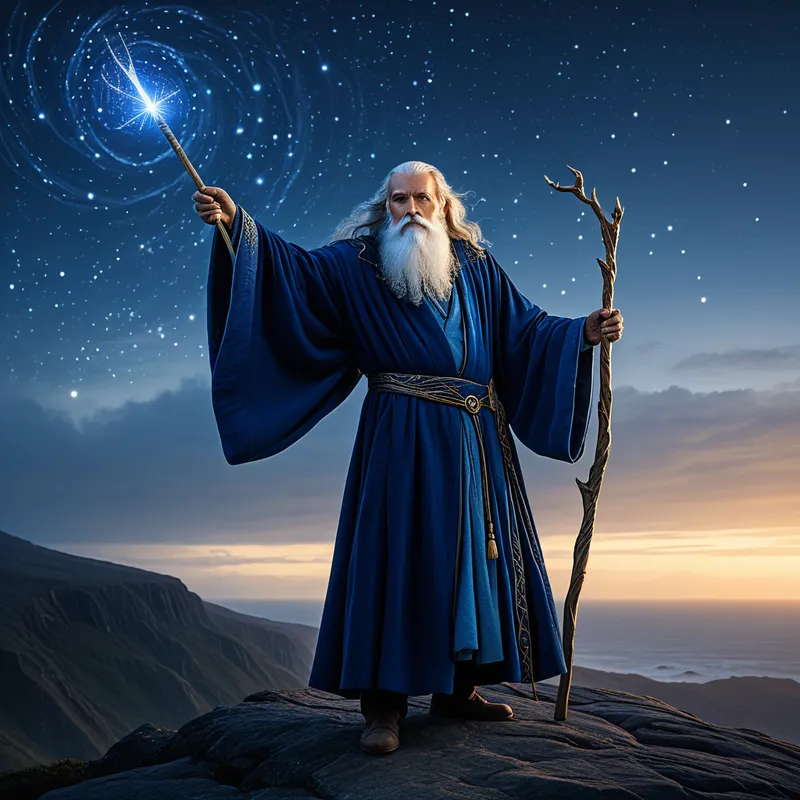
Merlin Myth Meaning & Symbolism
The tale of the prophet-wizard born of a spirit, architect of Camelot, undone by his own heart, who retreats into the living earth.
The Tale of Merlin
Listen, and I will tell you of the one who was born of no mortal father, of the man who was a bridge between worlds. In the time when the old gods still whispered in the oak groves and the new God’s bells began to toll, a shadow fell upon the land of Britain. Vortigern, a usurper king, sought to build a tower upon a high hill, but each night the earth itself swallowed the stones. His seers declared that only the blood of a fatherless boy could secure the foundations.
They found such a boy in the wilds of Dyfed. His name was Myrddin, though you know him as Merlin. He was but a youth, yet his eyes held the depth of forgotten lakes. Brought before the furious king, the boy did not weep. Instead, he laughed, a sound like cracking ice. “Your seers are fools,” he said. “Dig beneath your tower, and you will find a pool. Drain it, and you will see what truly shakes your kingdom.”
They did as he commanded. Beneath the pool they found two great stones, and beneath the stones, two dragons—one red, one white—locked in eternal combat. As they flew into the sky, breathing fire and frost, Merlin’s voice rose above the din, not in terror, but in prophecy. He sang of the red dragon and the white, of kings to come and kings to fall, of a great bear and a lion, and of a king who was not yet born, who would pull a sword from a stone. The tower was forgotten. All who heard knew they stood in the presence of a power not seen since the Druids walked the land.
This power became the architect of destiny. He orchestrated the conception of Arthur, shaping his birth through magic and mystery. When the boy-king proved his right by drawing the sword from the anvil, it was Merlin who stood as his guide. He was the wise counselor, the prophet who saw the threads of fate. He gathered the knights, he inspired the quest for the Grail, and in the hidden places, he whispered the secrets of the world to the young king.
But the prophet, for all his sight, had a blind spot—his own heart. He took as his apprentice a girl of surpassing beauty and cunning named Viviane, the Lady of the Lake. Enamored, he taught her all his arts. She, in turn, wished to learn one spell above all others: the spell of imprisonment. With guile and feigned affection, she coaxed the secret from him. Using his own power against him, she wove an enchantment of air and thorn, of invisible stone and eternal twilight. She trapped the greatest mage in Britain not in a dungeon, but in a tower of pure perception, or within a hawthorn tree, or deep within a crystal cave—the stories vary. But all agree on this: he who shaped the destiny of a kingdom was undone by his own longing, and vanished from the world of men, leaving behind only his echoing prophecies and the kingdom he built, now destined to fade without its guiding spirit.
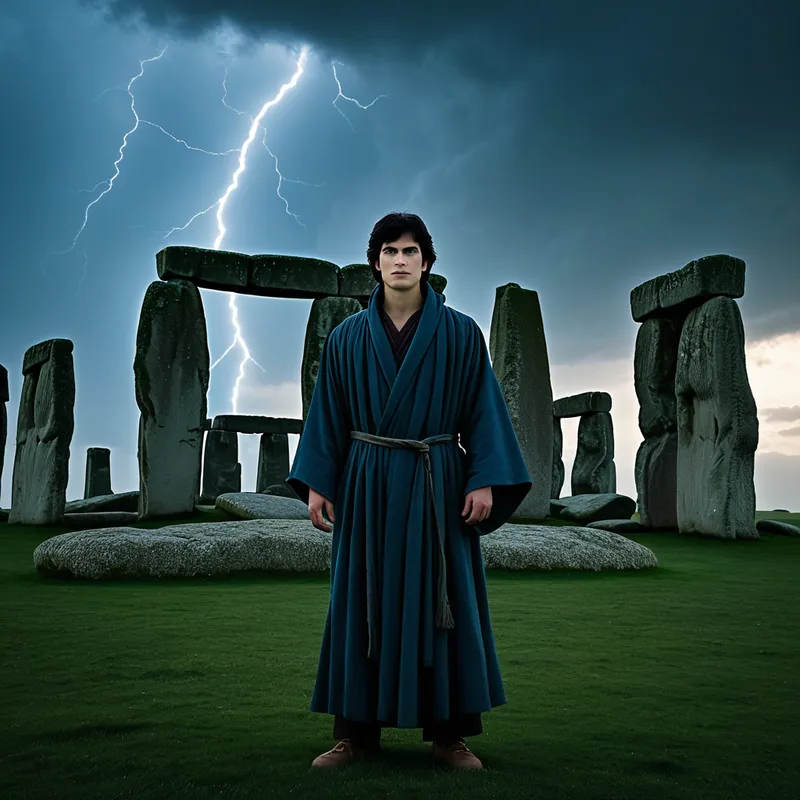
Cultural Origins & Context
The figure of Merlin is a palimpsest, a layering of cultural memory. His earliest literary incarnation comes from the Historia Regum Britanniae by Geoffrey of Monmouth in the 12th century. Geoffrey fused two distinct strands: the legendary prophet Myrddin Wyllt (Merlin the Wild), a bard driven mad by battle and living as a wild man in the Caledonian Forest, with the tradition of the Ambrosius, a youth who confounds Vortigern’s wise men. This synthesis created the core archetype: the wise, prophetic, yet ultimately tragic counselor.
The myth was passed down and elaborated by French romancers like Robert de Boron, who Christianized the narrative, making Merlin a neutral force, a prophet of God’s will who facilitates the Grail quest. He became the essential hinge between the pagan, magical past of Britain—the “old world” of standing stones and deep forest wisdom—and the new Christian world of chivalric order and divine purpose. His function in the societal imagination was multifaceted: he was the explanation for Britain’s mythical origin and destiny, a symbol of the land’s inherent magical power, and a cautionary tale about the perils of wisdom untempered by human vulnerability.
Symbolic Architecture
Merlin represents the archetypal principle of consciousness itself—the Logos that seeks to shape chaos into order. He is not a god, but a hybrid, a demiurge figure born of a human woman and an incubus or spirit. This birthright symbolizes the fundamental human condition: straddling the instinctual, unconscious realm (the spirit world) and the realm of conscious will and civilization.
He is the mind that seeks to build a tower of reason upon the shifting soil of instinct, only to discover the dragons sleeping beneath.
His prophecies symbolize foresight and the burden of knowing patterns others cannot see. His role as architect of Camelot represents the ego’s attempt to construct a perfect, ordered psyche (the Round Table as a symbol of wholeness). Yet, his downfall is the most profound symbol. Viviane, the Lady of the Lake, is not merely a temptress; she is the embodiment of the unconscious, specifically the anima. Merlin’s fatal error is believing he can master this realm through knowledge alone. He intellectualizes the numinous, tries to teach the mystery of containment to the very force that contains him. His imprisonment is not a defeat, but an integration.
The greatest mage is not defeated by a foe, but voluntarily succumbs to the deeper magic he himself has activated—the call of the soul to return to its source.
The Dreamer's Resonance
When the pattern of Merlin stirs in modern dreams, it signals a critical engagement with the archetype of the Magician. To dream of being a powerful guide who is suddenly trapped, silenced, or rendered impotent often points to a “Merlin moment” in the psyche. The dreamer may be experiencing the limits of their own intellect, strategy, or willpower. The somatic feeling is often one of constriction—being wrapped in invisible vines, sealed behind glass, or sinking into the earth—accompanied by a paradoxical sense of relief amidst the panic.
This dream state indicates that a period of intense conscious striving (building one’s Camelot) has run its course. The unconscious is now activating the “Viviane” complex: an allure towards something deeply felt, romanticized, or instinctual that promises completion but ultimately leads to a necessary dissolution of the old, controlling ego-identity. The dream is the psyche’s way of initiating an enforced retreat, a sacred captivity where doing is replaced by being, and planning is replaced by receiving.

Alchemical Translation
The alchemical process mirrored in Merlin’s myth is the Nigredo followed by the Albedo, but with a unique twist. His entire life is the Albedo—the distillation of pure consciousness, the building of the shining stone of Camelot. His imprisonment is the deliberate, if unconscious, choice to undergo the Nigredo: the descent into the dark, moist earth of the unconscious.
For the modern individual, the “Merlin process” models a late-stage individuation. It is the recognition that after a life of acquiring knowledge, building a legacy, and guiding others (the Magician’s outward work), the final and most profound task is to submit that very consciousness to the mystery it served. This is the transmutation of wisdom into gnosis. The active intellect must allow itself to be “spelled” by the soul’s deeper longing.
The ultimate act of magic is not to change the world, but to allow the world to change you, to be woven into its living tapestry.
We are not to avoid Merlin’s fate, but to understand it as the goal. It is the enantiodromia where the wise man becomes the hidden seed, the counselor becomes the silent, omniscient presence within the landscape of the self. His retreat into the tree, cave, or tower is not a death, but a diffusion. He becomes the wisdom in the wind, the pattern in the stone, the prophecy in the dream. He achieves the alchemical gold not by conquering nature, but by becoming one with it, completing the circle from spirit-born to earth-bound, now as its conscious, sleeping heart.
Associated Symbols
Explore related symbols from the CaleaDream lexicon:
- Degree
- Coach
- Guide
- Senior
- Spy
- Wizard
- Counselor
- Advice
- Suggestion
- Classic Fedora
- Vintage Hat
- Druid
- Time-Traveling Carriage
- Futuristic Hovercraft
- Beryl Prism
- Wizard Staff
- Enigmatic Magician
- Golf Clubs
- Billiards Table
- Chess Set
- Magic Show
- Abraham Lincoln's Hat
- JFK's Glasses
- James Bond's Briefcase
- Stonehenge
- Druid's Staff
- Enigmatic Narrative
- Toy Magic Kit
- Mentor Figure
- Senex Figure
- Animus
- Senex
- Emeritus